
Introducing the blockchain technology to the world, Bitcoin is a cryptocurrency that is the product of a Layer-1 chain. After his long loneliness, Ethereum started to accompany him. As of now, 50% of the $2.2 trillion market capitalization is owned by these two Layer-1 cryptocurrencies.
New chains that want to breathe new life into Layer-1 are focused on the smart contract space where Ethereum holds the market dominance. Successful blockchains have come to the fore in this regard. Ethereum, which holds 95% of Total Locked Liquidity (TVL), has dropped to 55% with the efficiency of the new chains.
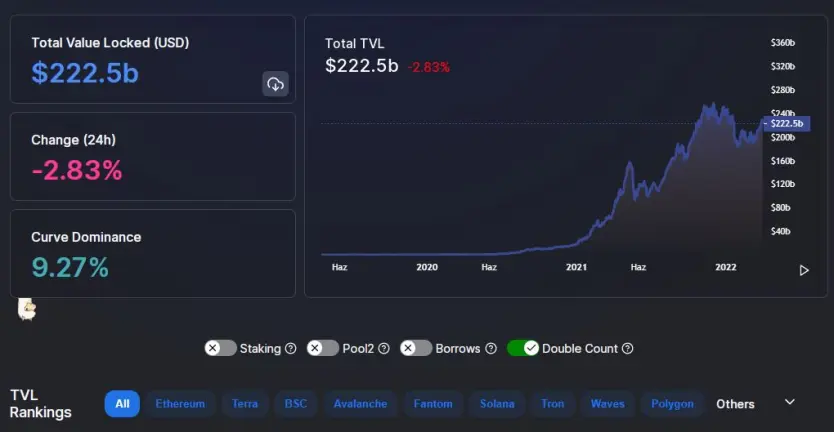
Total Source by DefiLlama
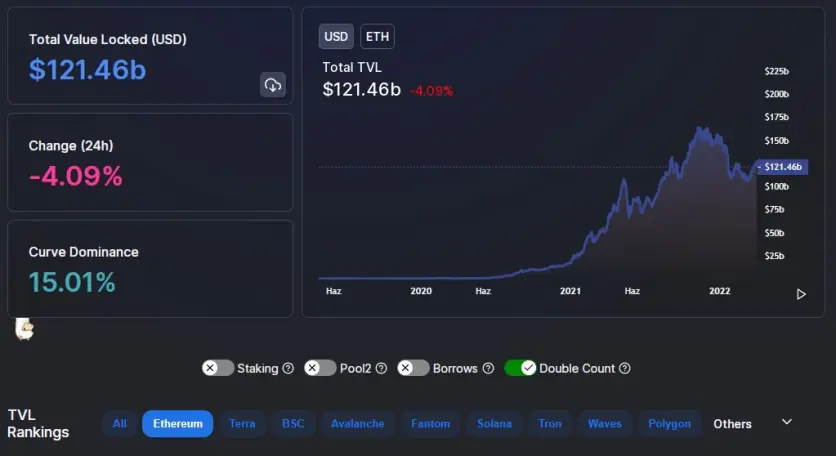
ETH Source by DefiLlama
The biggest reason for this is; New projects improve on Ethereum's shortcomings. Main shortcomings of Ethereum; Low speed, no scalability, high transaction fees…
The most important competitors of Ethereum until recently; SOLANA, AVAX and LUNA…
TVL; LUNA 28.5 billion $, AVAX 10.3 billion $, SOLANA 7.8 billion $
But this situation seems to change with the entry of a new player into the market.
New player Near Protocol (NEAR) …
With a good team, strong funding, and new underlying technology, Near Protocol (NEAR) quickly reached a market cap of over $10 billion within a year of going public. In this article, I want to tell you about Near Protocol (NEAR).
A little history ...
Near Protocol (NEAR); It was founded in 2018 by Illia Polosukhin and Alexander Skidanov. Skidanov had worked as a software engineer at Microsoft. Polosukhin worked as an engineer at Google. The two met while working on Y-Combinator and they grappled with a common problem with machine learning. The two embarked on a search for ways to decode program synthesis, which is considered the holy grail of computer science. But they needed help from developers from all over the world with small pieces of code. A problem arose when it came to paying these people. Paying through traditional financial networks was costly and slow. When they wanted to pay with cryptocurrencies, they realized that existing blockchains were also very slow and costly. So, they decided to build a better and more efficient blockchain themselves.
So they created the NEAR Protocol (NEAR).
NEAR Protocol (NEAR); As he took a deeper look at Ethereum's technology, he realized that the coding mindset alongside the tools was not intuitive enough for most traditional developers. That's why they built NEAR components from the ground up using the WebAssembly and industry-standard tools used by Google, Microsoft, and other tech giants so that standard programming languages can also be used on blockchains.
NEAR Protocol (NEAR); always aims to prioritize developers. NEAR can support any language that makes up WebAssembly, including common programming languages today such as Java, Go, Rust. This is a great opportunity for decentralized application developers because anyone who wants to develop applications on the Ethereum blockchain needs to learn a very specific language like Solidity. WebAssembly also allows developers to more easily migrate legacy applications to Web3.
This flexibility that NEAR brings to blockchain technology could make it the foundational platform for Web3, that is, a decentralized and transparent internet network. Today, the NEAR team has embraced this vision. This vision encompasses everything we see in the concept of decentralized finance, from the convertible, permissionless transfer of value for financial assets to the tokenization of anything that can have value. To achieve such a thing requires the ability to handle an enormous volume of transactions at low cost and at high speed. As a matter of fact, NEAR aims to achieve this.
NEAR Protocol (NEAR); It uses a type of Proof-of-Stake (PoS) consensus algorithm known as Thresholded Proof-of-Stake. This approach distributes staking rewards to validators and stakers based on the percentage of NEAR staked with a given shard. This increases the number of validators, resulting in greater network engagement. Third-party solutions such as Metapool have also been created to deter large validator pools and further encourage decentralization.
NEAR's block generation technique is called "DoomSlug". DoomSlug allows NEAR to achieve "practical certainty" for transactions after only one round of communication between validators, rather than waiting for multiple blocks like Ethereum (ETH). Certainty is a term denoting that a blockchain transaction is effectively rendered irreversible by the network. NEAR can continue to generate and complete blocks if half of all participants are online and do not approve invalid or incorrect blocks. This 50 percent majority differs from the 66 percent majority required by the Byzantine Fault Tolerance (BFT) consensus algorithms that underpin Ethereum and other networks. This 50 percent consensus is called the “Doomslug Certainty.” The nuances behind this being so are quite technical, but this structure shortens the timing of communication and interaction between participants compared to popular BFT algorithms (PBFT, Tendermint, Hotstuff etc.).
NEAR Protocol (NEAR); can run smart contracts. It also has compatibility with the Ethereum Virtual Machine (EVM), so Ethereum (ETH) developers can easily migrate their applications to the NEAR blockchain. NEAR has implemented EVM compliance in a unique way: it creates a smart contract called Aurora on the NEAR mainnet.
Aurora works as a sidechain but does not validate blocks off-chain as similar Layer-2 type solutions in Ethereum do. All validation takes place on the NEAR and Ethereum blockchains. Aurora inherits block time and consensus mechanism from the NEAR network as it does not have its own blockchain. Users pay NEAR network transaction fees in ETH instead of native tokens when using Aurora or its apps. This approach increases simplicity for users.
Security in NEAR Protocol (NEAR); Nodes in a blockchain have basic functions such as processing transactions, communicating with other nodes, and storing the history of the blockchain. Current blockchain technology requires all full nodes in a network to process every transaction and store the entire history of the chain. While this helps keep the network secure, it causes it to slow down. For example, there are about 2,500 nodes on the Ethereum blockchain that need to stay in sync. This causes scalability problems in the network; It reduces the processing speed and increases the costs.
Scalability in NEAR Protocol (NEAR); It uses the sharding method. The fragmentation method splits the blockchain history into smaller chunks, allowing it to be stored on different servers. In doing so, it distributes data storage, processing, and computing across multiple nodes to increase network speed and scalability. That is, a node can process and store a piece of the global state instead of every transaction in the network.
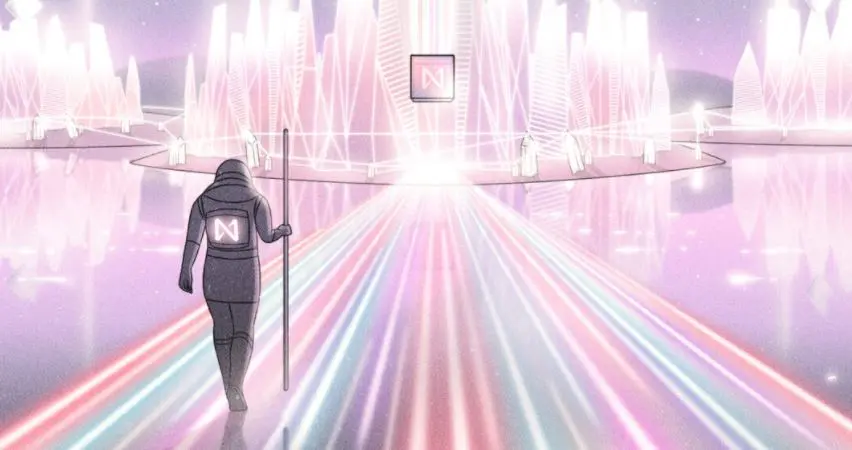
NEAR Protocol's fragmentation technology is called "NightShade". NightShade works by dividing the main chain into individual blockchains, rather than dividing them into individual blocks. Each piece produces its own set of data, called a "stack". This stack is then organized into blocks by a lead validator. Each block contains all the metadata, namely the stack headers, which contains information about the contents of the stack: This is a complete list of fragment operations. This approach reduces the footprint of the pieces in each block. In this way, communication about individual piece transactions is also spread across the entire blockchain. Thus, blockchain can parallelize processing, storage, and network propagation.
There are currently 100 validators maintaining NEAR Protocol (NEAR). These verifiers are responsible for producing and validating parts. Due to the small number of seats, the cost of sitting in the validator seat is also quite high. Currently around 50,000 NEAR tokens are required to become a validator. The number of validators will also increase with an update scheduled for mid-2022. Thus, the amount of NEAR tokens required to become a validator will also decrease.
NEAR Protocol (NEAR) It has also partnered with the Octopus network to allow developers to create and launch their own "app chains" designed for specific use cases and running in parallel with the main chain. Octopus is a network that provides pre-built functional application chains for developers. All application chains in Octopus are cross-compatible with other blockchains. Octopus network is launched as smart contract on NEAR protocol.
NEAR Protocol (NEAR) native cryptocurrency is the NEAR token. Transaction fees and storage payments on the network are paid in NEAR tokens. NEAR token can also be staked by token holders who participate in network consensus as transaction validators. These transaction validators are rewarded with NEAR tokens for their services, amounting to 4.5 percent of the total NEAR supply on an annual basis. A portion of the transaction fees created by smart contracts is also given to the developer who created the relevant smart contract as NEAR tokens.
Total Supply 1,000,000,000
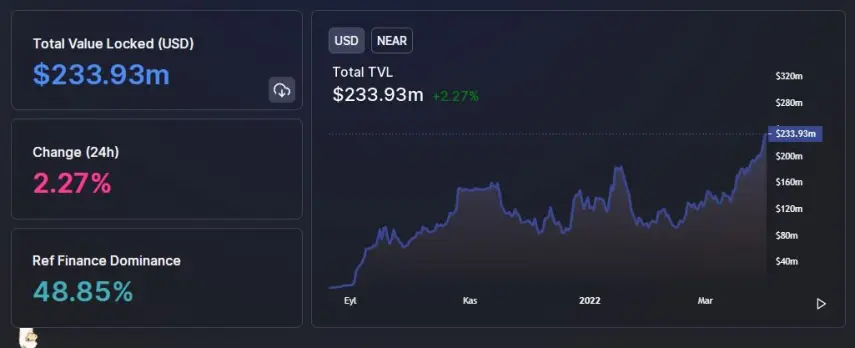
NEAR Source by DefiLlama
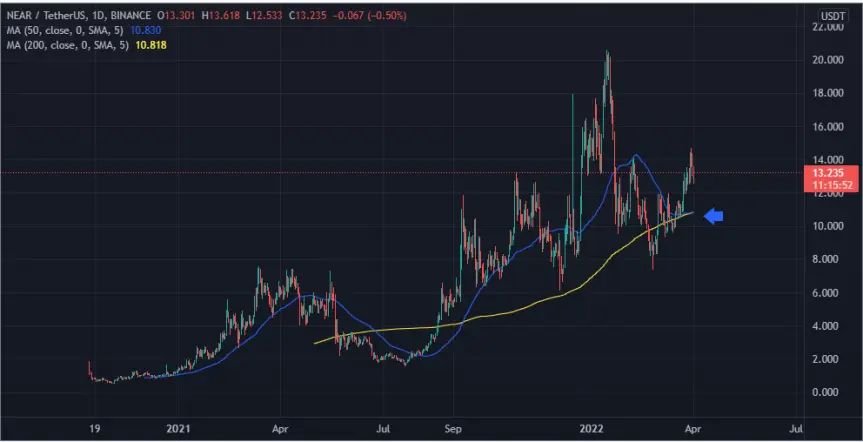
According to the one-day price chart, has given a Golden Cross signal.
My Last Words; NEAR Protocol has a technology that enables fast, accurate, cheap and secure transactions. Easy usability makes NEAR Protocol attractive to users. With its solid team and vision, NEAR protocol looks like a promising blockchain. NEAR Protocol (NEAR) should be followed closely. Soon his turn will come.
If you enjoyed reading my article here at Publish0x, be sure to hit the follow button at the end of this post. Thank you for your continued support!!!
You can also follow me on Twitter if you wish.
LimeWire is coming back. Join the waitlist!
Invest together with the smart money
Let the world’s best digital asset managers handle the trading. Share the profits.






