
Hey folks, so this is sort of a follow-up to an article I wrote back in March which coincided with the whole SVB/Circle/USDC scare, where the depeg of not only $LUSD, but across a whole basket of stablecoins rightfully scared the $h!t out of the market sending many to fly to the safety of $USDT.
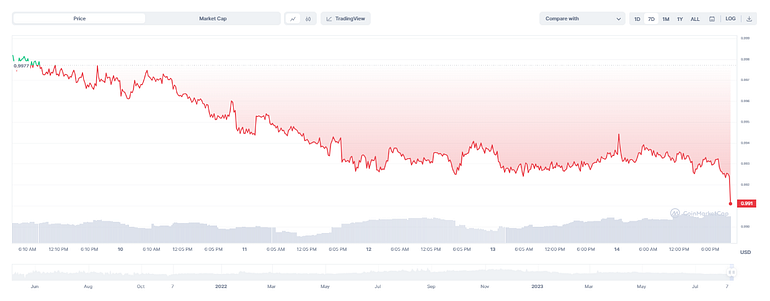
Not quite as extreme now, but at the time of writing, it looks like we’re seeing the beginnings of another $LUSD depeg now:
Whenever I see any significant price action with tokens that I’m holding, in order to find out why, my first go-to source is usually the protocol’s discord, in this case Liquity’s. 9 times out of 10 you’ll see some sort of explanation there, or at the very least some entertaining exchanges such as these:
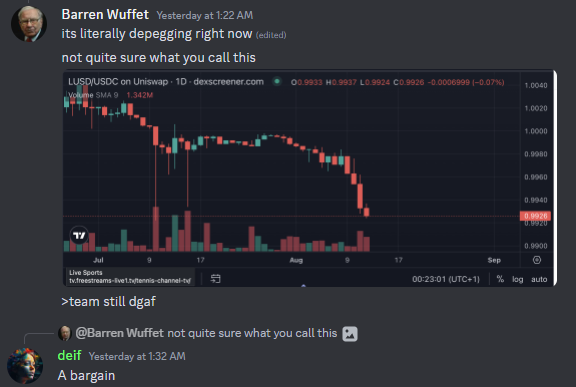
Amusing as interchanges like this might be, it prompted me to revisit my last article and try to reanalyze what potential depeg scenarios might holistically look like in order to better understand the market forces behind them and why most people are excited when they see $LUSD go off peg.
But before we go into “market forces,” let’s have a quick recap of $LUSD and its relationship with $ETH.
$ETH — if you’re betting on $ETH, then you’re betting on $LUSD
The absolute only way in which $LUSD can be newly minted is when a user puts up $ETH as collateral. Users can do so by opening up a “trove” which has to maintain at least a 110% (or 150% in recovery mode) overcollateralization ratio to their $LUSD minted. If the trove goes below this threshold, the loan gets immediately liquidated.
In order to not get liquidated, it behooves the trove owner to ensure that they are paying back some of their debt in order to maintain a high collateralization ratio or if they want to close it all together, the owner needs to pay off all of their $LUSD completely in order to retrieve all of their collateralized $ETH.
Simply from these mechanics alone, it means that as long as depositing $ETH is the only way to mint $LUSD, then as long as there is demand for $ETH there will always be an equal incentive and demand for $LUSD. Someone out there will eventually want to pick up and buy that $0.99 valued $LUSD because that $0.99 LUSD can always be traded in for $1.00 worth of Ethereum.
Great, OK, so if there’s always demand for $LUSD, then why is there currently a depeg? This leads me to my next section:
What happens if $LUSD goes below $1?
As we saw back in March, many people were exiting out of any stablecoin that wasn’t called $USDT and people were fudding the crap out of the Silicon Valley Bank collapse. The significant sell-off pressure caused a mass de-pegging event across the board:
Generally when there is a significant imbalance between buy and sell pressures (in this case a lot of sell pressure), an asset’s price will go down. As mentioned before, since we know that 1 $LUSD can always be redeemed for $1 dollar’s worth of $ETH, there should have been a great incentive for people to buy up $0.95-valued $LUSD and arbitrage the price difference. However since there was so much FUD in the market, there was a lack of immediate buy pressure which normally would restore $LUSD closer to peg:
OK, so there’s a clear arbitrage profit incentive for when $LUSD drops below a dollar. What about when it goes above $1?
What happens if $LUSD goes above $1?
This is just as easy to explain. If we zoom out on $LUSD’s price history, you’ll see that for the majority of time $LUSD actually tends to trade at a premium at above $1:
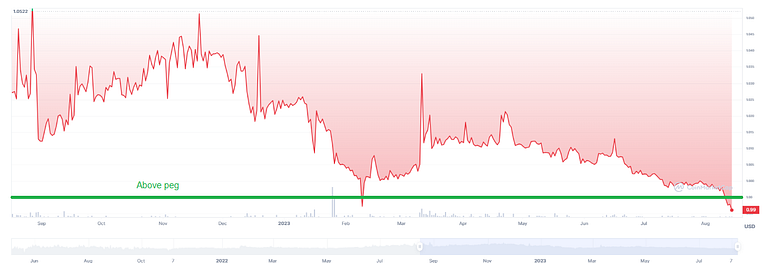
In addition to $LUSD’s scarcity and monolithic minting options, $LUSD is decentralized and essentially immutable which makes it one of the safest stablecoins out there. The inherent security that it provides should always give it premium value compared to its centralized competitors like $USDC or $USDT (or even Paypal’s new $PYUSD) which can be frozen by third parties against the owner’s will.
In addition to the value added premium, generally when the price of $LUSD goes above peg, the more incentive that there is to sell. If I’m opening up a trove and I’m able to mint 1000 $LUSD and then sell off that 1000 $LUSD for $1100 dollars — that’s a bargain. Going back to basic buy vs. sell pressures, if 1 $LUSD is valued at $1.10, parity back to $1 dollar should be achieved due to significant selling pressure and little buying pressure.
Conclusion
There are many vulnerabilities in the world of cryptocurrencies and DeFi, but from what I can tell, Liquity has really been able to find the secret sauce in creating a truly decentralized system — a system so profound that it seems like it’s being forked left and right by different protocols every other week across different chains (perhaps to be talked about in a future article?). And speaking of different chains, probably the biggest limitation to Liquity as of right now the mechanisms are only on mainnet — a price that comes from the cost of being immutable.
Interested in learning more about Liquity? Read my deep-dive analysis that I wrote before on $LQTY.
And as always, thanks for taking the time to read this and be sure to follow me on twitter (https://twitter.com/CryptosWith) to get all my latest updates. Also, looking for a gift for your Crypto-loving/hating friend? Give them a REKT journal to cheer them up!
Disclaimer: And as a final reminder, this is not financial advice and this is for educational and entertainment purposes only. Please as always, do your own research and find what investments are best for you. Cheers everyone!






