
Hello folks, so over the past few months I’ve read a lot of conflicting reviews/comments about Freeway, so I’ve been kind of putting off doing a deep dive as I knew that there was going to be a bit a time sink trying to sort through everything. Fortunately (or unfortunately maybe) as we’re continuing to chop through this bear market, I’ve had a bit more time to finally get this analysis completed. In case you haven’t heard of Freeway, I’ll do a bit on a quick review of what it is, but my main focus here is to go through some of the main criticisms I’ve heard and to analyze which of them hold any weight, and/or which seem to be unreasonably founded.
A quick intro to Freeway:
In a nutshell, Freeway, a rebrand from Aubit Prime, is a centralized non-custodial platform that allows users to generate relatively high yields:
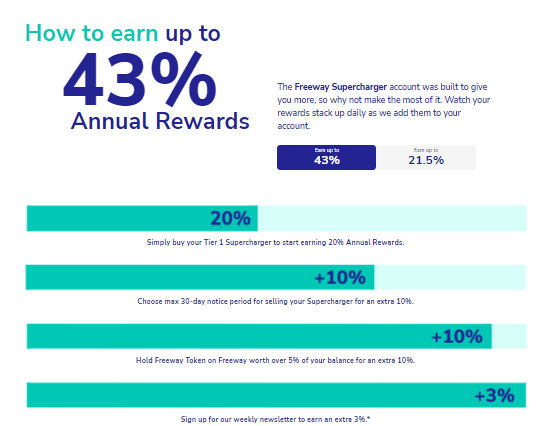
There are some nuanced yet significant differences with the way that Freeway presents itself (which I’ll get into a bit later), but essentially you’re able to earn a base rate of around 20% APY and then if you go through other hurdles (each of these which can take on a bit of extra risk), eventually you are able to gain up to 43% APY.
How do they generate returns?
As controversial as it might be, the answer is a simple one — leverage. And maybe I should have put this as an immediate disclaimer, but if you’re so uncomfortable with using leverage that it makes you nauseated, then you should probably stop reading right now and completely forget that you ever heard about Freeway. If you’re unfamiliar with the concept of leverage, essentially with more liquidity (or more funds they have from people like you and me), they are able to have better credit to be able to borrow more money. With more money borrowed they can do bigger-funded trades which in turn creates more revenue. The complementary danger however is that with more money borrowed, if the trade does not go your way, the greater the risk you are getting rekt. How much leverage are we talking about? In May’s AMA, the amount of leverage was reported to be around 30x. If you don’t know what this means, this essentially means that if they open maximum leverage for let’s say a $1,000 dollar account, they would now have a position value of $30,000,
For you remaining degens reading, there are a couple of key factors that Freeway that I suspect gives them greater advantages which includes utilization of AuBit Prime — a regulated brokerage exchange that they own and is part of the Freeway ecosystem. Just like a regular bank, it’s probably easier to get a loan (also a loan with better terms) if you’re well known and have a good working relationship with them. Secondly, Freeway utilizes quant trading, which essentially uses mathematical models and algorithms towards trading. Now I’m definitely not a quant trader (in fact I wouldn’t consider myself a trader at all), but from what I do know about quant trading is that there’s also a considerable degree of risk, but there theoretically should be less error due lack emotional volatility. I know algorithmic and bot trading are gaining evermore popularity (a future article on this later)and I know other major higher-than-average yield platforms such as Haru Invest and Midas utilize algorithmic trading at least to some degree.
You Don’t Deposit Money into Freeway, you buy Superchargers…so what the hell is a Supercharger?
Through all the information I read on Freeway, I found myself increasingly annoyed about reading superchargers, because they kept getting mentioned as sort of the conduits through which users get their returns. They specifically define superchargers as:
“a tokenised virtual simulation…when you buy Superchargers from the platforms, then you own them. That’s it.
What you use to purchase Superchargers is Freeway’s revenue. Freeway then deposits its revenue with AuBit Prime.
-Freeway AMA Transcript, 5/17/2022
Now if you read between the lines here, my assumption is that by clearly stating over and over again that users are NOT depositing funds into Freeway, is that Freeway is going around some major regulatory hurdles. This is distinction is clearly made by design, and I assume that the moment you say “deposit,” then there’s an immediate implication that you are acting either as a bank or some other financial institution that has to abide by specific regulations. In other words, money is easily regulated whereas superchargers are not. You’ll also notice that they play by the same rules as the likes major exchanges like Binance and FTX, where they have a separate US-based accounts (freeway-lite) for US users that have their own separate rules. The most notable differences — US users will find that by opening a US-based Freeway account, you won’t get access to all of the superchargers, most notably $BNB, $ADA, and $DOT and that there’s no over-the-counter (OTC) trading.
Currently there are 11 superchargers to choose from, with AUD being added just this past month:
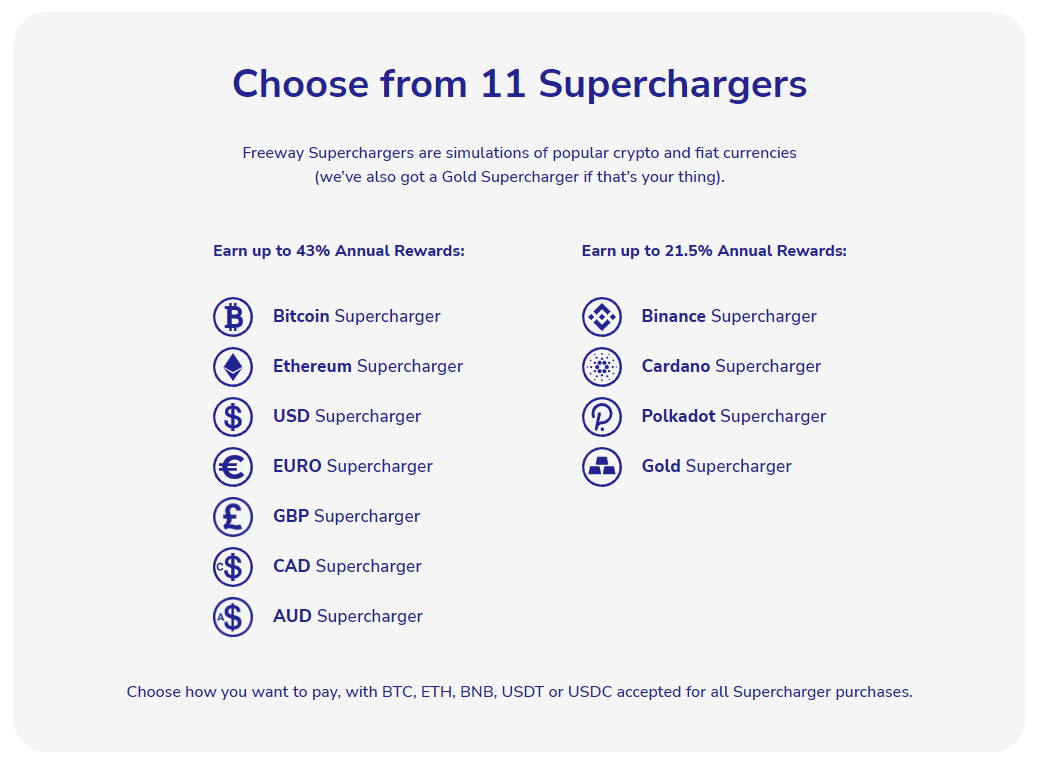
You’ll also notice that all the superchargers aren’t necessarily crypto-based, and that’s because these guys aren’t necessarily just doing crypto-based trading. And in fact from a recent Twitter spaces, Freeway reported that they actually have little exposure to stablecoins, whether it is USDT or USDC, as they instead move off-ramp to fiat, only moving back to stablecoins if a user is selling one of their superchargers.
Major Criticisms (or FUD)
So hopefully you have a good enough understanding of what Freeway is and what they’re trying to do. What about all the negative accusations out there? What should we believe?
I spent a good deal of time dissecting some of attacks out there because just like any other platform I’m contemplating on putting money into, I think it’s just simply best practice to weigh out your risks or rewards before doing so. Let’s sort through each one-by-one shall we?
Is Freeway a Ponzi?
To start off, here’s what co-CEO Graham Doggart said in his May AMA:
“Freeway does not rely on new money coming in to be sustainable. That means we are not only not a Ponzi, but we are not even in the realms of traditional startup or business risk. We are quite profitable in our own right, we don’t need Freeway users even to be profitable. That is the strength of the ecosystem and network effects will just help us exponentially grow and become more and more robust over time.”
Assuming that this is true, this is a pretty clear statement saying that they’re not. I think a lot of the Ponzi-accusations come from the fact that they have lock-up periods, but it’s important to note that these lock-up periods are not mandatory. If you choose to lock-up your funds for at least a 30-day period, I imagine that this benefits the platform by guaranteeing liquidity for sustained periods of time which also in turn allows them to access increased leverage for their trades. And if we zoom out a little bit, there’s plenty of platforms and hedge funds out there (even US government t-bills) that have different lock-up periods that may offer increased yield rates depending on the length of the lock-up period, so I don’t think lock-up period inherently mean that the platform is a ponzi.
A ponzi scheme by definition would be that the platform is paying off investor B by investor A’s funds. Is Freeway doing this? Well if they’re saying they’re making money off of trading, this would be easily verifiable by accessing data on their trades. Freeway has not made this information public, but there have been snippets that have been released:
Verdict: Is this a full comprehensive report? No. But, honestly if this is truly a sample of roughly a day’s worth of trades between 3–4 asset classes, I imagine a full report would be…just ridiculously long and quite superfluous to publish. That being said, their 2021 trading data was reviewed by ACA Global, who confirmed that they had made pretty ridiculous returns of 112%. I have not seen this report because they require you to sign an NDA beforehand in order to do so, but if you’re interested in seeing it yourself, anyone can request to do.
Is Freeway a Scam?
This is definitely a popular criticism that assumes that Freeway is simply trying to take your money, and that they are using fraudulent practices to try to snake oil you with their attractive rates. There’s an ethos that Digital Asset News uses that I really like, which is basically to treat everything like a scam. So I can completely understand why there’s a great deal of skepticism when it comes to lacking trust in a platform that’s giving you double the highest rewards of nearly any competitor out there. And of course there’s no way of knowing the hearts and minds of the people involved with Freeway, but there is a great deal of information out there that points to the contrary:
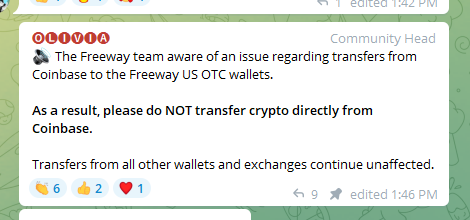
- I have yet to find a single person that has had troubles pulling their funds out. In fact, there are more problems with people getting flagged by Coinbase trying to transfer funds to Freeway:
- I’ve read in quite a few places that many of the Freeway traders are people who have been lured out of retirement by Freeway’s ethos of #AccessForAll. With #AccessForAll, the company “envisions a world where everyone has equal access to the world’s top investment products…no matter where they’re from, what they earn, or where they live”:
- In this same vein, if you’re a skeptic you might consider this a bunch a PR fluff, but they’re the only platform I’ve seen of its kind that has dedicated philanthropic lanes through their “Charity Supecharger” where they ask users what charities they’d like to see the company donate to:
Verdict: I have yet to find anything backed by anything concrete that they’re a scam, but obviously I assume they wouldn’t be that public about any wrongdoings.
Freeway Risks
No matter how you hack it, there are risks with using Freeway, and the biggest that I have found are:
If it’s not your keys, it’s not your crypto: This like many other platforms, is probably the biggest, and this is why it’s highly important that you make sure you do your own research to see if you personally trust the platform with your assets. We’ve seen this be a problem with many other platforms such as Celsius and Voyager, but like with any CeFi instrument, if you’re absolutely risk adverse to allowing someone else to take custody of your assets, then you shouldn’t be messing around with Freeway or any other CeFi platform (BlockFi, Coinbase, etc.) at all.
Freeway is not obligated to buyback your superchargers: In the same vein of not being your keys, the way that Freeway setup has the potential of a rug pull. In other words, let’s say in a doomsday scenario where Freeway goes under or in the more likely scenario, if they have to drastically reduce their rates, you may not lose your supercharger, but you won’t unable to recover the initial principle that you paid in order to buy the supercharger.
There is more risk to lockups: With greater risks there are greater rewards, which makes sense that there’s a 10% boost in earnings if you decide to lockup your funds for the 30-day period. In the Terra death spiral, we saw countless of people unable to withdraw their $LUNA (myself included) from validators as the price got rekt literally overnight, so this is another consideration if you’re planning on keeping your funds locked for significant periods of time for really any time period.
$FWT: $FWT is the native token for Freeway and if you saw in my first graphic, if you hold a 5% balance of $FWT in your portfolio you can get an additional 10% in rewards. I know there’s a lot of FUD around Freeway because of this, but this practice is not uncommon, as we’ve seen with many CeFi and DeFi platforms including Nexo and Midas. Like many of these native platform tokens, essentially having more people own $FWT on Freeway helps the platform retain liquidity which increases value for the entire ecosystem. However it is important to note that $FWT itself is a risk because of it’s volatility:
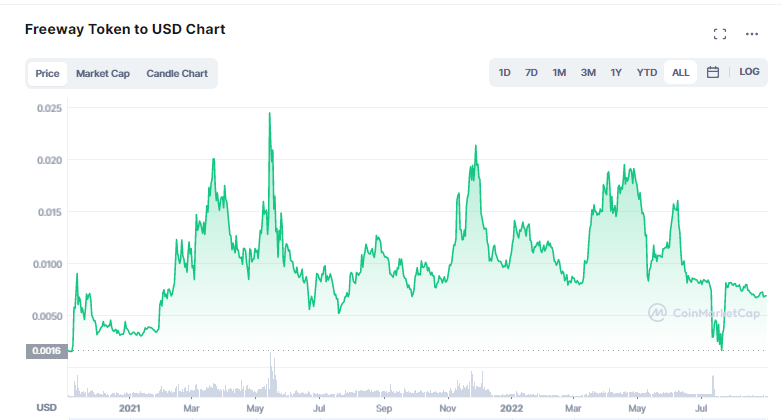
Like any small marketcap coins, $FWT is subject to huge fluctuations in price, and buyers should be aware. This risk was magnified by the latest crash in July when the Coffee Bridge was hacked with a “large number of FWT tokens” being sold off:
The price of $FWT has since then recovered, but I believe that this is still worth noting nonetheless. If you’re curious about some of the token’s statistics, according to freewaystats.com, there’s a total supply of 10 billion tokens with almost 7 billion in circulation, and nearly 90% of circulating supply staked on Freeway itself.
Conclusion
Generally speaking, I found that most speculators fall into 4 camps: 1) Freeway haters, who believe that it’s a complete scam and that it’s completely ridiculous and stupid for people to get into. 2) Sideliners who will not get involved because they’re skeptical but timidly hope for the goodness of the crypto-world that Freeway is able to be successful and not a scam. 3) People who want to believe that Freeway works so they’re experimenting with putting in and pulling out funds. And lastly 4) people who completely believe in Freeway and are all-in.
I fully believe that Freeway gets a lot of the flak it does because these rates because people are classifying these returns as “too good to be true,” and that consequently it has to be a ponzi or a scam, but honestly I’ve had an extremely difficult time finding anything concrete that backs any of these assertions.
If you’re keen to try out Freeway yourself, consider supporting me and my blog and use my referral link: https://app.freewaylite.us/ref/cryptoswith. According to their affiliate program, if you go through a referral link referees get an extra 2% for their rewards.
I myself was probably a sideliner, but after doing a great deal of homework, I have been slowly convinced that Freeway might be worth a try. If you have any adverse experiences yourself with Freeway or else have any information that could shed any light on the many, many popular criticisms circulating about Freeway and their crazy yield rates, I would greatly appreciate it if you dropped a comment below. Otherwise thanks for taking the time to read this and be sure to follow me on twitter (https://twitter.com/CryptosWith) to get all my latest updates.
Disclaimer: And as a final reminder, this is not financial advice and this is for educational and entertainment purposes only. Please as always, do your own research and find what investments are best for you. Cheers everyone!





