
Hey folks, in today’s article I’m going to do a deep dive into Solblaze, one of the premier up and coming options to liquid stake your $SOL, and why their liquid staking derivative $bSOL is where the majority of my Solana is allocated. As I’ll dive into further, Solblaze creates several leveraged opportunities that I’m anticipating will help pay off big in the future, while at the same time helping secure one of the fastest blockchains out there.
Let’s dive into shall we?
First, what’s liquid staking?
Generally if someone wants to spin up their own validator, they’d be confronted with a lot of upfront costs and fees. Specifically for Solana, several hurdles must be cleared including:
▹Voting transaction fees — which can run to more than 1 $SOL a day, or roughly more than 2 $SOL per epoch (usually a 2–3 day period)
▹$SOL — speaking of $SOL, you’ll need 100 $SOL yourself, which at time of writing is more than $10k dollars.
▹Hardware costs — the hardware costs alone can run you several thousand dollars, and given today’s costs and the demand for proper hardware are only looking to rise.
▹Bandwidth — it’s generally recommended that you need fiber optic cables, or in other words, 56k modems aren’t going to hack it.
▹Electricity — For my colleagues in natural-resource-scare countries like South Korea, this can lead up to potentially thousands of dollars a month.
With all these deterrents in place, it’s simply not feasible for the average person to spin up a validator, which is where SolBlaze and other liquid staking services come to play.
SolBlaze allows users to delegate their $SOL for validate without all the upfront costs, allowing them to not only get exposures to the yields from validating, but also by giving them a liquid-staked receipt token in order to continue to leverage more DeFi opportunities. In the case for SolBlaze, users can liquid stake their $SOL and get $bSOL in return, which currently trades at about 0.9 $bSOL per 1 $SOL:
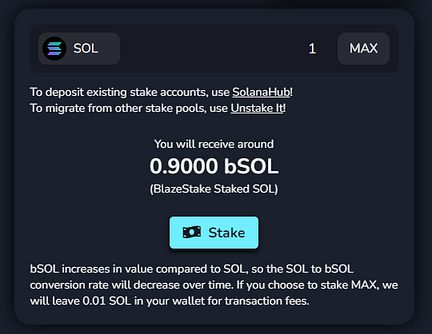
As mentioned in the graphic above, the price of $bSOL appreciates over time because the underlying $SOL is gaining yield from being staked. If you compare the price action between $bSOL and $SOL, the two are highly correlated, yet due to the fact that $bSOL is an LST you’ll see that the price of $bSOL naturally starts to appreciate slightly faster as time goes on:
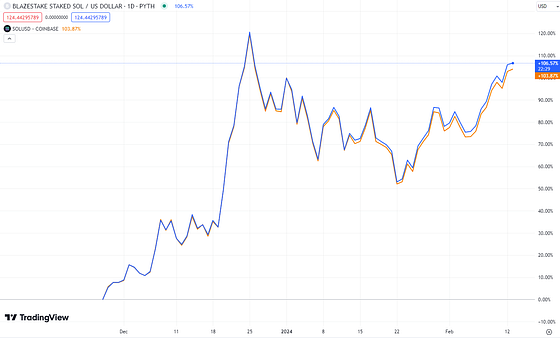 $bSol is in Blue — $SOL is in Orange
The current rate at which $bSOL appreciates at is approximately 7.33% APY, which means from simple liquid staking alone, if you redeemed $bSOL after one year, you should be able to get 1.0733 $SOL for every 1 $SOL that you initially staked.
Why being liquid is better than being illiquid
The primary benefit for all liquid staked tokens is that you can leverage up your returns by participating in different DeFi strategies. Generally speaking, the more DeFi strategies that are available, the more value you can extract from your initial investment. Breaking down some of the main benefits for $bSOL:
Liquidity Pools
Generally whenever one token gets swapped for another, the protocol generates a small fee for each trade. On the bigger protocols such as Orca or Radium trades generate fees which can range from 0.25 to 0.3% or more, depending on the type or the size of trade that’s being made. Taking this a step further, the total fee amount can be divvied up to different parties (the DAO, the protocol, etc.), but normally a portion of the fees will be awarded as an incentive to the liquidity providers who provide liquidity to the liquidity pool. In the case of $bSOL, the different rewards can vary greatly depending on the popularity of the protocol, the size of the liquidity pool, and the popularity of the tokens being traded:
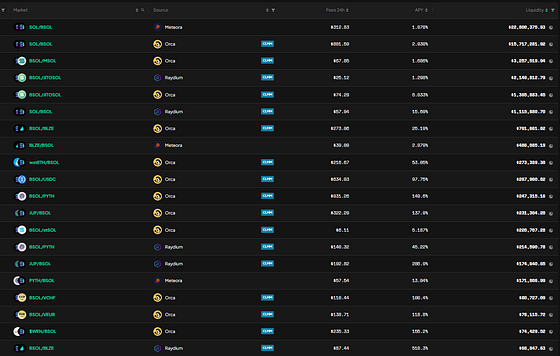
$bSOL has more than 100 different liquidity pairs with differing amounts of liquidity, ranging from the 100s of dollars to the millions. Generally speaking, the higher the liquidity, the lower the returns — with more token holders getting a smaller piece of the reward pie.
Risks: Apart from general smart contract risk, the primary risk with liquidity pairs is impermanent loss. Impermanent loss occurs when one of the paired token increases or decreases significantly in price, yet the second one does not, giving you only half the price exposure compared to if you were only holding one token alone. If you’re curious as to how much impermanent loss can effect your tokens, I’d recommend plugging some numbers into this nifty Impermanent Loss Calculator.
Borrowing and Lending
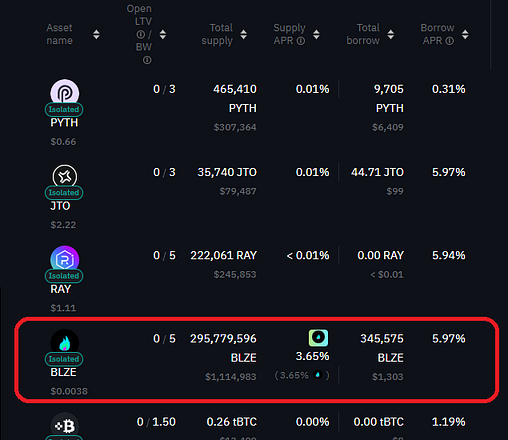
Whether it’s for trading or reinvesting, many protocols incentivize people to either supply or borrow different assets in order to attract liquidity and fees. Generally speaking, protocols are able to accrue fees by lending assets out to others, which in turn are passed on (at least partially) back to the suppliers. On Solend.fi for instance you’ll see that the borrowing for most assets, in this case $BLZE (the native altcoin for SolBlaze), the borrowing rate is slightly higher than the supply rate, as is the case with all of the assets:
Risks: There’s generally little risk for simply supplying assets, which is the reason why there’s little APR% provided for doing so. The main reason why people generally use borrowing and lending protocols is to leverage up their returns, but at the same time there’s always associated risk of liquidation if your Loan-to-Value ratio passes a certain threshold. In other words, if the collateral you put up drops significantly in value, it may be liquidated by the protocol in order to recoup the funds needed to pay back your debt.
Alrdrop Farming
The last major advantage of liquid staking that I’ll highlight is alrdrop farming — a strategy that could combine either liquidity pools or borrowing and lending. With many new up-and-coming projects in the Solana ecosystem, there are an incredible number of current alrdrop opportunities some which include:
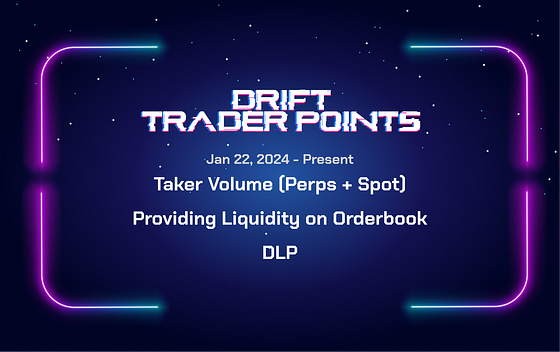
Drift — a perpetual trading DEX that offers you to trade different tokens at up to 10x leverage, and they have a very transparent point system which allows you to accrue points for either providing liquidity or conducting trades:
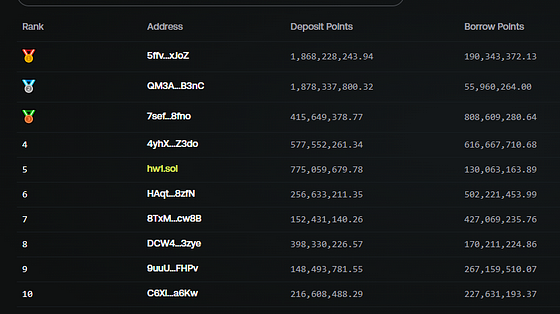
Margin.fi — is a lending/borrowing protocol which allows you to earn “mrgn” points, which similar to Drift, has a very transparent point earning system as well. Currently you can earn 1 point per dollar lent per day and 4 points per dollar borrowed per day.
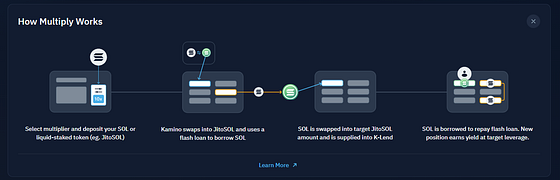
Kamino Finance — is a borrowing/lending platform with an option to leverage using $USDC that’s currently in beta. Kamino also has a points system which is shown in additional APR. Apart from traditional lending and borrowing, Kamino also has a “Multiply” option (also in beta), which essentially leverages your yields through flashloans:
Meteora.ag — is a DeFi trading hub that’s associated with Jupiter, the premier DEX aggregator in the Solana ecosystem. Unlike the other protocols I’ve mentioned, Meteora doesn’t have a point system so the potential for an alrdrop is a bit more opaque. That being said, they do not have their own token, and the Jupiter has already done the $WEN and $JUP alrdrop, so people are speculating that it’s likely that Meteora will as well too.
Why I’m choosing SolBlaze
The previous list of potential alrdrops isn’t all inclusive, but the main reason why I’ve highlighted those 4 strategies in particular, are because all 4 have significant integrations with $bSOL, SolBlaze’s liquid staked version of $SOL. $bSOL has multiple advantages, but in terms of a1rdrops, instead of a point system $bSOL intrinsically has an a1rdrop built in through what they call Blaze Rewards:
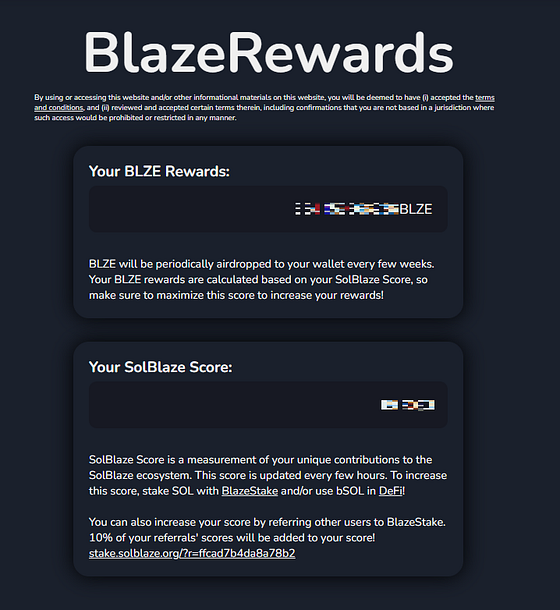
By simply holding $bSOL, one can start earning $BLZE, which you can track in real time. As it states in the above graphic, these rewards will be airdropped automatically into your wallet, and you can earn more $BLZE at a higher rate depending on your SolBlaze Score. In other words, your SolBlaze score acts as sort of a multiplier that’s dependent on multiple factors — referrals, lending/borrowing, etc.
$BLZE — the icing on top
In addition to the 7–8% interest you’ll earn from staking your $SOL, you’ll also earn an additional 1–2% (dependent on the price of $BLZE) on top of your stake. The great part about this is that in most cases you’ll still be able to accrue your $BLZE rewards regardless of whether or not you have it pooled, lent or borrowed.
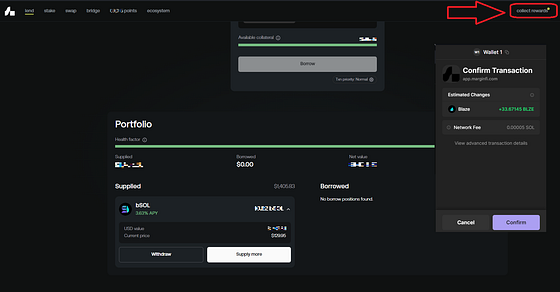
If you take Margin.fi for example, in addition to supplying your $bSOL in order to earn mrgn points, you’ll also still be able to accrue $BLZE which you can collect into your wallet at any time:
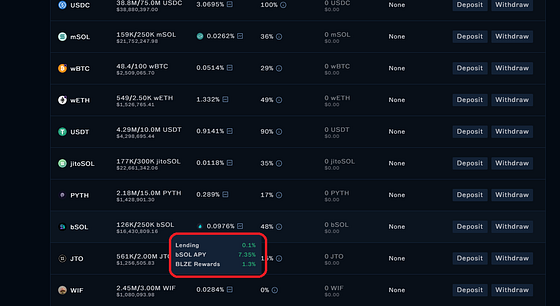
Similarly on Drift, once you lend your $bSOL, they also factor in the additional $BLZE that you would earn on top:
Custom Liquid Staking
Another significant advantage of SolBlaze is it allows you to reduce further risk by giving you the option to choose with which specific validator you would like to stake. With 100s of options, if there’s a specific validator that you trust above others, SolBlaze allows you to select them in a click of a button:
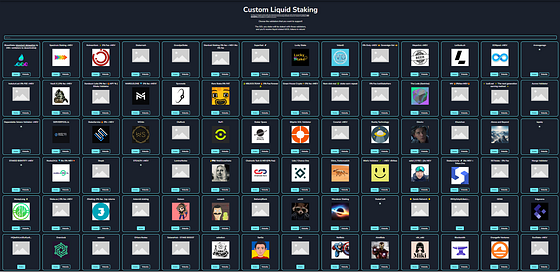
Therefore if there’s a known validator that you trust and/or would like to support, SolBlaze allows you to liquid stake with them, all the while still being able to earn your $BLZE rewards.
$BLZE Tokenomics
According to the official “Blazenomics” released in Q3 last year, $BLZE has a total supply of 10 billion tokens, with 30% released in their initial airdrop, and the following 70% released ongoing through rewards.
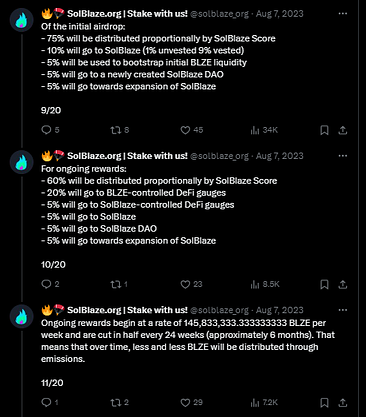
By taking a look at the figures above, assuming that I did my math correctly this means that only 300 million or 3% of the total supply of tokens have been allocated for the SolBlaze team itself (9% of which is vested), with the overwhelming majority (approximately 64.5%) of total supply going to SolBlaze rewards.
Utility — The primary utility behind $BLZE is for governance of SolBlaze DAO and their use of gauges. Once your $BLZE is locked, you can use it to distribute voting power among different validators or DeFi gauges:
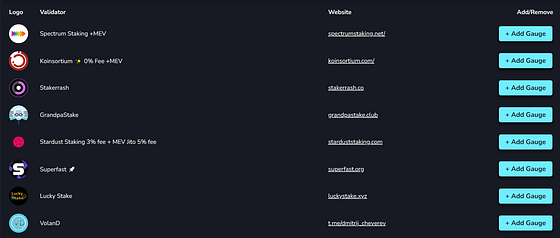
Depending on the length of time you want to lock up your $BLZE, you can maximum your voting power up to 10x if you choose the maximum lock time of 5 years.
Other considerations
Before aping in your life savings into $bSOL or other liquid staked derivates, there’s a few important things to consider, these include…
Unstaking (Instant vs. Delayed): $bSOL is a liquid staked token so you can easily trade out of it for any other token at any time, but you can also choose to unstake your $bSOL directly through SolBlaze’s dashboard. In doing so you’re faced with two options — Instant or Delayed, where if you choose instant, you’ll be a convenience fee of 0.1% of your total unstaked amount:
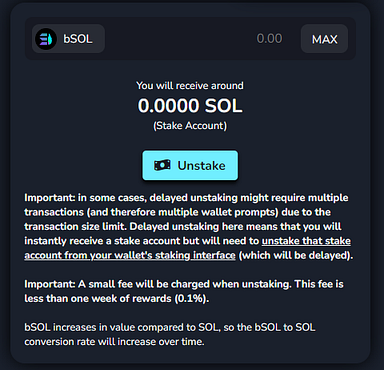
This optionally is pretty common in a lot of different liquid-staking platforms, but before unstaking, I’d check first if you can get a better rate on your favorite DEX.
Keeping the peg — speaking of DEXes, $bSOL’s price like any other cryptocurrency is subject to broader market forces and there’s never a guarantee on price correlation.
One great example was in 2022 prior to Ethereum’s merge, where a massive Celsius-related selloff for $stETH (Lido’s version of liquid-staked $ETH) caused the price of $stETH to crash significantly. At the time since $stETH couldn’t be directly unstaked for its underlying $ETH, market FUD ensued causing the price to go down even further.
Conclusion
With the addtion of $BLZE, SolBlaze offers one of the highest returns on your $SOL investment out there, and given how integrated is in within DeFi, it allows for one of the greatest leveraged plays on your investment. Given there’s so many different potential alrdrop opportunities on Solana right now, for me personally it makes $bSOL an easy choice for where to hold my $SOL.
Did I miss any bit $bSOL plays? If so, drop me a hint in the comment sections below because I’d definitely be willing to check them out.
And as always thanks for taking the time to read this and be sure to follow me on twitter (https://twitter.com/CryptosWith) to get all my latest updates. Also, looking for a gift for your Crypto-loving/hating friend? Give them a REKT journal to cheer them up!
Disclaimer: This is not financial advice and this is for educational and entertainment purposes only. Please as always, do your own research and find what investments are best for you. Cheers everyone!





