
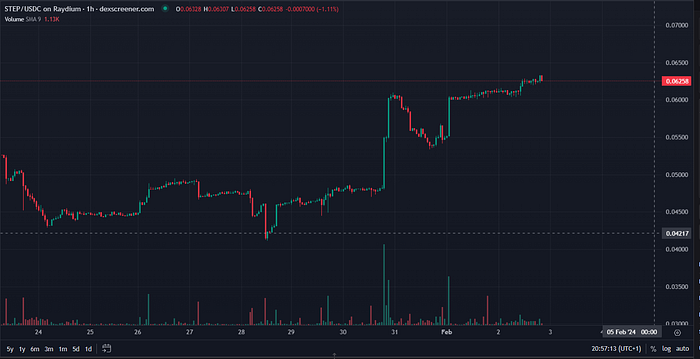
Hey folks, in today’s article, I’m going to be doing a deep dive into Step Finance, otherwise known as the “Front Page of Solana” — a one-stop-source for all things DeFi in the Solana ecosystem, and their native token $STEP, which has been on a rampage upwards for the past couple of weeks:
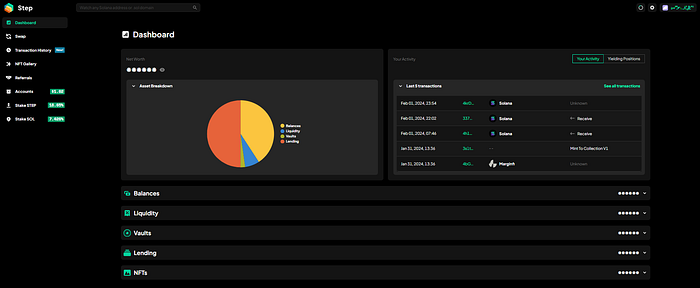
Perhaps most popular for its wallet dashboard, Step Finance allows you to see nearly every position, stake, and/or farm that your wallet has in the entire Solana ecosystem, while at the same time giving you real time analytics such as asset breakdowns and yield projections:
Yet as we’ll break down in this article, more than a fancy wallet, Step Finance continues to build out an ecosystem where you can access all things Solana, including trending analytics on tokens or NFTs, recent news within the DeFi ecosystem, and perhaps most importantly, supporting content and builders that will hopefully onboard the Next Billion into Solana.
Let’s dive in shall we?
Let’s breakdown the basics first…What is Step Finance?
As I alluded to earlier, Step Finance has several key features — all essential for anyone who is investing in Solana. These include…
Wallet Dashboard: (Most comparable to DeBank): Once again, the product that Step Finance is perhaps most known for is their wallet dashboard. Similar to DeBank (which aggregates wallet data for EVM-compatible addresses), Step Finance allows you to see all your Solana DeFi holdings including vaults, lending/borrowing positions, and NFTs (and all in my opinion, with a much cleaner and easier-to-use UI). Covering approximately 95% of all the different projects on Solana in one source, Step Finance makes it extremely easy to monitor all your holdings — truly a must if you’re invested in dozens of Solana’s protocols.
And sorry just to vent a bit — after using Step Finance for months, like nails on a chalkboard, every time I go on DeBank I still can’t comprehend why they can’t incorporate 24-hr price changes on your tokens like Step does:
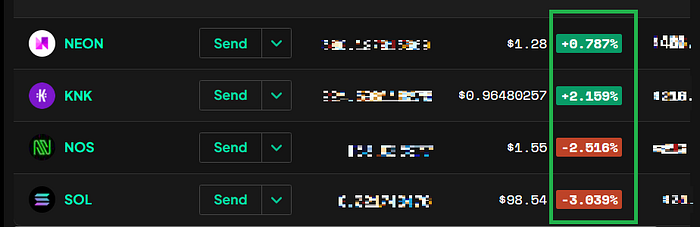
I don’t know if it’s just me, but I almost always have to go to a secondary site like DeFiLlama or DexScreener in order to see how or if the price of my tokens has changed. Yet going back to Step, more than showing price histories, from a analytic sense, this is just the tip of Step’s iceberg…
Analytics (Most comparable to DefiLlama/Coingecko/Coinmarketcap): If you’re looking for where to get the best yields, or which tokens are getting the biggest capital in-flows, analytics.step.finance offers all the real-time data that you need in the Solana ecosystem. If I’m bullish on one particular coin, let’s say $MYRA, all I have to do is click through on the token’s name where it will tell me historical price data and also what LPs or farms can give me the juiciest yields:
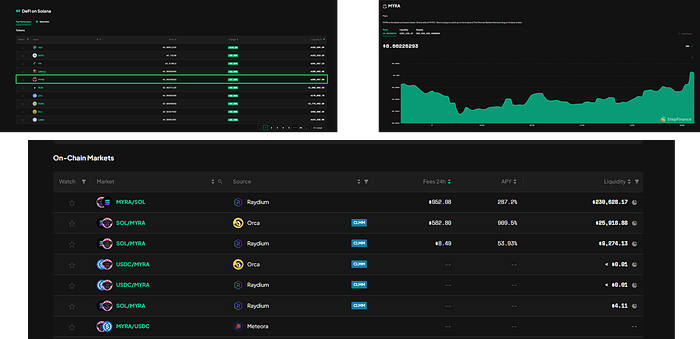
APRs all given in real time, and Step Finance notifies me of not only what the top performers are in the broader market, but it also allows me to track specific tokens through my own customized and curated watchlist:
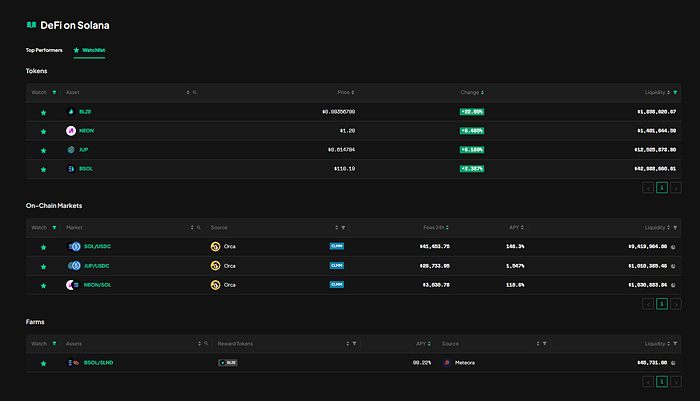
You’ve probably seen similar ‘watchlist’ functions on platforms like Coingecko or DEXScreener, and if you don’t use a watchlist, I highly recommend that you do so — every time the market has a pull back, I go straight to my watchlist to see if there’s anything I’m willing to buy.
DeFi Integrations
Apart from all the data aggregation and analytics that you can gather from Step Finance, perhaps the biggest reason for what sets it apart from may other websites is its integration of smart contracts directly into the platform. In other words, given the suite of services that Step provides, it might be easy to overlook that Step Finance is actually a DeFi platform itself.
Step has a few core DeFi functions including:
The ability to stake $SOL — Step allows you to easily stake with their validator which can earn you currently 7.321%.
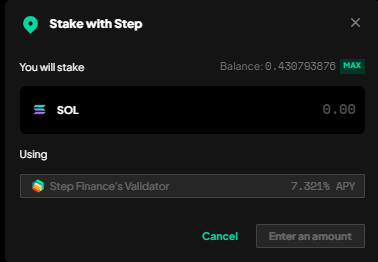
(To note as of November 2023, “Reward Options” are also distributed to $SOL stakers, which I’ll get into more detail later.)
Swaps— Straight from Step’s UI, users can swap tokens via Jupiter, Solana’s biggest DEX:

Liquid staking with $STEP — Currently you can liquid stake $STEP (Step Finance’s native token), receiving $xSTEP in return, which at the time of writing is earning a yield of 18.65%:
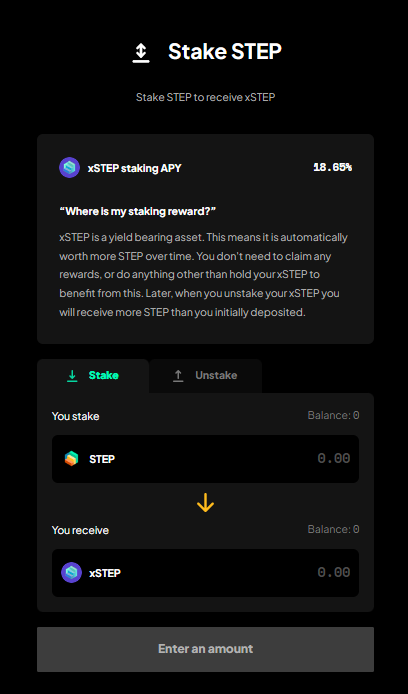
Furthermore, if you go back to Step’s analytics page, you’ll see that you can even further enhance your yield by entering it into Orca’s On-chain market for STEP/xSTEP, currently earning 31.62%:
 https://analytics.step.finance/defionsolana/token?mint=xStpgUCss9piqeFUk2iLVcvJEGhAdJxJQuwLkXP555G
$STEP Tokenomics
The tokenomics for $STEP are perhaps just as unique as the platform itself…
Call Options as Rebates — Perhaps the most interesting feature about Step is that users who use the swap function can essentially gain a rebate on their fees in the form of call options. The call options (or technically reward options) are airdropped to swappers in proportion to the amount of fees that were levied when their swaps were conducted. Once issued, the call option has a strike price that’s 10% above $STEP’s current market price when the option was minted.
Conversely, if the call option never hits its strike price, then the option essentially expires and becomes worthless. The purpose of this setup creates a natural price stability check for the $STEP token — if the price increases, options hit their strike price which when holders sell can bring the price back down, but conversely if the price of $STEP increases, the options become worthless.
Fees — According to their discord, Step Finance has multiple different fee revenue streams including:
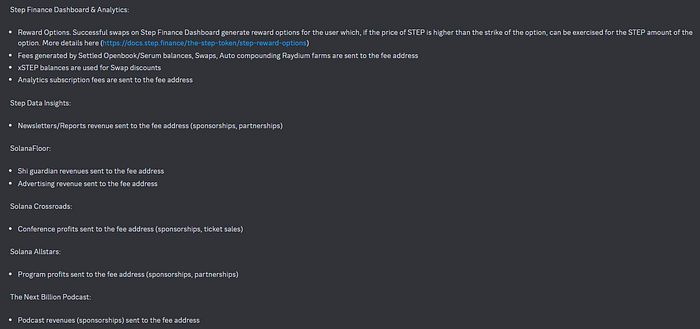
As you can see from the graphic above, many of these revenue streams aren’t just from DeFi, but they also come from other #RealYield sources such as advertising revenue from podcasts or ticket sales from conferences.
All fees that are earned by any of Step’s projects are essentially used for buybacks of $STEP on the open market, which is then passed on to $STEP stakers. Therefore, the more that Step Finance is used, the more fees that are generated, which causes more $STEP that’s bought back, which then ultimately goes back to the $STEP stakers:

Token Supply — In the initial TGE, there was initially a total supply of 1 billion $STEP, yet this number was reduced significantly back in October 2021 when the team decided to do a whopping 37% total supply burn:
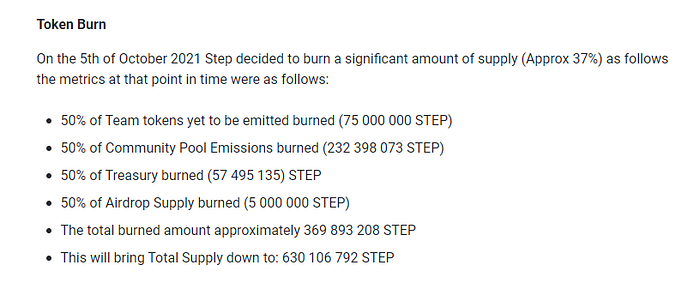
Now in its Tokenomics version 3.1, not only has the amount of accessible tokens changed, but token emissions has been cut significantly as well too. According to the docs, the only emissions for new $STEP tokens to be released is when/if reward call options hit their strike price. Incidentally this means that the current reported total circulating supply of 376 million $STEP tokens, will only be increased if utilization of Step Finance’s swap feature increases and if the price of $STEP continues to increase as well too. In other words, assuming that the price of $STEP remains relatively constant, there’s a relatively good chance that another new token of $STEP may never be emitted again.
With a currently fully diluted value of less than $40 million dollars( and only $24 million dollars in circulating market cap), and given that Step is perhaps one of the most widely visited tools in Solana, I suspect that this figure will easily grow once Step’s DeFi legs start showing some more strength.
In “Step” with Solana — Normally I’d warn readers that low market cap tokens come with high volatility, yet considering that $STEP’s market cap makes less than 0.1% of Solana’s, you’d probably find it very surprising that their price actions are highly correlated:

The correlation might seem obvious since Step is branded as the “Front Page of Solana,” but I think it’s more of a testament to the tokenomic incentives (and price protections) that the Step team has put in place.
Other Considerations
Despite my overall bullish sentiment on Step Finance’s future, with all of their many irons in the fire, it was also apparent that there’s a lot of work that’s left to be done. Some of these include…
DeFi — Simply from an apples-to-apples comparison with other DeFi protocols, Step Finance is a very small fish in a very large pond. Taken from their own analytics page, the total liquidity on Step Finance is barely less than than $75k, which is a drop in the bucket compared to some of the biggest Solana players like Raydium and Orca:
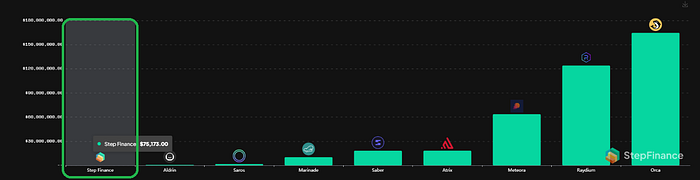
Arguably Step Finance may not need greater liquidity if it continues to integrate protocols like Jupiter for its swaps, yet I would imagine that until we live in a world where we have complete cross chain liquidity and interoperability, limited liquidity can still provide limitations towards growth.
$SOL Staking — Speaking of liquidity, although this has been identified as something that will be addressed soon, currently in Step’s UI there’s no ability to unstake your $SOL once it’s staked:
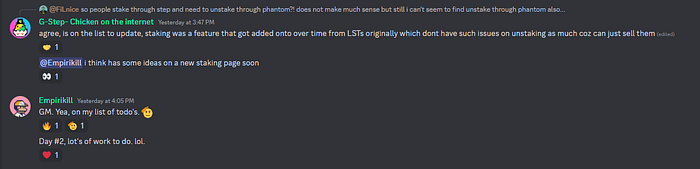
(To note, you reportedly can unstake your $SOL through your Phantom wallet, but still a bit of a hindrance nonetheless.)
APIs — one of the disadvantages that Step has compared to other sites like DefiLlama is the lack of APIs:

An API, or otherwise known as an Application Programming Interface, allows cross-functionality between different applications. It makes sense that this isn’t a priority for a protocol that seeks to become a one-stop shop for all things Solana, but nevertheless it arguably can still stymy innovation.
Step Finance shows almost everything, but not literally everything — Crypto moves unbelievably fast with new protocols and DeFi projects launching all the time. Therefore, it’s understandable that Step can’t have everything integrated as soon as it’s available. That being said, SonarWatch, another Solana Wallet tracker that not only allows APIs, but it also allows you to track Solana and EVM — compatible wallets as well too.
Conclusion
When I’m using EVM chains, there’s at least 7 different websites bookmarked that I go through rigorously to capture all the data that Step Finance provides in one singular source. Undoubtedly, Step makes things convenient and easy to know not only what’s going on in my wallet, but also what’s going on in the entire Solana ecosystem as a whole. Here are several of their products that I didn’t talk about in length, yet which I still think are definitely work checking out:
- SolanaFloor — a complete news publication outlet for all things Solana. (I recommend that if you’re not one that likes regularly going to news sites, at least subscribe to their weekly substack where they quickly cover some of the top stories that are going across Solana)
- Step Data Insights — another weekly newsletter yet with more institutional-grade news, especially in their quarterly reports.
- Next Billion — a weekly podcast that’s mission is to educate and help on-board the next billion into crypto.
After sorting through all of Step’s documents and publications, it’s evident that their ultimate vision isn’t really one of self-indulgence, but it’s really one towards generating public goods and fostering increased adoption of the Solana cryptospace. Over the past couple of years, they’ve spent a great deal of resources acquiring and building out different tools to help educate people on the fundamentals of crypto and the benefits of what Solana can bring to the average user.
If you’re an avid Step user and if you think there’s something cool I missed, I’d love to hear about it in the comments below. If you’ve never used Step and are interested in trying it out, then consider supporting this blog via my referral link: https://app.step.finance/en/?ref=6VDnyWFx, where I’ll be able to earn 30% off your swap fees if you do.
And as always, thanks for taking the time to read this and be sure to follow me on twitter (https://twitter.com/CryptosWith) to get all my latest updates. Also, looking for a gift for your Crypto-loving/hating friend? Give them a REKT journal to cheer them up!
Disclaimer: This is not financial advice and this is for educational and entertainment purposes only. Please as always, do your own research and find what investments are best for you. Cheers everyone!





