The world of crypto changes at breakneck speeds, and it is often hard to keep up with everything that is happening. This is especially true when looking into ways to generate yields from our crypto assets. One of the options to generate passive income is through a process called stacking in which the STX cryptocurrency is locked as part of the consensus mechanism of the Stacks blockchain. This consensus is called proof-of-transfer, as opposed to the more well-known proof-of-work and proof-of-stake ones, and it has the benefit of leveraging the security of a different blockchain. In the case of Stacks, it currently leverages the security of the Bitcoin blockchain. This is all good and fun, but in order to make an informed decision on if this is a basket worth putting some eggs in, one needs to understand how the STX stacking rewards work. It turns out that the earnings can be often juicy (and paid in BTC!), but understanding them is not that straightforward. So here’s a primer:
Earnings from Stacking STX depend on a variety of parameters including:
- Market parameters (STX and BTC prices, STX blocks per day, and BTC transaction fees)
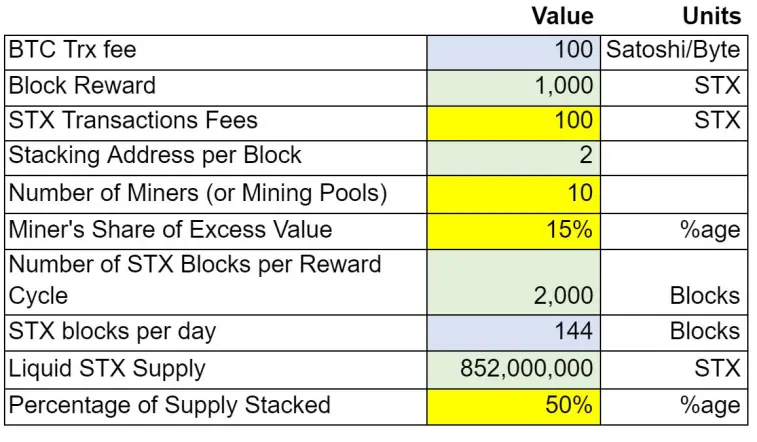
- Protocol parameters (Block reward, Stacking Address per Block, Number of STX Blocks per Reward Cycle, Liquid STX Supply)
- User parameters (STX transaction fees, Number of Miners (or Mining Pools), Miner's Share of Excess Value, Percentage of Supply Stacked, and User's Holdings)
Given the volatility of the crypto market, we will explore what is the effect of large changes in the price of STX and BTC in the earnings. We will look at the earnings in USD since our groceries are still priced in this currency. For the sake of simplicity, we will assume that all parameters are constant except the price of STX and BTC. The parameters used in these estimates are listed below in appendix 1.
Note that the annualized percentage yield (APY) is a function of the prices of STX and BTC (among the other parameters described above), and APY should not be assumed to be constant when STX and BTC change.
Let’s assume we made an investment and we bought 1100 STX at 2.5 USD, and the BTC price is $60000. This will be our reference and we will imagine subsequent earning cycles, subject to extreme volatility, in which our initial 1100 STX investment is giving us yield, while the price of STX and BTC changes through the cycles. The tables below represent these cycles, with the earnings denominated in BTC and USD, as well as APY for that “cycle”.
Cycle 1. Reference (*USDs are rounded to integers)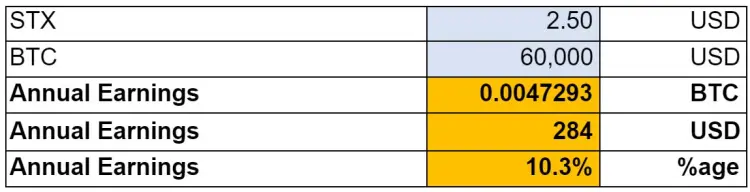
Cycle 2. STX and BTC both double from reference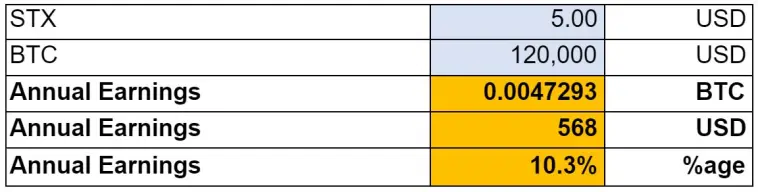
Cycle 3. STX and BTC both half of the reference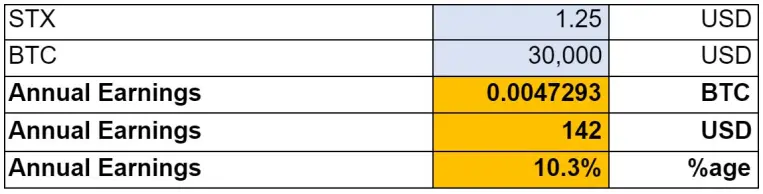
Cycle 4. STX constant and BTC double from reference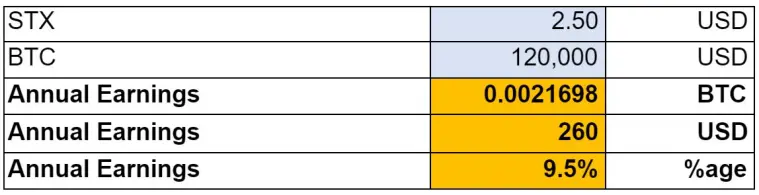
Cycle 5. STX double from reference and BTC constant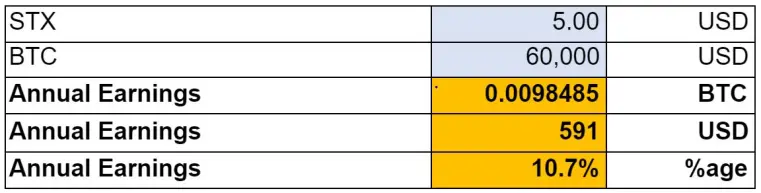
As you can see, the rewards are some of the best in the market but they are still subject to volatility if the only parameters that change are the price of STX and BTC. Some observations worth mentioning are that 1. when STX and BTC move together, the BTC-denominated earnings do not change, and 2. that if BTC is volatile but STX is not, the USD earnings volatility is low. So, the earnings per cycle, in USD terms, depend mostly on the price of STX but not so much on the price of BTC. An example of this is the comparison of cycles 2 vs 5, which have both STX prices of $5 and give similar USD earnings ($568 and $591), even when the price of BTC went down by 50% from cycle 2 to 5.
Estimates based on STX Stacking Earnings Estimate Worksheet
Link to Article by Muneeb Ali on the Stacking Earning Model
Appendix 1. Parameters used