
In this article, we’ll learn all about Chainlink. If you’re already familiar with the project, feel free to skip down to the section below the graph where I elaborate more on the future forecasts of the project.
Chainlink ($LINK) is an ERC-20 token that is intended to act as “middleware” between smart contracts and off-chain data. It enables this interaction through decentralized, blockchain-agnostic, ‘oracles’ that pull real-world data that they are then able to integrate into smart contracts.
Chainlinks’s mainnet went live on the Ethereum blockchain this past May. It also hosts an active community of developers, investors, and activists who champion it as a cryptoasset that they believe possesses a straightforward use case, something said to be rather elusive in the current cryptomarket.
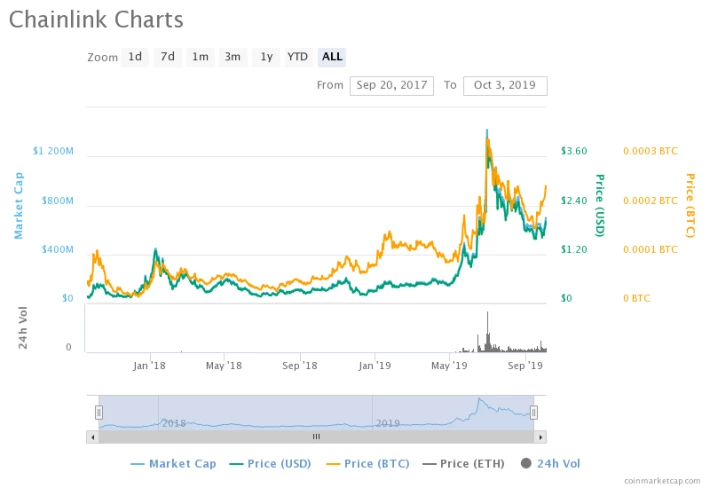
The LINK cryptotoken is valued at $1.95 as of writing and is ranked at #17 on Coinmarketcap.com’s list of cryptocurrencies ranked by market capitalization with a market cap of $695, 440,542 USD and a 24-hour volume of $98,836,090.
(Source: coinmarketcap.com)
Chainlink ended its ICO in September of 2017. During its short time as a publicly-tradeable cryptoasset in the 2017 bull market, the project saw modest growth. The cryptotoken rose in value from $0.15 USD to $1.21 USD in this time. However, Chainlink was not unaffected by the prolonged bear market that dominated much of 2018 with the LINK token bottoming out at $0.21 USD.
A significant price surge began to show in April of 2019. From April 30, LINK saw an increase from $0.47 USD to its All Time High on June 29 when it was valued at $4.54. This increase has become the highest return on investment in 2019 thus far, outpacing both Litecoin and Binance’s native token’s growth. Since then, the cryptotoken has dropped nearly 60% in value.
Chainlink won the Innotribe Startup Challenge in 2016 for best new FinTech startup. The Challenge, led by the Society for Worldwide Interbank Financial Telecommunication (SWIFT), the monetary organization that enables the majority of the world’s security and money transfers. The team's victory at Innotribe, and the subsequent relationship with SWIFT, cannot be overstated. The Proof-of-Concept that Chainlink then brought to SWIFT’s 2017 conference successfully demonstrated how they could pull off-chain data through SWIFT’s APIs (in this case, interest rates) into a smart contract that was then able to calculate a bond coupon payment. Since the conference, word on the SWIFT/Chainlink partnership has not been forthcoming. However, the idea that a cryptoasset has already established a legitimate relationship with SWIFT is something touted by many illegitimate cryptos, and provable only be a select few; this project included among them.
(Source: Steemit)
Chainlink is involved with Google’s Cloud division. LINK's meteoric price rise in April continued with the added announcement of their partnership with Google Cloud. The pair are working on integrating hybrid blockchain/cloud applications using the Ethereum blockchain. Google’s BigQuery data-analyzing web service will make use of the project's oracle smart contracts as storage for BigQuery’s data. In a recent interview, Chainlink CEO Sergey Nazarov had this to say about their partnership with Google:
“We’re trying to create the next generation of smart contracts that are able to go beyond tokenization, and will find their usefulness based on interactions with market events [...], IoT events [...] and various other use cases”.
Chainlink joins a select echelon of cryptoassets such as Ethereum and Qtum that have attained a partnership with Google. It is worth noting that Google’s announcement of their partnership mentions that their partnership will continue into the future and that it will be documented in future blog posts:
“[we are developing] a pattern of hybrid cloud-blockchain applications in which smart contracts can efficiently delegate to cloud resources to perform complex operations”.
(Source: Bitcoinexchangeguide.com)
Oracle, the global software company, announced a partnership with Chainlink in June. Through the Oracle for startups program, where Oracle assists startups in developing their products through access to various Oracle products, mentorship, etc., Oracle will be benefiting startups through blockchain access. Oracle will now be providing startups with access to Chainlink’s oracles for greater access to smart contracts and data integration. In an article with Forbes, the senior manager for Oracle for Startups, Fernando Ribeiro, said that:
“We believe that the easier you make it for blockchain applications to securely leverage off-chain data sources, the more value they could generate for customers using blockchain, and this collaboration with Chainlink [...] is going to help to test, learn and hopefully validate that”.

(Source: Wikipedia)
Chainlink’s partnerships make it appear like to be one of the best investment options of 2019. However, some are warning that the project's 2019 highs are less an example of the cryptotoken’s potential use case, and more an example of FOMO. It is believed that LINK’s impressive rise in value was triggered by an unfortunate incident where a, likely inexperienced, trader accidentally placed a market order for LINK at $9,999. Amazingly, this error, and its upward price trajectory, seemed to have launched renewed interest in the crypto token as the order was filled and one lucky seller was able to make off with $399,960 USD when they sold $40 LINK tokens.
Other Detractors have pointed to the fact that Chainlink is strictly a utility token, claiming that it will be unlikely to maintain price highs in the future as publicity dwindles. However, public opinion of the cryptoasset’s role in smart contract development is quite high. The project has benefited from a number of mentions in popular publications such as MIT Technology Review, The Wall Street Journal, and Forbes. While searches related to Chainlink are still very popular according to Google Trends, searches related to the cryptoasset have been on a steady decline since their June highs. If FOMO was in fact the main reason that LINK was able to reach the coveted title of 2019’s “best performer”, then slows in publicity shown in Google Trend’s data are likely to affect the utility token's value considerably going forward. The token's slip from #10 in market capitalization in June to #17 today is indicative of this slide.
Detractors also point to the fact that Chainlink recently sold a significant portion of their LINK tokens that they have kept in reserve. This sale, 1% of the 35% of the tokens they have in holding that is designated for business development, is viewed by some as them cashing out on the All Time High. While one thirty-fifth of the project’s holdings may be cause for concern for some, Chainlink was quick to announce that they were using the funds to increase the size of their development team. The project's official Twitter account Tweeted in the affirmative, confirming that they will be investing in new developers, coders, marketers, etc.:
Whether they are able to see a Return on Investment on their new hiring remains to be seen. Chainlinks future developments, both internally as they develop their product, and externally as they grow their partnerships and online presence, are key to the success of the cryptotoken.
Cryptoassets with a similar blockchain-agnostic approach to blockchain interoperability include Cosmos (ATOM) and ICON (ICX).
Icon ($ICX) is a cryptoasset that intends to “hyperconnect” the world. Like Chainlink, ICON is blockchain-agnostic. In its quest to hyperconnect the world, ICON is working towards creating the “...largest decentralized networks in the world”. ICON’s goal is to allow cross-network transactions between financial, healthcare, security, insurance, commerce and educational industries all on the their own blockchain platform. Developed by the Korean FinTech company, Dayli Financial Group, (the owners of the Korean Coinone exchange), ICON’s ICX cryptocurrency is valued at $0.17 as of writing and is ranked at #55 on Coinmarketcap.com’s list of cryptocurrencies ranked by market capitalization with a market cap of $85,380,585 USD and a 24-hour volume of $15,159,830 USD.
Cosmos ($ATOM) is a cryptoasset that, like ICON, seeks to improve the interoperability of blockchains. The Cosmos Network, The Cosmos Network provides a distinctive capability wherein projects attached or built on the Cosmos Network can exchange tokens with one another. This is achieved through the Inter-Blockchain Communications protocol (IBC). The interoperability provided by IBC essentially allows for atomic swaps. Cosmos’ ATOM cryptocurrency is valued at $2.59 as of writing and is ranked at #22 on coinmarketcap.com’s list of cryptocurrencies ranked by market capitalization with a market cap of $492,956,258 USD and 24-hour volume of $119,098,820 USD.
While Cosmos and ICON both share a focus on interoperability between blockchains, neither options have laid out a way in which APIs, and the off-chain data they can provide, will be readily integrated into their respective blockchains. Chainlink is currently unique in the crypto market in that it alone provides a system in which off-chain, real-world, data can be incorporated into smart contracts.
To summarize, despite a recent dip in price from its All Time High, Chainlink’s future still holds promise. The offiical partnerships that the project touts offer tantalizing promises for where the utility token’s price could one day reside. Instrumental to continued success going forward will be in how they develop their outstanding partnerships. With internal investments focused on growing their team, this project is poised to continue making waves in the crypto market. If they fail to develop the product and their partnerships bear no fruit, this cryptoasset can expect to find itself becoming stagnant in a crypto market that has been known to kick stagnant projects to the curb. Chainlink’s ‘middleware’ approach to blockchain development and adoption is certainly worth keeping an eye on as the crypto markets and the products they represent, continue to mature. As always, this should not interpreted as financial advice. You should do your own research and determine what investment opportunities you think are worthwhile options.
To learn more about Chainlink, and how it is leading smart contract development, check out our full overview of their project. You can also learn what ‘mixicles’ are, and how they can influence blockchain networks, by watching Coindesk’s interview with Chainlink CEO, Sergey Nazarov.






