
During these incredibly volatile and unnerving times, it is more important that ever to keep your head and have clarity on your investment goals. From my 20+ years’ experience of investing in traditional markets, and more recently 3 years in Crypto, I have highlighted a few key principles that might be helpful. If you don’t already have a plan, then now might be a great time to bed down some good investing fundamentals.
Principle 1: How do I know when to buy?

Well it depends on what your objectives are. Are you a trader or an investor? If you are a trader, then good luck to you! You can try to use technical analysis, follow other traders or rely on your own ‘spidey sense’ for the ebb and flow in prices.
I am not a strong advocate for technical analysis as it relates to crypto markets. Technical analysts look for patterns in price movements to identify support and resistance levels to guide their timing of buy and sell trades. I think these techniques can be applied quite successfully in mature and liquid markets such as FX, commodity and equity markets. In these markets, there are lots of market participants looking at the same patterns and signals and trading on them. This makes these trading patterns to some extent self-fulfilling.
However, the issue that I see with crypto markets is that they lack liquidity and can be easily manipulated by whales, taking highly leveraged positions. This gives me little confidence that these patterns can be traded on reliably.
As a long-term investor, I pick the cryptos that I like and buy them regularly. This approach known as ‘dollar cost averaging’ takes the stress out of timing your buy decisions. I simply buy the same amount of crypto every month within a 1-week window. I am flexible with the exact day of purchase though and typically try to buy on a down day.
Principle 2: How do I know when to sell?
Again, given that I am not a trader, I am not trying to time the market and do not automatically take profits when the market goes up. Rather I have set an investment rule to maintain a disciplined approach, by setting an overall weighting in my portfolio for crypto. In my case, this is set at 10% of my wealth.
If my crypto holdings are below this level, then I continue to dollar cost average and buy more crypto every month. If my weighting goes over 10%, due perhaps to a strong bull move in the crypto markets, then I will sell some crypto for stable coins (generally Dai as I am highly sceptical of Tether). This gives me ‘dry powder’ to put back in the market, if and when my weighting falls back below my 10% target.
Principle 3: Which cryptos should I buy?
This is a matter of portfolio construction. I recommend having a strategic asset allocation and sticking to it. I have experimented with a number of different approaches and have now settled on something very simple. In the past, I allocated my portfolio as 80% core (which I classified as top 10 cryptos by market cap) and 20% speculative (which were a combination of ICOs and ALTs outside of the top 10 cryptos).
I have further refined this approach to a ‘barbell strategy’. In this approach, you split your holdings between what you see as a relatively safe asset and a highly speculative asset with high potential upside and have nothing ‘in the middle’. In my case, I allocate 95% of my monthly purchases to my core holdings. In my core, I allocate 60% Bitcoin, 20% Ethereum, 10% Litecoin and 10% Ripple. These are just my personal preferences and not investment advice, but my reason for focusing on these assets in particular is due to their scale and adoption.
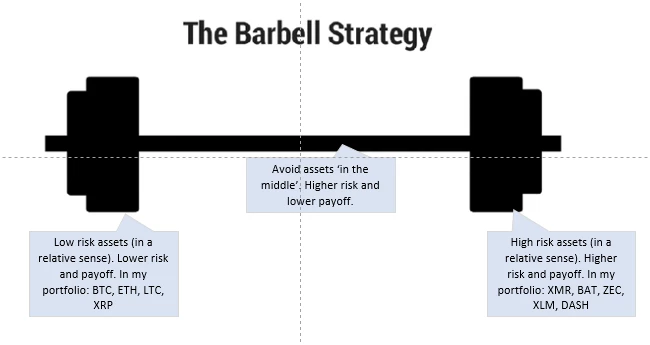
Figure 1. Constructing a crypto 'barbell' strategy
At the other extreme I allocate 5% to speculative ALTs. In terms of the ALTs I have been buying, I mix it up a little, but have recently been accumulating cryptos such as XMR, BAT, ZEC, XLM and DASH. Again, these are my personal preferences and not investment advice. Since my overall objective is to maximise my long term position in BTC and ETH, when there have been significant move ups in ALTs relative to BTC or ETH, I am happy to sell these down to increase my ETH and BTC holdings.
 Table 1. Asset allocation
Conclusion
I try to keep it simple at all times and sticking to these principles allows me to stay calm, even at these times of high drama.
Of course, this is not investment advice and I am not a financial adviser. I am only sharing with you the approach that helps me to sleep at night, stay focused on the long term and manage my risk and return position.





