
Versión en español
The power of the State tends toward geometric expansion—a growth driven ideologically by socialism and communism, systems founded on centralized planning. This manifests with alarming frequency in nations blessed with vast natural resources. Such a scenario creates the perfect breeding ground for a financial mirage: the perception of solid well-being which is, in reality, merely the squandering of extractive rent that requires neither innovation nor labor to flow. It projects a transient prosperity that lacks the capacity for self-reproduction.
The Dosing of Poison: The Path to Absolute Monopoly
Historically, the catalogue of government systems is vast, but few have exerted as destructive a pressure on human development as socialism and communism. It is an analytical error, however, to view them as isolated phenomena; they represent, rather, different speeds of the same process of centralization.
Socialism is not the "moderate" alternative to communism; it is its most efficient administrative method. The strategists of these systems understood that the frontal, violent assault of classical communism immediately triggered a society's defense mechanisms. They perfected the tactic: socialism is, essentially, a poison administered drop by drop. By injecting communist ideas in calculated doses, they numb the population's resistance. The path is singular; socialism is merely the vehicle that allows one to travel it without noticing the final destination until it is impossible to turn back.
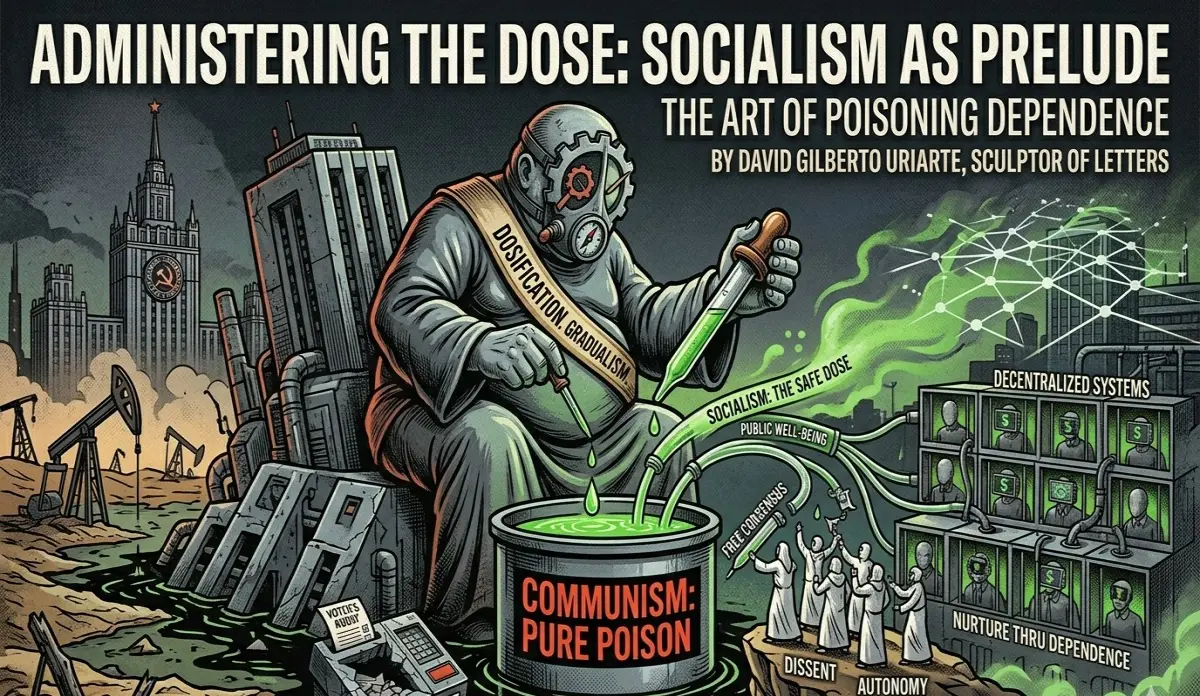
The Geography of Power: Administrative Hyper-Centralization
A distinctive trait of these systems is the creation of an administrative "black hole" in the capital. The "State-as-Corporation" does not just monopolize the economy; it absorbs the autonomy of every region. This hyper-centralization turns any administrative procedure, investment, or regional development into a bureaucratic nightmare.
In practice, this translates into what citizens call, with resignation, "having to ask permission from the capital." When a state loses the capacity to self-manage its daily life, development grinds to a halt. This is evident on three fronts:
The Paralysis of Infrastructure: The repair of a bridge or the management of electricity depends on budgets and licenses approved exclusively in the center, condemning regions to decay.
Commercial Suffocation: Regional entrepreneurs face an internal customs barrier where obtaining operating licenses is a privilege granted only by the central bureaucrat, turning the country into an archipelago of economic deserts.
The Control of Production: Agricultural producers, trapped in national movement permits, watch their harvest rot while waiting for an order that never comes.
The Mirage’s Fuel: The Trap of Abundance
A critical factor accelerating this process is the presence of vast natural resources. This abundance allows the State to purchase the population's loyalty and finance its excesses without needing to generate added value. It is the "curse of abundance": the State does not need to be efficient or competitive to survive because it possesses an external source of income that keeps it afloat despite its constant failures. This makes the State the sole owner of the national "booty," transforming everyone's wealth into a tool of control for the few.
The Kill Switch: Hijacking Digital Sovereignty
The ultimate expression of this centralized control is the power to decide who has a voice and who does not. When the State is the only provider of critical infrastructure—such as the internet—technology ceases to be a tool of freedom and becomes a tool of submission. As seen in cases like Iran, a centralized State possesses a "kill switch." By monopolizing infrastructure, the leadership can disconnect an entire country from the outside world regardless of whether its inhabitants agree. In a system where the State owns the network, freedom of expression is at the mercy of the few, proving that in the "State-as-Corporation," the citizen is not a customer, but a hostage of the switch.
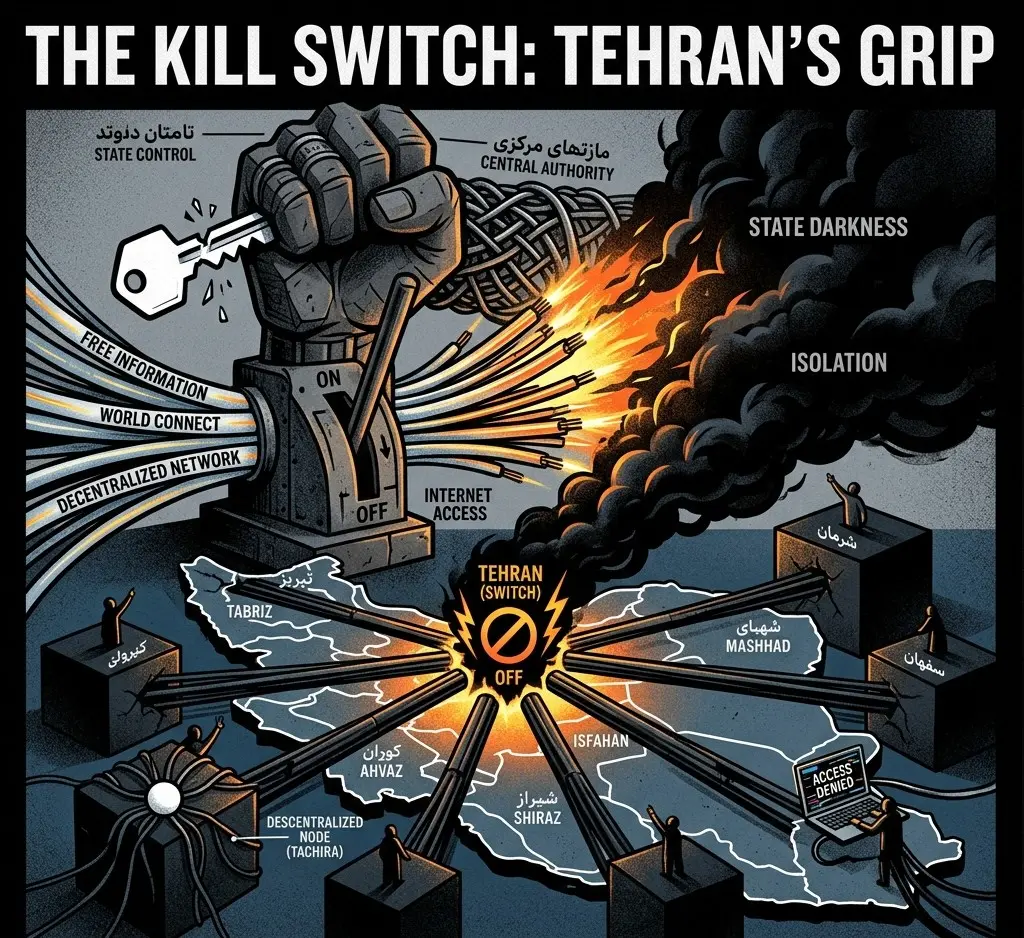
The Monopoly of Truth: The Electoral Architecture
To understand the difference between centralization and decentralization, the Venezuelan electoral system serves as a stark example. The architecture of this system acts as a "Black Box" where the State is the sole decision-making node.
The process begins with a simple technical act: the electoral machine issues a physical receipt for every vote—a ticket that reflects exactly who the citizen voted for. In theory, that paper is the only real and legitimate proof of the popular will. However, the "State-as-Corporation" neutralizes this proof through bureaucracy. Instead of performing a total count of those physical receipts—which would be the logical audit—the system imposes a centralized digital truth.

They justify this opacity through the "sampling fallacy." By auditing only a partial sample of the ballot boxes (selected by the central power itself), the State avoids a general count, treating the election as a probabilistic survey rather than an absolute census. It is a system of "permission": the citizen holds the only physical proof of their vote, but the State retains the key to the final data, giving the "green light" to official information only when it suits them, effectively invalidating the tangible evidence the voter possesses.

The Lesson of the Crypto World: Permission or Consensus?
Faced with this centralized model, cryptographic projects and decentralized finance (DeFi) propose a radical paradigm shift:
In the Centralized Model: Trust is an act of blind faith. The citizen must trust that the sole administrator is not altering the sample and that the official truth will prevail over the physical receipt. There is no transparency because the State controls the server.
In the Decentralized Model (Blockchain): Trust is mathematical. In a distributed network, every node holds a complete and synchronized copy of all records. No one needs to ask for a "green light" to verify the result because the technical architecture makes the information public, immutable, and verifiable by anyone.
The Trap of the "Well-being Mirage"
How is this mirage maintained? Financially, it is the consumption of accumulated capital. The State does not generate wealth; it lives off the sale of assets created by the previous system or the direct rent from natural resources. It is like a family that, to maintain its lifestyle, begins selling the furniture from their home: for a time, they have money to eat, but they are destroying their heritage.
The end result is a schizophrenic society: a facade of an empty official market and a real structure of scarcity and privilege.The citizen is no longer an economic actor, but a subject of the "State-as-Corporation," where buying and selling is not an act of freedom, but an exercise in obedience. The mirage breaks not when the system changes, but when, inevitably, the assets are depleted or the rent from natural resources is no longer sufficient to sustain the structure.
Author's Note:
All writing in this work is 100% my own. Regarding the images used in this post, some are AI-generated, crafted from the original themes and ideas of my work, while others are authentic, original photographs.
History teaches us that centralism is not an inevitable destiny, but a structural choice that we can reverse. Decentralization is not just a technology; it is the definitive tool to reclaim our sovereignty over data, over money, and over our own reality. Do not wait for the system to give a "green light" to your freedom. Start by auditing your environment, questioning the centralized narrative, and adopting architectures that, by design, return to you the power that belongs to you. The future is not in the bureaucrat’s office; it is in the network you help build yourself.
David Gilberto Iriarte
Sculptor of Letters





