
Bitcoin isn't perfect.
What? A Bitcoiner who dares to criticize Bitcoin?
Yes, because even though I am a Bitcoiner, I am first and foremost someone who seeks the truth. Don't forget the Bitcoin motto: “Don't Trust, Verify.”
So I spend my time verifying to try to form a personal opinion that I share with you. I'm not trying to sell you anything contrary to what some people tell me in comments or messages. I share my opinion, which is subjective.
My opinion is for me the truth. Not an absolute truth, but MY truth, and the one I invite you to challenge by thinking for yourself.
While I have recently debunked many false myths about the ecological impact of Bitcoin, to re-establish what I consider to be the truth, it's up to you to prove me wrong if you don't agree, I have also written an article recently criticizing Bitcoin.
Bitcoin is not perfect, and I am aware of that.
So there are 3 legitimate criticisms you can make about Bitcoin in my eyes:
-
Bitcoin does not consume energy.
-
Bitcoin does not have enough nodes.
-
BTC units are bought mostly in KYC mode, and this is something dangerous for those who buy Bitcoin.
I explain all this in detail here:
"Here Are the 3 Legitimate Criticisms About Bitcoin That You Can Make." As for the rest, the latest report from the Bitcoin Mining Council (BMC) has just been published, and I think it's always interesting to look at it to see how the Bitcoin mining industry is evolving regarding its environmental impact goals.
As a reminder, the BMC has 51 miners now representing 45% of the Bitcoin network's Hash Rate.
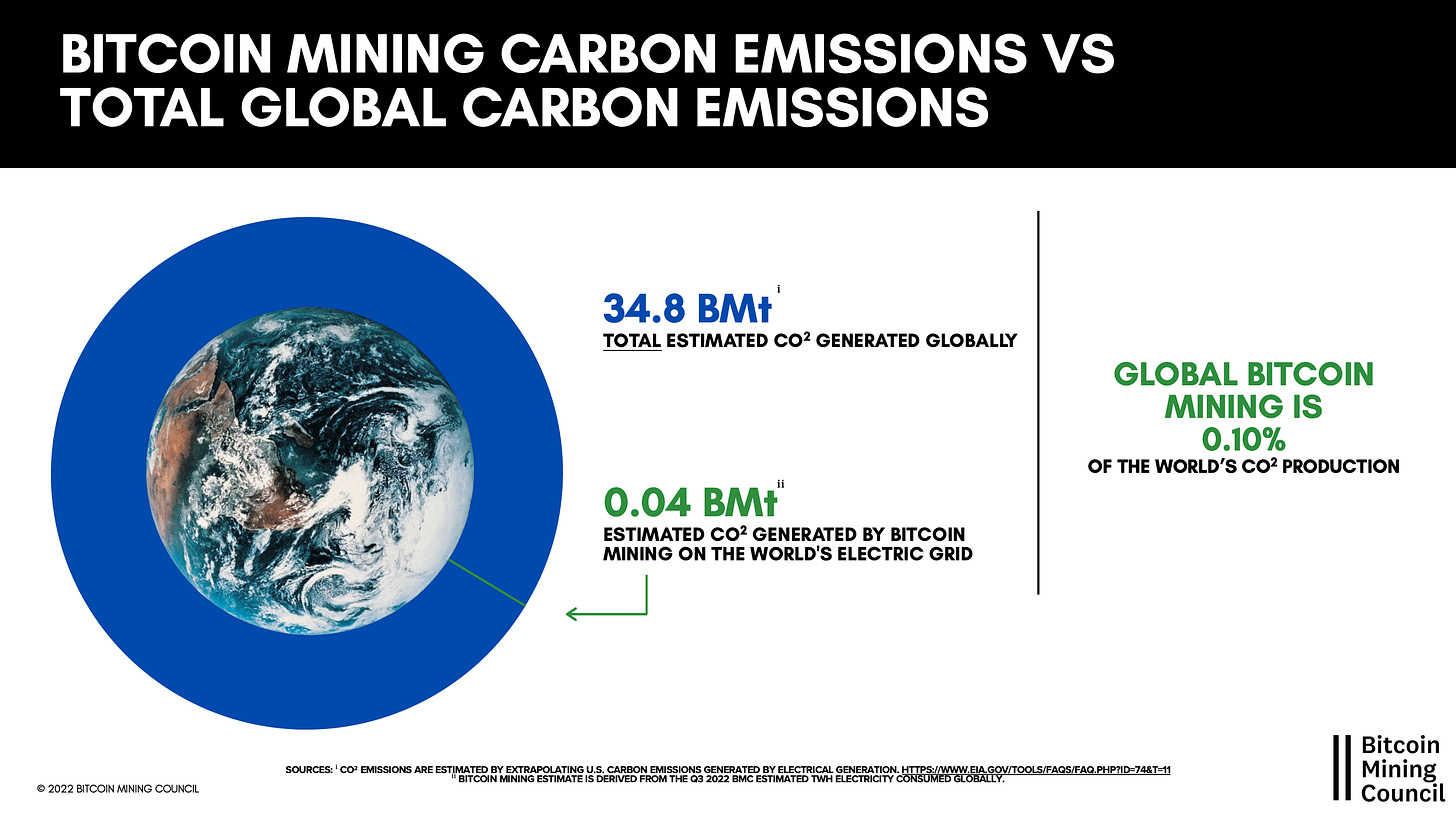
The BMC's Q3 2022 report, which I urge you to read, tells us that Bitcoin uses an insignificant amount of the world's energy (0.16%) and that its share of CO2 emissions is even more negligible (0.10%):
The reason is simple: almost 60% of the electricity used by Bitcoin miners comes from renewable energy:
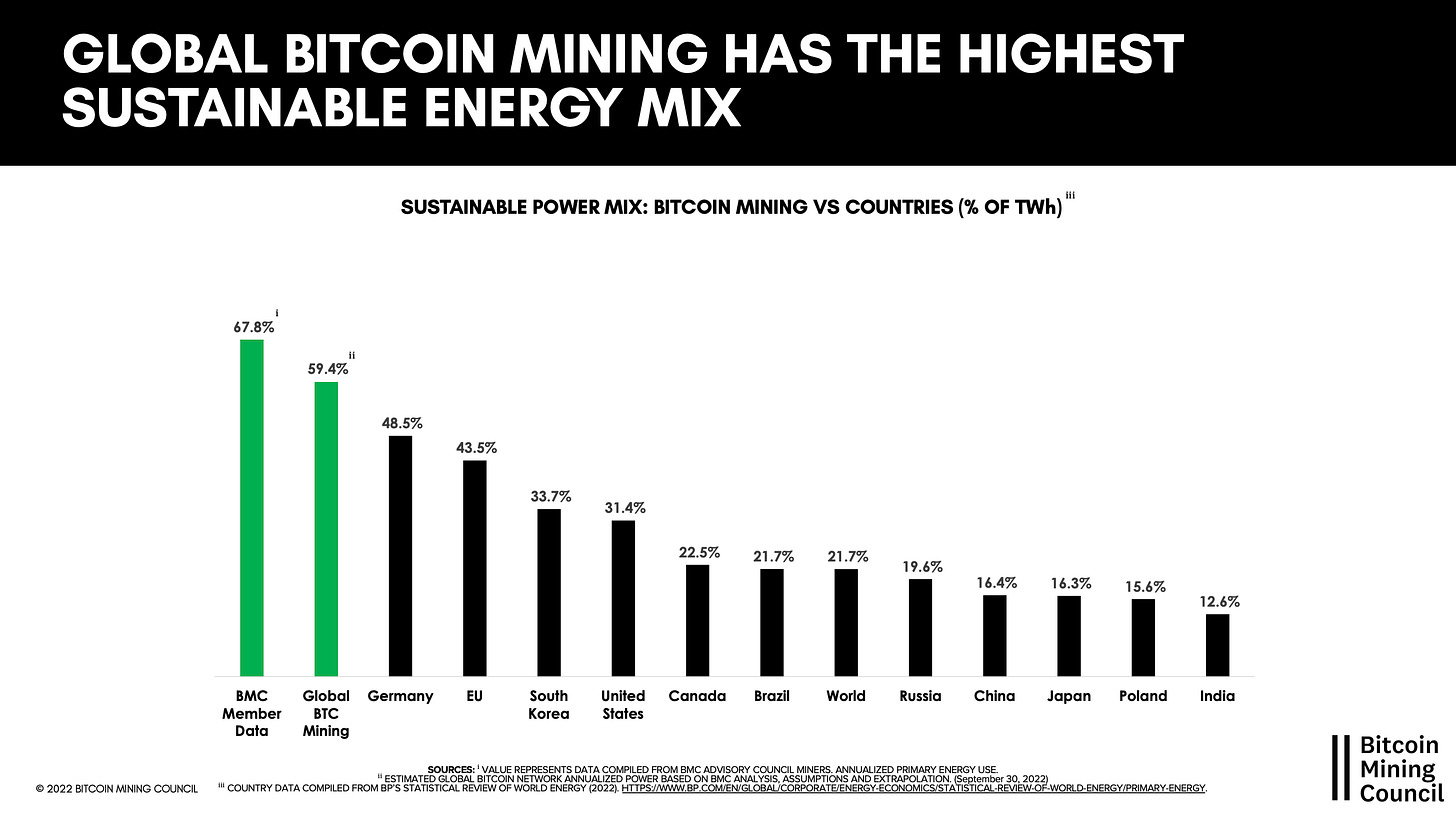
As you can see, the figure rises to 67.8% for BMC players who account for 45% of the Bitcoin network's Hash Rate. Their commitment to making Bitcoin ever greener is to be commended.
The computing power allocated to securing the Bitcoin network has soared by 73% year on year. However, its energy consumption has only increased by 41%. This difference is explained by a 23% increase in the energy efficiency of the mining machines.
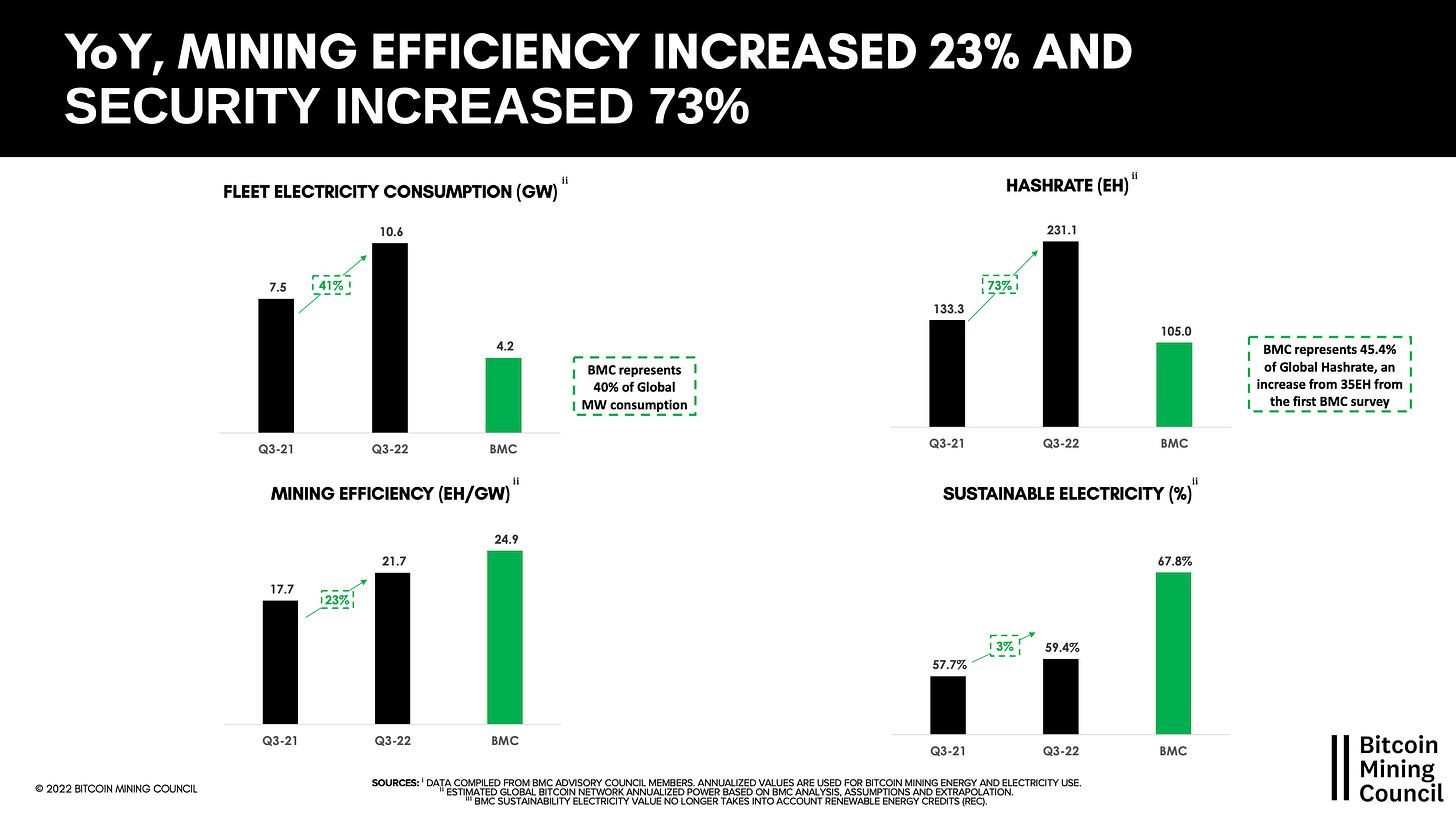
This increase in efficiency is largely due to Moore's Law, which states that the transistor density of microprocessors doubles every two years due to technological advances. Mining machines today use 5nm chips and by 2027 will use 1.4nm chips according to world leader TSMC.
Moore's Law and the fact that the reward paid to miners is halved every four years during the Bitcoin Halving event considerably curb the power consumption of Bitcoin. This allows us to say in passing that the security of the Bitcoin network does not depend only on the amount of energy injected. It also depends on the technological advances in the semiconductors used to generate hashes. This is why Proof-of-Work makes Bitcoin superior.
The BMC estimates that the amount of electricity required to maintain the current level of security of the Bitcoin network will be divided by 24 within eight years.
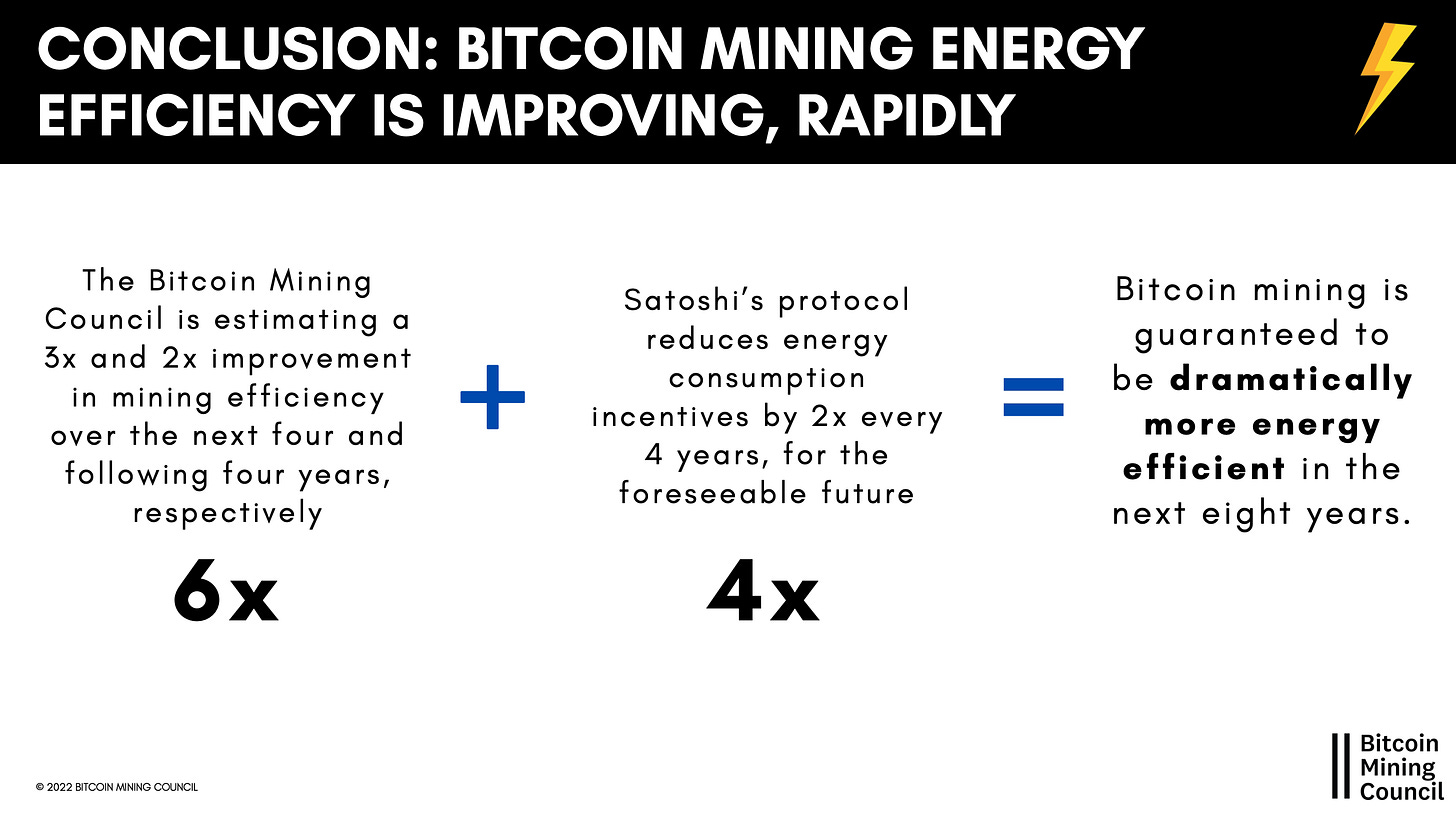
Of course, if the value of Bitcoin increases by a factor of 24 in the same period, electricity consumption will stagnate. Indeed, an appreciation of the BTC makes it profitable to plug in more machines. Given these figures, we are very far from “boiling the oceans,” contrary to what Bitcoin's opponents say. Not to mention the fact that Bitcoin is the best technology to extinguish methane flares and thus help fight global warming.
During the presentation of the BMC for Q3 2022 report, it was pointed out that from this quarter onwards, we will see a 40% increase in the energy efficiency of Bitcoin mining machines, thanks to the arrival of S19XP Antiminers. These sport an energy efficiency of 21.5 watts per Terahash, compared to 29.5 W/Th for its predecessor S19Pro.
The BMC did not fail to notice that Ethereum has just abandoned the Hash Rate race, which raises fears that Ethereum 2.0 is a huge censorship machine in the hands of the American OFAC.
"Ethereum 2.0: How the Centralization of the Network Makes It a Scary Censorship Machine"
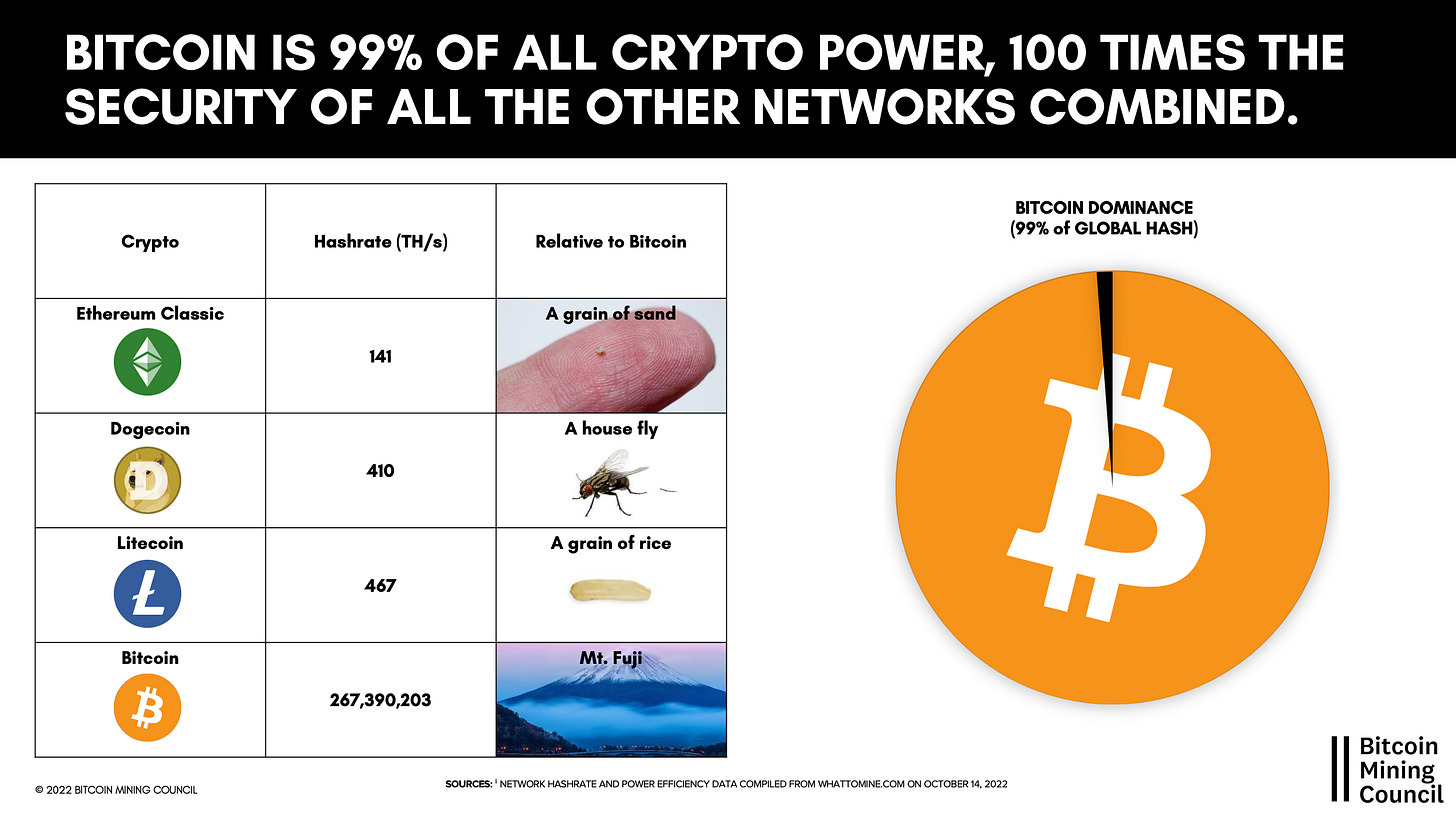
Now, Bitcoin is “100 times more secure than all competing cryptocurrencies combined.”
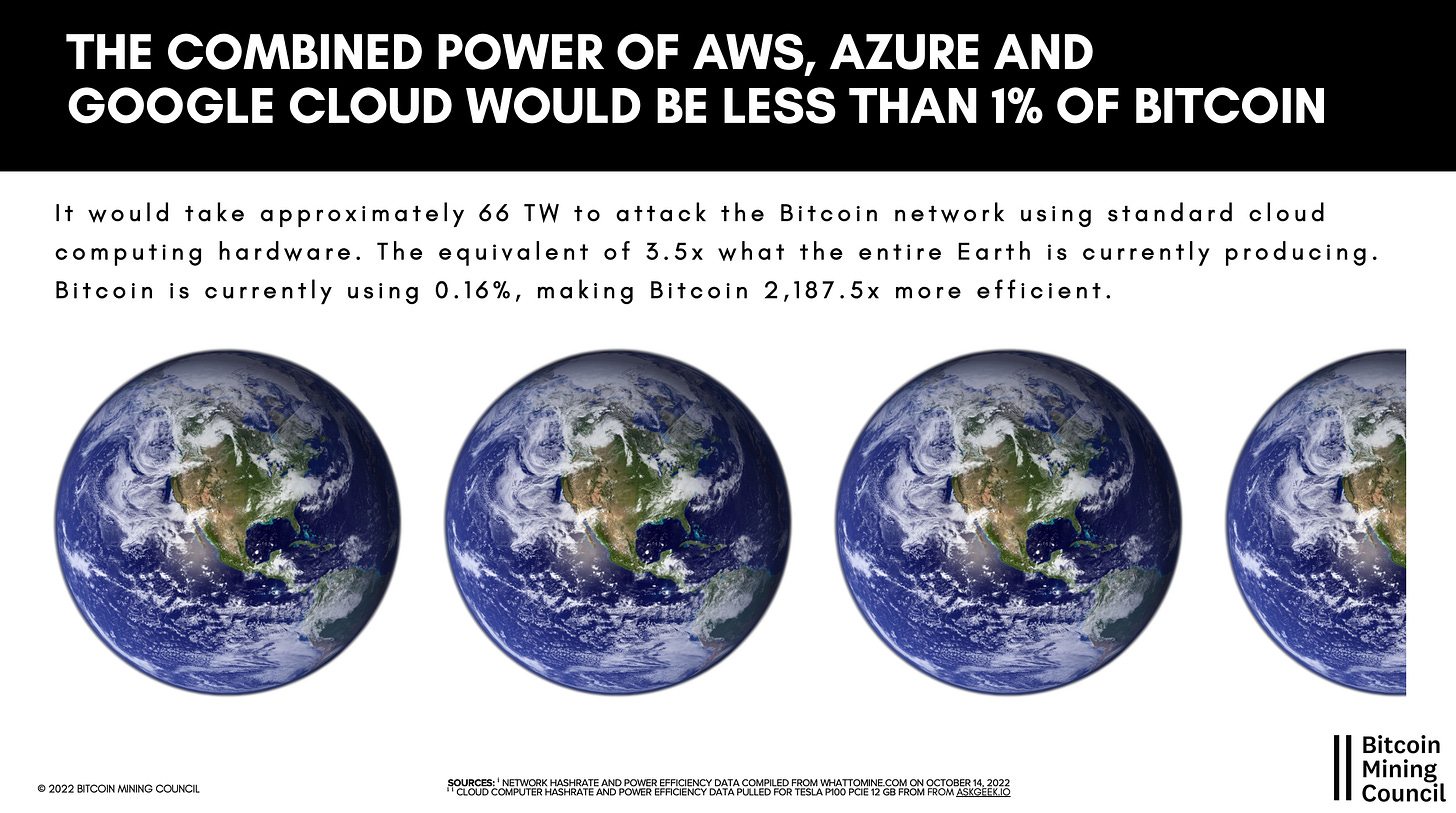
Another way to look at it is that the combined computing power of Google, Amazon, and Azure is less than 1% of that of the Bitcoin mining industry. This gigantic gap is because the miners use ASICs specifically dedicated to the SHA-256 algorithm.
The BMC completed its quarterly report with a presentation by Romain Nouzareth on the usefulness of Bitcoin mining to solidify electrical networks. The big challenge for energy companies is to be able to cope with peaks in consumption. These force them to maintain numerous power plants that are economically unprofitable, but necessary to avoid blackouts during peaks.
All this is to say that the electricity demand is not constant over time. Daily, the peaks in consumption occur in the early morning and evening. The explanation is simple: these are the times when people are at home.
Weekends are less energy-intensive because industries are generally idle. Added to this is the climatic factor responsible for seasonal peaks. They occur in winter (heating), but also in summer during hot periods (air conditioning).
Romain Nouzareth then explained:
“We are the only digital industry in the world that can stop consuming electricity all of a sudden. This is not the case for Google or Amazon data centers, which are always running.
For example, in Quebec, where we use 20 megawatts of energy, we shut down our machines mainly during winter peaks. When the population needs to heat because it's cold, the energy provider can ask us to shut down our miners. We do this for a certain number of hours each year, mainly in winter.
It's a great way for the utility to sell electrons that they weren't selling before. Let's take an example: you're a municipality with 20,000 homes and you have access to 100 MW of power. You never want to use your grid at 100% because you need a margin for very large peaks. So you're going to increase it to 80 megawatts. In the summer, the municipality will use 60 megawatts of power, and in the winter, because it's cold, 80 megawatts.
Before having bitcoin miners on this grid, the energy company was selling 60 megawatts in the summer and 80 megawatts in the winter. With us on the grid, he will be able to sell closer to 80 megawatts all the time. That means more revenue for the municipality and the energy company, which will be able to invest that money in replacing its carbon-based energy sources with renewable energy sources.”
Of course, in Quebec, most of the energy is hydroelectric, so the energy consumed by the mining industry in Quebec does not emit CO2.
Finally, remember that Bitcoin miners are encouraged to locate where electricity is cheapest. This electricity is necessarily generated from a surplus of renewable energy.
Let's face it, Bitcoin is a force for good in the fight against climate change!
In Bitcoin We Trust Newsletter: Everything around Bitcoin, Blockchain, and the cryptocurrency market





