
The Van Gogh brothers' woman
To whom does Vincent van Gogh owe his (posthumous) success?
Instant spoiler: to Mrs Van Gogh! But the good Dutch painter was not married ...
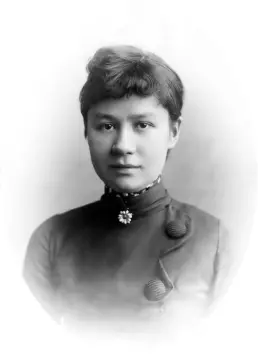
The Van Gogh brothers' woman
We all, more or less, know the story of Vincent van Goh and the scarce, practically non-existent success he enjoyed during his lifetime, and how his works were preserved by his brother: Vince painted throughout his wandering life, sent the works to his brother Theo, who kept them, deceiving him that he was selling them, until the truth came out, then Vince cut off his ear, and after a while died. It is not even worth linking any sources, as the story itself is well known.
OK, he was not married, but a Mrs Van Gogh did exist.
OK, he didn't really amputate his ear, but he only cut off a small piece of the lobe, the precision purists will say, and he didn't inflict the wound on himself out of artistic disappointment, but mutilated himself out of nerves after an argument with his painter friend Paul Gauguin. Let us take a look at the self-portrait with the bandaged ear, in which Vincent is also shaved, and which is just one of several paintings that testify to the mutilation:
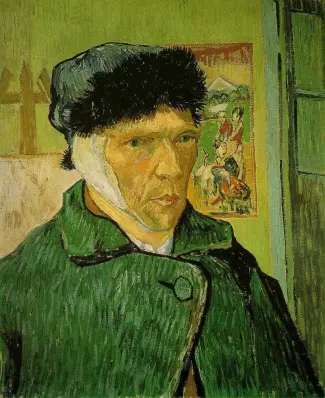
https://it.wikipedia.org/wiki/Autoritratto_con_l%27orecchio_bendato#/media/File:VanGogh-self-portrait-with_bandaged_ear.jpg
WikiCommons public domain photos
The episode itself is not very clear: some even speculate that he may have been wounded by his painter friend, since in one of the letters in the correspondence between the Van Gogh brothers, Vincent describes an argument with Gauguin, and wishes that the latter would never come into possession of a firearm, because it could be dangerous. Vince himself was quite reticent about what had happened that day, having stated that he had no precise recollection of the incident, whereas Gauguin, in his diary, reconstructs the episode with good accuracy: van Gogh would - unreasonably - pour a glass of absinthe on his friend in a club, and then forget all about it. The Dutchman allegedly pursued the Frenchman afterwards, brandishing a razor, then stopped and went home. The same razor with which, that night, he cut off a piece of his earlobe, left as a souvenir in a brothel.
Gauguin regrets not having disarmed his friend, and not having given due importance to earlier episodes, which testified to Van Gogh's descent into the valley of madness, that state of mental suffering, which would lead him to suicide seventeen months after this episode.
In short, Vincent, to the end, remained penniless and unknown, but he sent his creations to his brother Theo, and, although he was not entirely unknown to the public when he was still alive - so much so that Tolouse Latrec had appreciated “The Sunflowers” - his canvases were finally sold post mortem.
The good Vincent, to tell the truth, sold at least one painting when he was alive: it was The Red Vineyard, which was exhibited in Brussels in 1890 and valued at 400 francs (let's say around 800 euros today, against a current quotation of 50 million), and perhaps he also sold another one, since he mentions in a letter to his brother that he sold a portrait for 20 francs, of which, however, no trace remains. Two paintings sold out of about nine hundred that he is supposed to have painted are not bad, still better than zero. Always without taking into account the youthful works, sold (according to wikipedia) by his mother to a junk dealer in Neunen, his home town, for 10 centimes each.
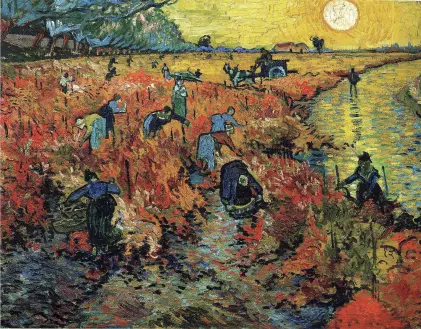
The red Vineyard, at Puskin Museum

pubblic domain image https://it.wikipedia.org/wiki/La_vigna_rossa#/media/File:Red_vineyards.jpg
In short, Vincent Van Gogh is successful thanks to his brother Theo, long live Theo. But what if he, in fact, prevented him from being successful? And then, who is the lady in the photo?
She is Johanna Bonger, sister-in-law of the famous painter, wife of his brother Theo, and widowed only two years after Vincent's death, from whom she inherited hundreds of works, without (at the time) any value whatsoever, crammed into an attic: so yes, she is Mrs. Van Gogh, on Theo's side, though.
Johanna, having to invent something to live on, devoted herself mainly to publishing the correspondence between the two brothers for a Dutch publishing house - a work she continued to edit throughout her life - but also to publicising and disseminating Vincent's works through donations to exhibitions and small museums.
In fact, Theo kept the canvases, but, had it been up to him, they would have remained rotting in his attic, because, let's face it, it's not as if he was convinced of his older brother's talent either, and thank goodness he was an art dealer. But can you imagine, Mrs. van Gogh, inheriting a mountain of virtually worthless paintings?
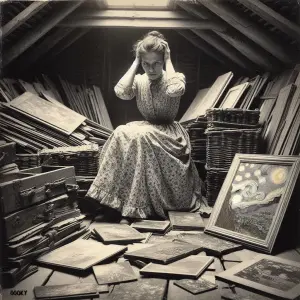
Poor mrs. van Gogh, imagined by the author
Johanna, on the other hand, organised around twenty exhibitions dedicated to her late brother-in-law in the space of ten years, culminating in 1905 with an exhibition at the Stedelijk Museum in Amsterdam with over 400 works, which attracted critics and aficionados from all over Europe, decreeing Vincent's official entry into the Olympus of contemporary artists. She had probably understood, better than her husband, how to adopt an effective marketing strategy, riding on the bohemian and romantic ideal of the tormented artist, which was in vogue in the late 19th and early 20th century,
Hardly great artists are good promoters of their own work, leaving aside exceptional cases such as Raphael Sanzio, or in recent times, Picasso, and very recently, Cattelan, and in this Van Gogh really sucked, as profiting from art was as far as he could get as a painter. He fantasized about the creation, together with Gauguin, of a kind of artists' coterie, which would promote art for art's sake, where they could exchange ideas, techniques, compare their respective worldviews. The nucleus, which broke up after a few weeks, was composed of Vincent himself, Paul Gauguin, and the artists Charles Laval and Emile Bernard. A vision of art that was perhaps utopian, almost Renaissance, out of time? Yet he, in many ways, had been an author absolutely ahead of his time, just look at his “Skull with Cigarette”, a truly pop painting, in spite of the seen and seen sunflowers:
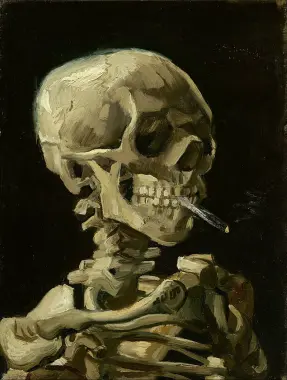
https://it.wikipedia.org/wiki/Vincent_van_Gogh#/media/File:Vincent_van_Gogh_-_Head_of_a_skeleton_with_a_burning_cigarette_-_Google_Art_Project.jpg
WikiCommons public domain photos
It looks like it came out of Andy Warhol's Factory, but instead sprang from Van Gogh's brush in 1885.
If there is any truth in the saying “behind a great man, there is always a great woman”, here we have confirmation.
So long live Vincent, long live Theo, but also long live Johanna.









