
It is impossible not to notice, and we have all wondered: why is Moses horned? Not in the slang sense of the term that we use in Italy, but Moses - yes, the bearded one sculpted by Michelangelo around 1514 - sports a nice pair of horns on his head.
Stories and legends connected to the statue are several, and one only has to take a tour on the web to find out, starting with the one (often associated, without foundation, with Giorgio Vasari), concerning the hammering that Buonarroti himself allegedly dealt to the statue that refused to speak to him (see, as an example https://michelangelobuonarrotietornato.com/2018/06/17/perche-non-parli/), probably originating from a vein on the statue's knee, of natural origin.
We do not discuss some of the work's particularities, which testify to the sculptor's greatness, such as the flicker of a small muscle on the patriarch's forearm, which makes us realize how deep the sculptor was in the study of anatomy, or the "re-culture" that Michelangelo is said to have made of the head, which is said to have been rotated 45 degrees from the initial version, according to the theory, of restorer Antonio Forcellino.
We remain focused on the detail of the horns.
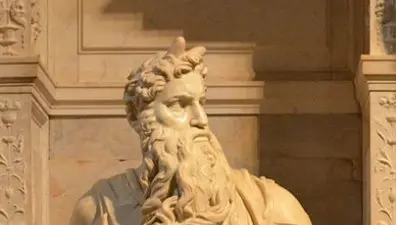
Detail of the head of Moses, image found at the link:

https://it.wikipedia.org/wiki/Mos%C3%A8_(Michelangelo)#/media/File:Mois%C3%A9s_iluminado_por_un_rayo_de_sol.jpg

Image with licence Creative Commons Attribution-Share Alike 4.0 International
Clearly Buonarroti was fully aware of what he was portraying; both he and the commissioner, the embattled Pope Julius II, were facing the one who can be considered THE patriarch par excellence, revered not only by the three major monotheistic religions, but even in the Rastafari, who consider him a kind of messiah (as well as David, Solomon, or Jesus).
Why then portray the most important character in the Old Testament with horns? Just take a quick trip around the Web to find what seems the most likely explanation.
In designing the sculpture, Michelangelo probably relied on the "Vulgate," the Bible translated into Latin from the Greek original by Sonophrius Eusebius Jerome in the late fourth and early fifth centuries. This would be a "simple" error, inherited from a mistake by St. Jerome, who mistook the Greek word "keren" (horn), for "karan," or ray of light.
Because Moses saw (in Exodus 34) God, his face became radiant, and he began to shine as a living light, so much so that he had to wear a veil over his face so as not to dazzle the people. The horns would thus be a representation of the rays of light, a horned rather than a glowing face, and wikipedia also aligns with this interpretation: thus Michelangelo simply represents the enlightened face of a man who has received from God, for the second time, the tablets of the law: that is, he has known the face of God and reflects it.
The mosaic iconography portrayed by Buonarroti influenced art in later centuries, see for example Diotti's Moses, dated 1800.
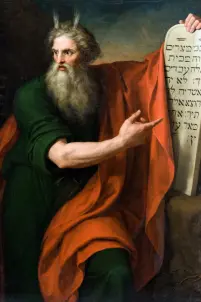
It should be pointed out, however, that the horns on Moses' head are not exclusive to Buonarroti; a "horned" Moses can be seen in an early 12th-century miniature in the Bury Bible (year 1135), England, or in the 13th-century Walters manuscript, as well as in many other medieval iconographic representations.
Another example can be traced to the illustration in the Nuremberg Bible, which dates from 1483, although, indeed, it appears to be two flames rather than two horns.

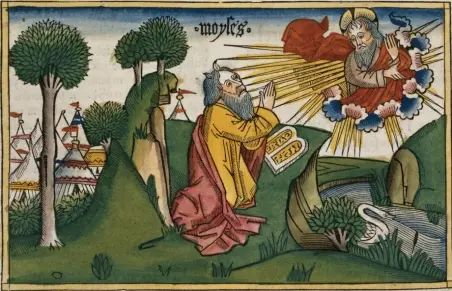
Images in the public domain worldwide.
The reproduction is part of the collection of reproductions compiled by The Yorck Project.
The copyright of that collection as a whole belongs to the Zenodot Verlagsgesellschaft mbH and fired under the terms
of the GNU Free Documentation License.
There is, however, an "alternative" reading that can be made of Moses' horns, and of the same translation made by the good Jerome. Today we are accustomed to attributing the horns to Satan, probably thanks to artistic depictions of the devil, which have often taken their cue from portraits of the god Pan, and one cannot blame the artists: Pan was not handsome, wild, depicted with goat's legs and horns, hirsute legs and ungulate hooves, while the torso is human, the face bearded and with a terrible expression, often in drunkenness. Because he had difficulty mating because of his appearance, he was given to masturbation and often to sexual violence, although he was not of an evil disposition.
He embodied, in short, a number of characteristics that Christianity attributed to the Enemy.
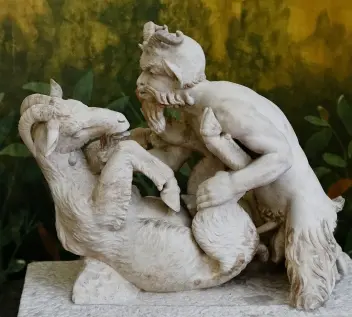
Photo published by Marie-Lan Nguyen under a cerative commons license.

https://commons.wikimedia.org/wiki/File:Pan_goat_MAN_Napoli_Inv27709_n01.jpg
Okay, but what about the horns? Let's go to the origin, what did horns mean in the Bible?
There are several verses with the word horn, and, spoiler, they are often a positive emblem, and in any case a symbol of power.
In the book of Daniel, from verse 8 of chapter 7, horned beasts symbolize the kingdoms that are to come before the coming of the Most High, a foretaste of what will later be written by John in Revelation.
In Luke's gospel (ch. 1 verse 69), Zechariah, the father of John the Baptist, thanks the Lord for granting Israel a mighty savior, and uses the expression "horn of salvation," just as in Psalm 89, in verse 17, the Lord increases the horn (power) of his anointed David.
They were probably taking their cue from Deuteronomy 33: 17 (referring to Joseph's lineage):
As the firstborn of bulls, he is majestic in appearance, and his horns are of bùfalo;
With them he shall clash against the peoples,
All together, even to the ends of the earth.
Even the prophet Zechariah, in chapter 1 verse 18, uses the term horns to refer to the peoples who defeated Israel.
After all, in Revelation 5:6 The seven horns of the Lamb represent the seven spirits of God to symbolize the power of sacred truths.
Here, then, is the idea: the Michelangiolesque horns are not (or not only) a way of representing the radiance of the divine light that radiated from the patriarch's face, but express the power of the same divine spirit embodied by Moses.
Small bonus:
Michelangelo was a scholar of human anatomy, but also a keen observer of the works of his competing artists. The suspicion that he studied Donatello's St. John the Evangelist (dated 1408), before making his Moses (in 1513), seems legitimate. To the reader the task of finding "any" similarities ...


Images licensed under the GNU Free Documentation License, found at the link:

https://it.wikipedia.org/wiki/San_Giovanni_Evangelista_(Donatello)







#/media/File:Mois%C3%A9s_iluminado_por_un_rayo_de_sol.jpg)
