(IJCH) The PHANTOM Protocol: Improving Proof of Work WITHOUT Off-Chain Solutions - Part III
(or Why this BlockDAG is suitable for Advanced Generations of Decentralized Distributive Ledgers)
For Part I of this Trilogy:
For Part II of this Trilogy:
IJCH - Inside JaiChai's Head (meaning: My warped, personal opinions and musings)
From the Author:
Salutations.
I am JaiChai.
And if I haven't had the pleasure of meeting you before, I'm delighted to make your acquaintance now.

The Aim

My aim in this last article of the "Improving Proof of Work WITHOUT Off-Chain Solutions" Trilogy is to explain as simply as possible the generations of Distributive Ledgers and how PHANTOM can go where other BlockDAGs (e.g., GHOST and SPECTRE) cannot go.
As usual, I will NOT get into the deep, technical details of the protocol. That's what its Academic Papers are for.
Instead, I'll discuss the reason PHANTOM was created; that is, the issues with previous protocols that PHANTOM addresses and how it benefits the PoW blockchain.
Generations of Decentralized Distributive Ledgers

If you think of it, we have already witnessed many generations of revolutionary decentralization.
Each generation's contributions opened up new vistas of creativity and innovation; prompting massive onboarding of new cryptocurrency enthusiasts.
Legacy institutions could not continue burying their heads in the sand and finally began to acknowledge the potential of distributive ledger technologies.
And out of survival and FOMO, entering the space and establishing a foothold has now become a priority - even for those who previously ridiculed and shunned the whole notion of cryptocurrency and decentralization.
Bitcoin Protocol - The Revolutionary First Generation

As a response to the 2008 Worldwide Financial Crisis, Satoshi Nakamoto rolled out his revolutionary Bitcoin blockchain protocol.
For the first time in history, The Byzantine General's Problem was sufficiently addressed; making it possible to reach consensus in a Byzantine environment.
Why was this such a big deal?
Because it was the first decentralized distributive ledger; making it possible to do many things not possible before - such as transfer tokens of agreed upon value between two parties located on opposite sides of the world - without the approval of a money grubbing, controlling, and privacy intrusive third party.
Ethereum - The Second Generation

Charles Hoskinson and Vtalik Buterin saw the limitations of bitcoin as a platform. They didn't set out to create a mere copycat of Bitcoin.
They wanted to make an all-encompassing, general purpose platform where future DApps (Decentralized applications) could easily operate and thrive on.
The advent of "Smart Contracts" on Ethereum made it possible to inject conditions that have to be met first before any contract could be deemed complete.
In other words, with smart contracts, a users' payment could be withheld until all the particulars of any contract are fulfilled.
It is the invention of Smart Contracts that made it possible to create DAO's (Digital Autonomous Organizations) - an entity not influenced by the whims of any individual and executes protocol without concern of third party intervention.
And thus, the increased disintermediation and versatility of Smart Contracts enabled developers to make things like decentralized exchanges also possible.
Alternative Protocols - The Third Generation

The need for better transactions per second speed and robust scalability became an obvious roadblock to progress in the decentralized space.
This spawned a plethora of alternative consensus mechanisms specifically created to tackle those problems.
Blockchains were modified and non-blockchain consensus mechanisms were invented that significantly improved both the speed and scalability of reaching platform consensus.
Examples of this include Ripple and Stellar's "Cascading Consensus", IOTA and Bytecoin's "DAGs" (Directed Acyclic Graphs) and of course, Hedera's HashGraph (an advanced DAG).
PHANTOM - Apex of BlockDAG Protocols

Yonatan Sompolinsky (PhD candidate) and Dr. Aviv Zohar, both from the Hebrew University of Jerusalem, are pioneer researchers of BlockDAG protocols.
Sompolinsky and Zohar’s 2013 GHOST protocol introduced the BlockDAG structure.
The BlockDAG Topology
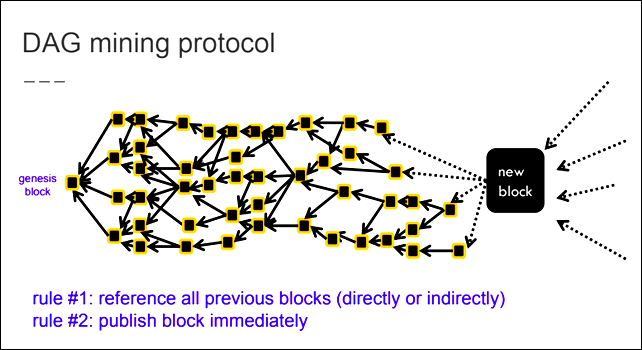
If you need information about DAGs and BlockDAGs, Click here.
In early February, 2018, they released a paper that describes their newest blockchain protocol named PHANTOM.
See:
"PHANTOM: A Scalable BlockDAG protocol - Yonatan Sompolinsky and Aviv Zohar, School of Engineering and Computer Science, The Hebrew University of Jerusalem, Israel {yoni sompo,avivz}@cs.huji.ac.il"
URL: https://eprint.iacr.org/2018/104.pdf
The PHANTOM protocol builds upon the researchers’ SPECTRE protocol, which confirms transactions with recursive voting of previous blocks.
PHANTOM - Segue to the Fourth Generation?

PHANTOM is an On-Chain BlockDAG protocol.
It is not a Layer 2, Off-Chain solution (e.g., Lightning and Raiden Networks), meaning that it does its magic without creating semi-autonomous Off-Chain communities (branches off the main chain).
This pleases critics of Off-Chain Solutions who argue that it may be easier for a user to become an oligarch (powerful, centralized player) in a smaller place where the only requirement is to broadcast the beginning and end of transactions to the main chain - in essence, invisible the majority of the time.
PHANTOM's "Raison D' Etre"
The reason why PHANTOM was created was to address the major shortcomings of SPECTRE - which are:
-
To achieve its superior performance, speed, and scalability, SPECTRE's ability to maintain the order of transactions were not emphasized.
-
Consequently, for transactions that are "order dependent", SPECTRE is not the best option.
Operations that are clearly "order dependent" include:
-
buy/sell orders on an exchange.
-
high-speed, high stakes gaming.
-
AND MOST IMPORTANTLY: SMART CONTRACTS!
In other words, PHANTOM is a BlockDAG protocol that can handle "order critical, sequentially dependent" operations - like Smart Contracts!
Conclusion

The PHANTOM Protocol was created to address the major limitations of SPECTRE.
With PHANTOM, a PoW blockchain can enjoy the improvements offered by BlockDAGs AND handle Smart Contracts.
However...
A Caveat

As always, in order to ensure you have a balanced perspective, I must provide you with this caveat about the PHANTOM Protocol.
And I also must stress that there is no perfect protocol for every use-case and environment.
There is always a trade-off between security, performance, and scalability.
In fact, for every supporter of this or that protocol, there will be many others who will find a reason (legitimate or otherwise) NOT to support or use it.
So, here goes...
In the spirit of full disclosure, the creators of PHANTOM acknowledge the following:
The linear structure of PHANTOM means sacrificing the faster confirmation times that came with SPECTRE, although the paper brings up the possibility of combining the two protocols in order to “enjoy the best of both worlds.” - Yonatan Sompolinsky and Dr. Aviv Zohar
Nevertheless, I believe the PHANTOM Protocol is yet another important advancement for the development of On-Chain Scalability and Security Solutions.
I hope this Trilogy was useful for you and that you had as much fun reading it as I had writing it.By JaiChai
Thanks for stopping by.
About the Author
Believing that school was too boring, he dropped out of High School early; only to earn an AA, BS and MBA in less than 4 years much later in life – while working full-time as a Navy/Marine Corps Medic.
In spite of a fear of heights and deep water, he performed high altitude, free-fall parachute jumps and hazardous diving ops in deep, open ocean water.
After 24 years of active duty, he retired in Asia.
Since then, he's been a full-time, single papa and actively pursuing his varied passions (Writing, Disruptive Technology, Computer Science and Cryptocurrency - plus more hobbies too boring or bizarre for most folk).
He lives on an island paradise with his teenage daughter, longtime girlfriend and three dogs.