
IJCH - Inside JaiChai's Head (meaning: My warped, personal opinions and musings)
From the Author
Salutations. I am JaiChai. And if I haven't had the pleasure to make your acquaintance, I'm delighted to meet you now.
Introduction
If you think of it, we have already witnessed many generations of revolutionary decentralization.
Each generation's contributions opened up new vistas of creativity and innovation; prompting massive onboarding of new cryptocurrency enthusiasts.
Legacy institutions could not continue burying their heads in the sand and finally began to acknowledge the potential of distributive ledger technologies.
And out of survival and FOMO, entering the space and establishing a foothold has now become a priority - even for those who previously ridiculed and shunned the whole notion of cryptocurrency and decentralization.
This article discusses the reasons for their change of heart.
It also covers some of the things causing all the current excitement within the decentralized space.
From an evolutionary perspective, we will take a brief journey and travel the road that chronicles the incredible generations of decentralization.
Stated differently, from the birth of Bitcoin to the appearance of HashGraph, we will examine the major achievements and impact of each generation.
Please Note:
I am a traditionalist.
When I refer to Bitcoin - capital "B" - I am talking about the Bitcoin blockchain protocol, not bitcoin - lower case "b" - the bitcoin cryptocurrency token.
A Big Problem for Exotic Generals

"The Byzantine Generals Problem" describes the dilemma a Byzantine General faces when the only way to achieve victory is by a concerted effort that includes other armies that are led by Generals he does not know - or even trust.
In short, how do you get a group of people to agree on something - reach consensus - when no one trusts the other person?
Additionally, everyone assumes that miscommunication, incompetence and bad actor maliciousness are inevitable.
This is called the "Byzantine environment".
Bitcoin Protocol - THE SOLUTION

As a response to the 2008 Worldwide Financial Crisis, Satoshi Nakamoto rolled out his revolutionary Bitcoin blockchain protocol.
For the first time in history, The Byzantine General's Problem was sufficiently addressed; making it possible to reach consensus in a Byzantine environment.
Why was this such a big deal?
Because the Bitcoin Protocol made it possible to do many things - such as transfer tokens of agreed upon value between two parties located on opposite sides of the world - without the approval of a money grubbing, controlling, and privacy intrusive third party.
And thus, the bitcoin cryptocurrency was born.
Ethereum - A Platform for Dapps

Charles Hoskinson and Vtalik Buterin saw the limitations of bitcoin as a platform.
They didn't set out to create a mere copycat of Bitcoin.
They wanted to make an all-encompassing, general purpose platform where future Dapps (Decentralized applications) could easily operate and thrive on.
And thus, Ethereum was born.
Note:
Compared to the timeline of Bitcoin, Ethereum is young; which makes it all the more amazing when you consider its meteoric rise to - and solid position in - the cryptocurrency elite (Top Ten).
I believe, unless supplanted by another, track record proven alternative, Ethereum has a long road of prosperity ahead.
Contracts with Brains

The advent of "Smart Contracts" make it possible to inject conditions that have to be met before any contract can be deemed complete.
In other words, now users' payment can be withheld until all the particulars of any contract are fulfilled.
It is the invention of Smart Contracts that make it possible to create DAO's (Digital Autonomous Organizations) - an entity not influenced by the whims of any individual and executes protocol without concern of third party intervention.
And thus, the increased disintermediation and versatility of Smart Contracts enabled developers to make things like decentralized exchanges possible.
Consensus Mechanisms - Alternative Moves

Source
The need for better transactions per second speed and robust scalability became an obvious roadblock to progress in the decentralized space.
This spawned a plethora of alternative consensus mechanisms specifically created to tackle those problems.
Blockchains were modified and non-blockchain consensus mechanisms were invented that significantly improved both the speed and scalability of reaching platform consensus.
Examples of this include Ripple and Stellar's "Cascading Consensus", IOTA and Bytecoin's "DAG" (Directed Acyclic Graphs) and of course, Swirlds' "HashGraph" (a DAG on steroids!).
HashGraph - Speed, Scalability Security and Fairness
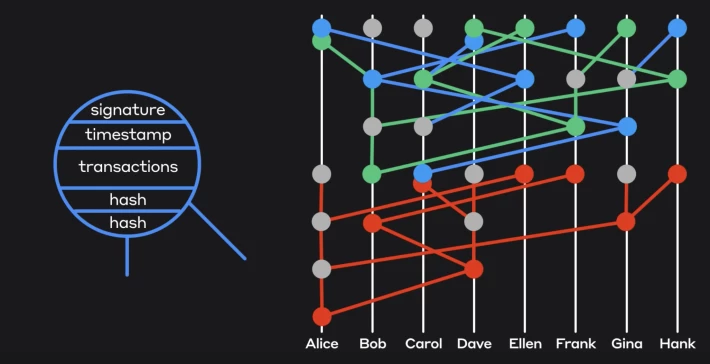
Last, but certainly not least, we come to the latest generation of decentralization technology: the HashGraph algorithm.
With its blazing 250,000 transactions per second (via its "Gossip About Gossip" protocol), instantaneous consensus (made possible by its "Voting Without Voting" mechanism), Bank-Grade, mathematically proven asynchronous Byzantine fault tolerance (BFT), and absolute "Fairness" (the ability to guarantee finality in the order of events - a boon for any exchange), Swirlds' HashGraph represents the apex of today's decentralized platform technology.
By JaiChai

About the Author

JaiChai has been in the Disruptive Technology, Computer Science and Cryptocurrency spaces for many years. He is an enigma, regarded by his cohorts as sarcastic, funny, intuitive, but most of all - elusive. He’s known for randomly submitting philosophical and contrarian posts on several diverse forums.
When asked about his vanishing acts, he says, "I’m just somebody who enjoys being nobody because I look like everybody. Besides, time checking things off my 'bucket list’ - sans notoriety - is time well spent.”






