 Source (Base Source #1)(Base Source #2)
IJCH - Inside JaiChai's Head (meaning: My warped, personal opinions and musings)
From the Author:
Salutations.
I am JaiChai.
And if I haven't had the pleasure of meeting you before, I'm delighted to make your acquaintance now.
Chaos Theory in a Nutshell
 Source (Base Source #1) (Base Source #2)
I've been fascinated with Chaos Theory for decades now.
Chaos theory is a field of study in mathematics, however it has applications in several disciplines, including sociology and other social sciences. In the social sciences, chaos theory is the study of complex non-linear systems of social complexity. It is not about disorder, but rather is about very complicated systems of order.
SourceChaos theory operates on "a hyper-sensitivity to initial conditions" premise. That is, an almost imperceptible change at the start of a process can lead to vastly different results in the end.
This has been coined as "The Butterfly Effect".
The Butterfly Effect
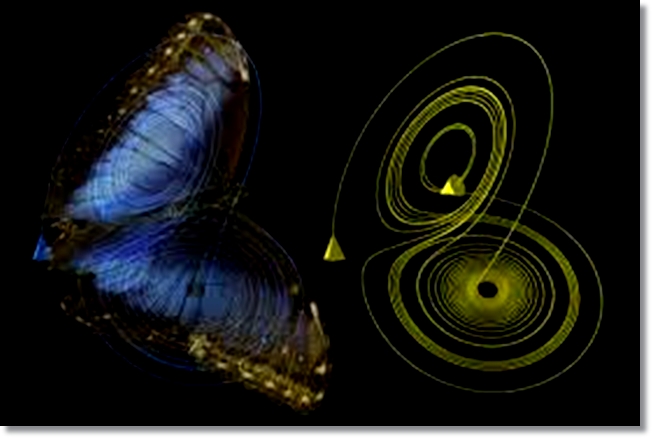
This effect grants the power to cause a tsunami in Japan to a butterfly flapping its wings in New Mexico. It may take a very long time, but there's a real connection.

If the butterfly had not flapped its wings at just the right point in space/time, the tsunami would not have happened.
And if you've ever done any land navigation the old fashioned way (no GPS allowed) during some recreational hiking - or military infiltrations over land, you fully understand how not adjusting for magnetic declination in the beginning can land you in Timbuktu!

Chaos Theory's "hypersensitivity to initial conditions" constantly comes into play in all aspects of our everyday lives.
This was VERY SELF-EVIDENT during my military career...

I wasn't the most gifted sniper.
To be honest, I was pretty lame.
(And no, I didn't name my rifle and caress it at night.)

Anyway, I often failed to DOPE my Scope right. I didn't always slow my breathing or shoot in between heartbeats either.
Results?
Well...let's just say there was Hell to pay in the form of "corrective physical training" for me, much ribbing by my buddies later - and many rounds of beers courtesy of yours truly!

Blockchain Hashes

What is a hash function?Simply stated, a hash function takes some input data and creates some output data.To expand on this concept, a hash function takes an input of any length and creates an output of fixed length.
SourceThe Blockchain Hash is crucial for all cryptocurrencies.
In the bitcoin protocol, hash functions are part of the block hashing algorithm which is used to write new transactions into the blockchain through the mining process.
Source

The Blockchain Hash - Same Effect
Similar to the Butterfly Effect in Chaos Theory, any small change in the initial input to a Hash will yield drastically different results.
For example, say we input the a string "This is a test", then enter the same string with only one upper/lower case difference:

That's some difference!
Transaction Malleability
What is Transaction Malleability?
A transaction identifier, called a transaction hash, is something like a fingerprint and is unique. Unlike a fingerprint, the transaction ID changes if the transaction it represents changes in any way.Because the transaction identifier takes into account everything in the transaction, the transaction identifier changes if the digital signature changes.Note: These subtle changes can happen only before a transaction is put into a block. Once a transaction is added to the blockchain, the transaction, including the signature becomes immutable.The mutability of the signature can be problematic because someone can take a transaction and modify the signature slightly and make the transaction identifier change.This would be the equivalent of replacing the signature on a check.
Source
Bitcoin Transaction Malleability - The MtGox Debacle

In Bitcoin, transaction malleability describes the fact that the signatures that prove the ownership of bitcoins being transferred in a transaction do not provide any integrity guarantee for the signatures themselves.
This allows an attacker to mount a malleability attack in which it intercepts, modifies, and rebroadcasts a transaction, causing the transaction issuer to believe that the original transaction was not confirmed.
In February 2014 MtGox, once the largest Bitcoin exchange, closed and filed for bankruptcy claiming that attackers used malleability attacks to drain its accounts.
Source
Since the Transaction Malleability weakness was known well beforehand, many experts attribute the Fall of MtGox to the incompetence of CEO Mark Karpelès, also sometimes known by his online alias MagicalTux.

Conclusion and Questions
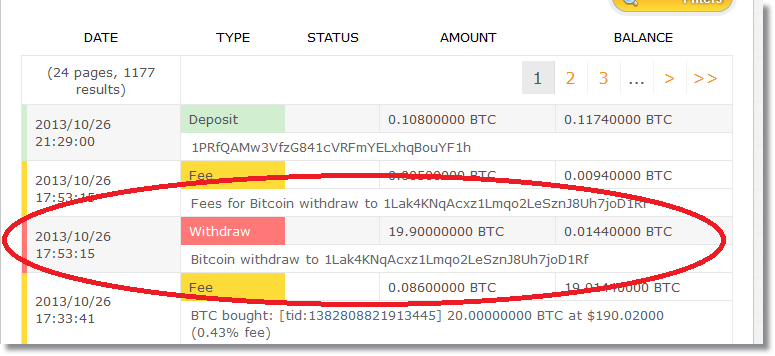
Instead of having the largest Bitcoin Exchange in the world processing billions of transactions securely, the unchecked "fluttering" of bogus Transaction Hashes changed the beginning of many transaction histories and resulted in the downfall of MtGox!
What would have happened if the CEO was on his toes and fixed the malleability vulnerability before the millions of dollars worth of Bicoin were stolen?
And what would Bitcoin be worth today if the bankruptcy of MtGox was prevented?
I would love to hear your views on this.
Parting Shots
 Source (Base Source)
 Source (Base Source)
By JaiChai
Thanks for stopping by.

About the Author
Believing that school was too boring, he dropped out of High School early; only to earn an AA, BS and MBA in less than 4 years much later in life – while working full-time as a Navy/Marine Corps Medic.In spite of a fear of heights and deep water, he performed high altitude, free-fall parachute jumps and hazardous diving ops in deep, open ocean water.After 24 years of active duty, he retired in Asia.Since then, he's been a full-time, single papa and actively pursuing his varied passions (Writing, Disruptive Technology, Computer Science and Cryptocurrency - plus more hobbies too boring or bizarre for most folk).He lives on an island paradise with his teenage daughter, longtime girlfriend and three dogs.