Let's not talk about "buying crypto at the top."
Because your brain doesn't only get rushed in markets'
it get rushed in life.
You're late for work, you see what like a shortcut,
you take it ... and it becomes the slowest road you could have chosen.
You're viewing a property, and the agents says "only two units left"
and "price increase tonight". Suddenly your chest feels tight,
your thinking becomes narrow, and your finger is already signing before logic arrives.
Most bad decision don't happen because we're stupid.
They happen because we're rushed.
And when you're rushed, your brain doesn't aim for the best decision.
It aims for the fastest relief.
Don't blame your brain. This is not a defect, it's a defense system.
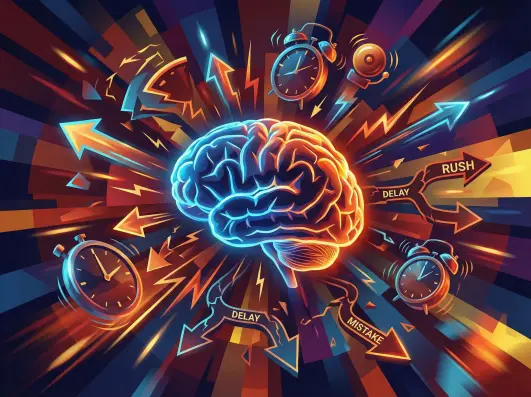
When brain detects threat, it prioritizes speed.
It shifts into survival mode, reduce options / reduce doubt / increase action / chase certainty.
Urgency feels like truth. That's the trap.
And the "threat" doesn't need to be a tiger. It can be,
- Time Pressure ( I'm going to be late )
- Social Pressure ( Everyone already knows this deal )
- Scarcity ( limited units left )
- Status Pressure ( If I miss this, I'll regret it )
This is why the most dangerous word in decision-making is not "crypto". It's Now.
If rushing to work, you're already under time pressure.
Your brain looks for any path that promises relief.
You mistake "shorter" for "faster", because speed becomes the goal, not accuracy.
If buying property, the agent's words are not only information, they are framing. "Limited units" is designed to make waiting feel like loss. Your brain doesn't want to lose, so it chooses quickly.
If new trends (yes, crypto too), sometimes news hits like a siren.
You see headlines, tweets, influencers, hype. Like the old wave when Elon Musk talked about Dogecoin. Should you follow the trend? Or just watch the show?
The answer is yes and no, depending on your intention.
If your intention is learning, you observe patterns.
If your intention is profit but your method is emotion, you're not investing. You're being pulled.
- That's why experienced investing teaches things like,
Stop-loss (where you exit if you're wrong) - Take-profit (where you lock gains instead of dreaming forever)
Not because they're negative".
Because your brain under pressure needs rules, or it will default to impulse.
Can you make good decision while rushed? Yes.
But only under one condition, the pattern is familiar.
If the routine is the same and the outcome is predictable,
your brain can act fast with fewer mistakes.
That's why skilled drivers can react quickly.
That's why trained professionals can respond under pressure.
But for new decisions (money, relationships, business, big purchases), rushing is expensive. Novel situations require thinking space.
When it's familiar, speed can work.
When it's new, speed is usually a trap.
Emotion can make you worse or better
(It depend who is driving)
Emotion is not your enemy.
Emotion is information, but it's not always accurate information.
it's often a signal about urgency, fear, or desire.
One simple way to regain control is labeling,
This is urgency.
This is pressure.
This is excitement.
This feeling is happening inside me, but it is not me.
That one sentence creates separation and separation creates choices.
Can we remove emotion?
Yes and it's not recommended.
Emotion is part of the mechanism that protects you. Imagine facing danger and feeling excited. That's not wisdom, that's malfunction.
The goal is not to delete emotion.
The goal is to stop emotion from being the decision maker.
Because when emotion becomes the driver in crypto purchases,
it's not investing. It's gambling with better marketing.
When you notice an amotion like excitement or panic, ask:
- What happened right before this feeling?
- What did I see or hear?
- What words triggered it?
- What picture is in my mind?
- What outcomes am I afraid of missing?
The more detail you ask, the more understand your internal system.
Why does that matter?
Because once you understand how emotion forms, you can check whether your decision is built on, facts or feelings dressed as facts.
With repeated practice, your brain become less sensitive to the same old triggers. You build a new link, fact checking becomes automatic, even under pressure.
That's real mental training.
Embrace your emotion.
But be suspicious of it when you're about to decide.
Urgency is useful for survival.
But it's dangerous when it becomes your strategy.
(Educational content only, not financial advice.)
Next post: How Investing Habits Leak into Daily Life