
Greetings Publish0x community, today I want to introduce you to the $TRIAS ecosystem, and its one of the newest platforms focusing mainly on launch new products, Triathon. Trias is an ecosystem where you can easily find decentralized infrastructures that are needed to grow your audience in the crypto world. It focuses to transfer the governing power from centralized infrastructure owners to the community, itself. On the other hand, while you can address the future of the ecosystem through DAO, specifically Trias DAO, Triathon lets you build, test, and audit your product without any need for third-party implementations. By doing so, Triathon lets investors protect the funds from fraud while they've got the right to test the product before both the launch and investment phases.
In this article, I'll cover the main features of Trias firstly, then I'll try to visualize the Triathon platform in your mind. Now, let's start with the basic knowledge about what Trias is...
What's TRIAS, briefly?
Trias is not a direct name by itself, it's an abbreviation. If you do some research, you'll face with ''Trustworthy and Reliable Intelligent Autonomous Systems'' pattern. As you may think from the expanded view of Trias, it's focused on building systems, infrastructures, and projects that will affect people's life directly by re-organizing the underlying nature of currently in-use products. For example, we're using Amazon or Apple-like products every single minute. But we must accept their user agreement forms, website cookies, or any provision that is dictated to us. Otherwise, access will not be granted. In such a world, Trias developers aim to change the strict rules by transferring the data infrastructure on blockchain technology.
Please don't think that Trias is a standard project launched previously on the Ethereum network. Because Trias is not as simple as 1 project launched on any chain. The Trias idea covers a generalized public chain including the developers, testers, investors, and many more. The founders of Trias are on the way to make Trias an all-platform-supported new-gen public chain system. And they have already expressed their thoughts about it in these words...
Trias is one of the most ambitious blockchain projects that has raised funds in 2018. The project aims to solve a few of the most daunting problems faced by blockchains such as Trusted systems, Scalability and Security. As we get into the technical details about Trias and how it works, we encounter some of the most brilliantly thought concepts.
As you can understand from the sentence above, Trias is not a new application in the crypto ecosystem. They worked hard for more than 3 years to launch Trias in its best form. There are 4 main developers and/or founders behind the project so far. They are RUAN, Anbang (Founder & CEO), WEI Ming, (Co-Founder & CTO), BIAN Kailing, (Co-Founder & CSO), and CHEN Xuming, (Chief Product Officer). They are both skilled and experienced people in IT services, infrastructures, service securities, and many more specialty areas. You can find detailed information about the team's background in the Trias WhitePaper, here.
What's The Scheme of TRIAS?
As I've explained to you previously, one of the most challenging problems in today's world is centralized applications. This is a natural result of dependence on one, single person, and/or one, single manufacturer at a certain level. By doing so, people don't have any other choice to obey the rules established by the owner to use the application. To overcome such a centralized point, Trias has developed three main constituents: the Leviatom, the Prometh, and the MagCarta. I'm hundred percent sure that you are familiar with at least one of the constituents above. And they are not different from their nicknames. Now, keep reading to understand the three main constituents of Trias before we start our journey into the Triathon world.
1. The Leviatom
Instead of layering consensus acceleration techniques above the consensus layer, such as the Layer 1 or Layer 2 improvements, Leviatom targets the performance issues by digging 1 layer “below” the consensus layer: a Layer -1 enhancement. Layer -1 focuses on constructing trust relationships among the voting nodes. Its main goal is to identify the set of nodes who possess the greatest difficulties to “tell a lie”, i.e. the difficulties to execute unexpected programs without being identified.
Leviatom solves this issue by introducing the transitive trust relationship. Transitive trust allows one node to deduce the trustworthiness of a remote node without initiating direct remote attestations: as long as there exists an iterative attestation path to the target node. Therefore, in a network of partially mutual attesting nodes, as long as a node has the largest number of attestation paths led to it, it is regarded the hardest one to “tell a lie”.
2. The Prometh
Prometh solves the software security issues by firstly recording the critical information (or its undeniable identification) of all the critical steps of a software’s full life-cycle on a distributed ledger. It then encourages a community to iteratively evaluate whether each step is correctly executed. Security verification methods will also be enforced on the artifacts produced by each procedure, such as the source codes, object files, binary files, package files, etc. These methods will iteratively dig the security and functional implications from the artifacts, generating a clearer profile for a target application. The following figure depicts the general procedures.

3. The MagCarta
MagCarta is a Turing Complete smart contract description language. MagCarta schedules and coordinates Prometh applications on the Leviatom network. MagCarta distributes rewards to programs, computations, and data providers. Each MagCarta smart contract is defined by a set of declarations, which specifies the compute, programs, and data that will be referenced by the smart contract codes. Transactions are also defined to represent the input data for the contract.
(The descriptions above are directly taken from the Trias WhitePaper to let you understand the basic working scheme of the Trias project. If you want to know the details about it, please head over to the relevant page. Now, we're all ready to further continue with our main object, TRIATHON. Keep reading...)
What's TRIATHON, briefly?
Triathon is the latest product of Trias Labs which mainly focuses on bringing the developers, testers, auditors, and any other required people and/or institutions to one place. By doing so, anyone has the right to launch the project as well as letting the other members test and provide feedback while the ongoing project gets audited at the same time. They call Triathon ''the alchemist and launcher for blockchain''. Also, Triathon provides a marketplace for developers to collect funds and build new DApps.
Triathon is built on Trias's computing technology. By implementing the infrastructure and the virtual world, one of the main aspects of Triathon appears as being a well-known Metaverse for any kind of user from any network. Nowadays, you should use the Binance Smart Chain network to reach the Triathon Metaverse but I'm sure it won't be limited to 1 chain in near future.
Triathon prioritizes 6 different aspects while you're building a DApp. They are security, scalability, decentralization degree, storage efficiency, processing capacity, and adaptability. All of them are important features for users to have a look at before using them. And developing the underlying application with the help of the community itself, everyone can add and/or remove any unnecessary blocks. When we come to the end, testers take place and share the experiences with you as well as they will help you by tweeting and posting. So, the app will become well-known even before launch, in the testing area. In Triathon, users test projects, play games, and earn financial rewards in different ways, including but not limited to:
- participating in testing to win rewards,
- competing in 1v1 test battles to win rewards,
- using NFTs to increase expected rewards,
- trading NFTs for price differences,
- creating new NFTs and selling in the market,
- collecting and auctioning rare and special NFTs,
- sharing the revenue stream of Triathon via staking,
- trading Tokens for price differences,
- investing in the launchpad for a certain project.
As the team highlighted in the tweet above, the word Metaverse has first introduced to our lives in 1992. With reference to that, many builders completed their applications or still continue to build. At the same time, Triathon has announced its Metaverse version of the project under the name of TRIATHON METAVERSE. It's in the early stages of development of course but you can still play games, use NFTs thanks to the decentralized community-driven testing infrastructure of Trias Labs.
The Components of Triathon
Similar to Trias itself, Triathon is composed of multiple features. If we want to sort them, they are Triathon Forge, Triathon Marketplace, Triathon Farm, and the Triathon Battleground. In brief; Triathon Forge lets users mint NFTs according to their wishes. You must only name the NFT and express your feelings about it. Then click the mint button, and it's over.
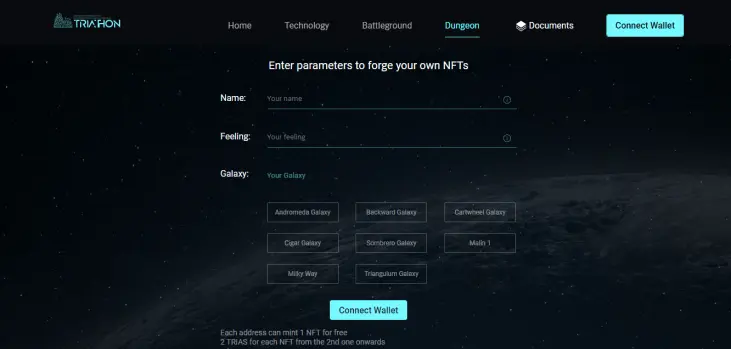
And the Triathon Marketplace. I'm sure you know the NFT Marketplace well. This is a decentralized platform where the creators can display their NFTs and the buyers can offer. For the Triathon Farm, it's too new for me. It's said that you can stake your NFTs to receive rewards within the platform, but I've no experience on that topic. So, I'm excited to see it.
From its launch on the 10th of July, 2021, the Triathon Battleground has improvised itself many. Now it's a platform that 3 different battle systems exist. They are Daemon, Delusionist, and Destroyer, respectively. Please check the relevant page to know more about the Triathon Metaverse. To start with the Triathon, you should have a BSC wallet, some BNB for transaction fees, and the TRIAS token for the platform itself. Up to now, over 3000 NFTs have been minted from 1500 different wallet addresses. Check the latest report about Triathon Metaverse here.
As you can understand from the sentence above, $TRIAS is the native token launched on Binance Smart Chain 6 months ago. The supply cap is 10,000,000 units of $TRIAS at the moment and it's available to trade on both Kucoin and PancakeSwap.
Don't forget to follow the official Twitter account of Trias Lab, join the Discord server and be a subscriber of the Medium page.
*This article is created to spread the awareness of Trias & Triathon and its features by utilizing my own experiences, Trias Medium Blog, and the Trias Whitepaper. None of the words above contain any kind of investment advice! Please DYOR (Do Your Research) before investing.
**If you are interested in writing articles about ANYTHING on Publish0x, you can follow this link.





