
Greetings Publish0x community, today I want to write about Notional Finance and the protocol's latest announced feature, Leveraged Vaults. In this post, I'll briefly introduce the Notinal protocol and its components, then cover how to maximize crypto gains using a DeFi protocol by lending and borrowing in the same transaction. So, let's start with the basics...
What's Notional Finance?
Notional is a lending & borrowing platform. It lets anyone borrow supported crypto assets in a ''fixed-rate'', ''fixed-term'' model. In traditional markets, government bonds are issued with previously decided coupon rates and maturity dates. And those numbers are not subject to change in the future. So, they have the same coupon rate which means a fixed-rate, and unchanged maturity date which means a fixed term. Governments sell bonds to banks and/or investment firms to take some $$$ in return. Notional's main goal is to implement this method with the unique features of the decentralized finance sector. They offer non-variable interest rates to major crypto assets such as USDC and ETH. So, they aim to be different than simple staking platforms.
Notional is the #1 Ethereum-based protocol for borrowing and lending at fixed rates and fixed terms. With more than $650M in total fixed rate lending volume, Notional is now a top 10 lending protocol providing core DeFi infrastructure.
In regular lending & borrowing platforms, users see a staking option with the APY associated with the relevant asset. On the other hand, if a user seeks to borrow some tokens in exchange for collateral, the borrowing rate is listed aside. Notional Finance makes it one step further and introduces us to two-optioned earning methods. In the first method, you can earn up to 6% through a simple lending method. And on the second option, you can lend, borrow, and invest assets in one transaction to receive up to 12% APY. (Rate is subject to change according to the date you join the leveraged vault but not after you invested.)

(Image taken from Pixabay)
As you can see from the image above, bonds are issued at fixed maturation times between 3 months to 30 years. Coupon rates are also subject to change according to the maturation date. Now let's see how Notional implemented these functions into the crypto sector:
Coupon rates are fixed APY rates on Notional. The maturity date of treasury bonds are due date on Notional, that day points out the time when your last coupon will be paid and the initial investment will be free to re-invest. Bonds are symbolized with ERC-20 tokens named 'fCash'. For example, a 3-month treasury bond issued today and maturing 03/09/2023 with a 12% coupon is reflected in an on-chain mechanism like this: If I'm the lender, I receive 1003 March 9th fUSDC and the borrower lose the same amount of tokens. On the maturity date, every single fUSDC turns into USDC. So, the lender gets his/her initial investment plus a 3% coupon.
Until that paragraph, everything is the same with the basic staking platforms. Here comes the feature that makes Notional unique: The Leveraged Vaults. Let's find out the details...
Leveraged Vaults, Explained...
Leveraged Vaults are designed for optimal capital efficacy. Those are smart contracts that let anyone deposit some amount of capital, borrow from the liquidity pool, the re-deploy all the assets together into the smart contract I mentioned in the previous sentence. By default, the maximum leverage is 10X. It means that the deployed amount can't exceed your initial capital more than 10 times.
For example, if a user lends 1000$ for 6% APY, borrows 4000$ for a 4% rate, then redeploys 5000$ into the vault for 12% APY, the total annual yield would be 440$ (excluding all swap and transaction costs.). The total gain is 600$ from 5000$ deployed with 12% APY and the 160$ loss comes from interest payments. 440$ annualized gain for only 1000$ makes it 44% APY. Now, you understand why they call it 'leveraged'. It's almost 8 times more efficient than the fixed staking option.
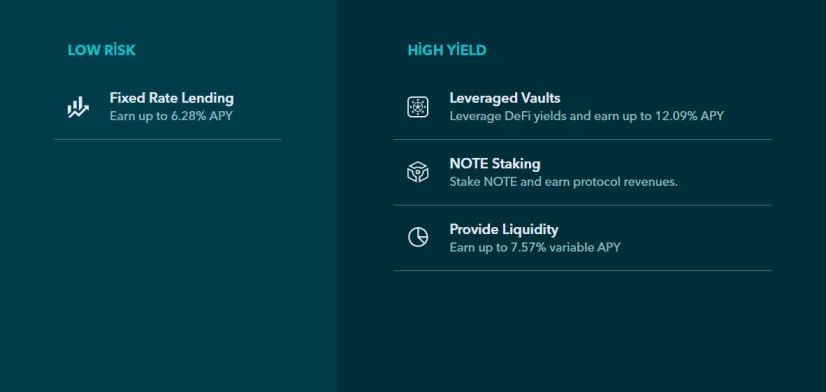
The picture above is taken from the Notional website. They are not the same as my example above I said that APY ratios are subject to change. For example, ETH yields are below 6%: 5.98% at the time of writing. Like other options, borrow rates are not the same. The 3-monthly USDC borrow rate is 2.2% while the 9-monthly rate is above 4%.
There are pros and cons to selecting leveraged vaults for the choice of investment, of course. From a lender's perspective, higher APY attracts more people to join the vault or use the Notional protocol. This will create bigger protocol fees which will be redirected to stakers & vault lenders. On the other hand, an increased borrow rate for the vault assets ($ETH specifically) will reduce the borrowing amount of ETH but increase the number of other tokens borrowed and swapped through the platform. For the protocol itself, higher protocol revenue coming from swap & transaction fees will stabilize it even further. So, the need for liquidity mining or similar incentives decreases. It also protects the value of the $NOTE governance token, too. Lastly, the leveraged vault covering Balancer ETH/wstETH LP will create more fees for the LP token holders. So, the vault is helpful for even non-member crypto believers.
Leveraged Vaults are in BETA right now and can be accessed here. The Notional core team has organized an AMA event on the 22nd of November, 2022 to increase awareness on Twitter. Kyle and Teddy had about a 45-minute long stream. If you have some questions, please check the video below:
Are you wondering about the real APY rates of previous leveraged vault users? As some of you know, Notional publishes a monthly recap article on its blog. On the last one, they cited a tweet that demonstrated the actual APYs of different addresses. We learned that the biggest APY for the latest leveraged vault is 46.27% (similar to my example above) while the average APY is around 32%. Even the lowest one is 19.5% while fixed ETH lending is about 6%.
How to Join The Leveraged Vaults?
There is a limit to joining the leveraged vaults. The minimum amount to enter the vault is 15 $ETH, right now. And the upper limit is 100 ETH per address. On the other hand, the vault has its own capacity. The capacity for the active vault was 2500 ETH but it's increased to 4000 ETH lately. The capacity also affects the APY rates. The highest one is above 45% but a current ETH depositor is subject to 12% APY after the capacity increase. It was 16% 2 days ago when Teddy from the Notional team announced the capacity increase.
To join leveraged vaults and receive higher rewards, you should have a browser extension wallet and at least 15 ETH (plus some ETH for the transaction fees). Nothing is needed more! Don't worry about paying more than one transaction cost. You should only pay once for the vault. It's again a benefit for users to save ETH.
If you're interested and want to be one of the earliest users of the leveraged vaults, please head to the Notional Beta Vaults page. You can change the maximal APY by editing the leverage count. Please be aware of the general risks of using crypto assets and DeFi, and also the risks of using the smart contracts associated with Notional and its products. Never invest with prior research. Always DYOR!
*This article is created to spread awareness of Notional Finance and its features by utilizing my own experiences. None of the words above contain any kind of investment advice! Please DYOR (Do Your Research) before investing.
**If you are interested in writing articles about ANYTHING on Publish0x, you can follow this link.






