
Greetings Publish0x community, today I want to write about Polynomial Trade, an on-chain trading platform built for Optimism users that rewards every single penny which is deducted from user accounts in the form of trading costs. In this post, you'll be able to learn how Polynomial works basically and what are the unique features of Polynomial and how to utilize them. Lastly, I'll cover the latest rewarding system co-created by Optimism and Polynomial members which let users retake the trading fee in the form of $OP tokens. So, let's start with the basics...
What's Polynomial Trade and How to Use It, briefly?
Polynomial Trade is an on-chain perpetual swap exchange built on a Layer-2 ecosystem, Optimism, and powered by Synthetix & Pyth Network. If you count the testnet process, it's operational for more than 18 months in the cryptosphere. There are multiple unique features belonging to Polynomial but today I want to talk about the Perpetual Swaps, OP Season, and how you can benefit by transferring your funds to on-chain trading protocols.
We are building in decentralized finance – a more fair, accessible, efficient, and transparent financial system enabled by crypto.
We started in HackMoney 2021 by ETHGlobal with the radical idea that anyone, anywhere, should be able to easily and securely buy on-chain derivatives.
There are two main sectors under the 'Derivatives' tab when you want to trade. These are 'Perpetuals' and 'Options'. Options trading is available on many CEXs & DEXs and it allows to you bet on the underlying asset's future price at a previous settlement date. In such trading, if you think the underlying asset will go upwards, you buy 'Call' option contracts, or vice-versa, you'll buy 'Put' contracts. According to the price of the underlying asset, you'll be a gainer & loser. In perpetual swap trading, you don't need to wait for a specified settlement date to realize Profits and/or Loses. As its name indicates, Perpetual swaps let you trade in both ways & realize the PnL before waiting for the date. So, Polynomial is a kind of trading protocol that fits the second one. It allows you to trade in favor and/or against the price actions. There are 18 different crypto assets that can you can long or short, some of them include BTC, ETH, OP, SOL, APE, and even DOGE!
Polynomial Trade allows anyone to leverage up to 25x in listed markets. It has a soft and easy-to-use UI on the trading section. Putting market trades is set by default in Polynomial but it can be changed easily through the UI (by setting the order choice from Standart Order to Limit Order). By using the Standart Order mode, people will be asked to select how many contracts he/she wants to trade or how many sUSDs to put as collateral before opening the position. By completing the whole steps I mentioned, you're ready to open the first position. Such easy, cheap, and even paying for trading on Polynomial. Please check the trading guide on Polynomail before using it!
Up to now, you may think everything is as same as what is in the CEX platforms. Polynomial is built on Layer-2 chain Optimism and there is an ongoing OP Season, right now. OP Season is an era that OP community shares some parts of their native token, $OP, to several protocols to accelerate mass adoption. The portion for perpetual swaps of OP Season is being directed to Polynomial and Kwenta exchanges. According to the official blog post published by the Synthetix team, the $OP reward for trading is active starting from the 19th of April, 2023. Rewards started at 10,000 $OP per week and now it increased to 300,000 $OP tokens per week. It's expected to end in 16 weeks from now. So, don't feel upset! You've still time to trade and earn on Polynomial.
How to Utilize Polynomial Protocol as A Trader?
There are multiple reasons to use Polynomial Trade. It has low trading fees (compensated through $OP), allows you to put Limit Orders, uses Smart Wallets functions, and many more. But for some of us, those features couldn't be enough to start on-chain trading. So, what offers Polynomial? In such a point, the team behind Polynomial works to implement 'Power Perpetuals'. Power Perp functionality lets you trade for perpetual contracts but it works in a bit different way. For example, 3X leveraged ETH-PERP trading gives you triple times ETH exposure of spot trading. But if you choose to trade for ETH^2 PERP, your ETH exposure will be 16X rather than just 4. The main principle behind Power Perpetuals has already been explained in an article in August 2021. Please check the relevant article here to understand more.
In the article mentioned above, it's stated that there are multiple power options for multiple underlying assets. For example, if you want to use ETH^3 PERP rather than ETH^2, your gain will be 8X rather than 4X in a condition where ETH doubles its value. In theory, it looks even greater than using leverage only. But to make it happen, there is a price to be paid. Traders assume that fee is something similar to a 'funding fee'. It's called 'premium yield'. It's calculated via some complex math which is outlined in the article I mentioned above. Here is an example:
Consider the ETH^2 power perpetual.
Assume for the sake of simplicity that ETH is trading at $3, and that the ETH^2 power perpetual is trading at $9.09 at the time funding is paid. Then the longs would have to pay the shorts $(MARK-INDEX) = $(MARK-ETH^2) = $(9.09 - 3^2) = $9.09 - $9.00 = $0.09 per contract.
By using power perpetual, traders get a chance to make money faster. It's more similar to options trading than leveraged trading, so I highly recommend fully understanding what you're trading before taking action. Soon, you'll be able to trade power perps on the Optimism chain! Don't forget to follow the official Polynomial Trade Twitter account.
I want to mention that there was an example of Power Perpetuals on the Solana chain before 2023 as I can remember. You can trade both perpetual and power perps using USDC on the Solana chain through the 01.xyz exchange. It let me trade both 2X leverage on $SOL and SOL^2 POWER PERPs at that time. After the 12th of November, 2022 01.xyz has never gone active again. Polynomial has more to come and I believe they're building on stronger ground to be protected against such volatile times that may affect the Ethereum price for the mainnet or the Optimism price for the network.
What're the Current Advantages of Using Polynomial Rather Than Other Exchanges?
Apart from talking about the future of Polynomial, let's talk about the current advantages of using Polynomial. The list I prepared constitutes some but not all of Polynomial's features:
- Fast and Cheaper Transactions: As I mentioned previously, Polynomial has built on Layer 2 Optimism chain. So, it's clear that transaction fees are not as high as you pay on the Mainnet Ethereum. Also, the Optimism network is less congested compared to Ethereum Mainnet. It means your transaction will be approved in the lower time frame. By allowing so, you are protected from price differentiation during volatile market conditions.
- Decentralized Oracles: Polynomial utilizes Pyth Network as price oracles. They use off-chain oracled from Pyht so it's available to trade for 5-10 bps trading fees. This ratio is similar and even lower for most centralized exchange derivative trading parts.
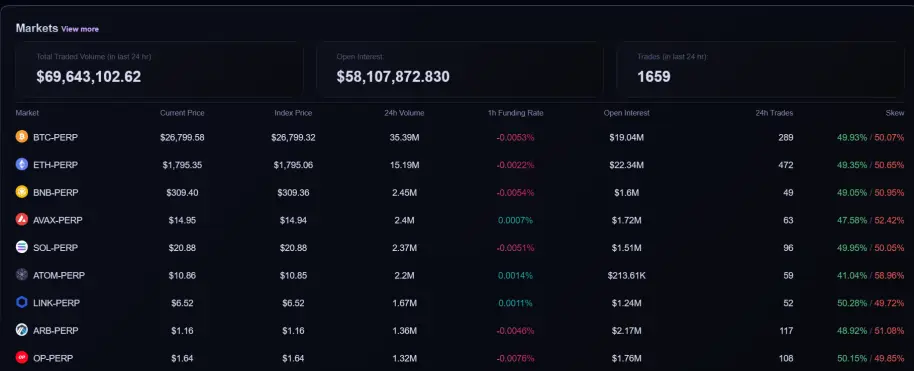
- High Liquidity: As you can see from the picture above, there is nearly $60m Open Interest on the Polynomial Protocol now. After the inception of Power Perpetuals, Delta-Hedged AMM is expected to be implemented in Polynomial. This AMM will offer tighter spreads, lower funding rates, and consolidate market liquidity into a single instrument, making it a robust portfolio management and diversification tool.
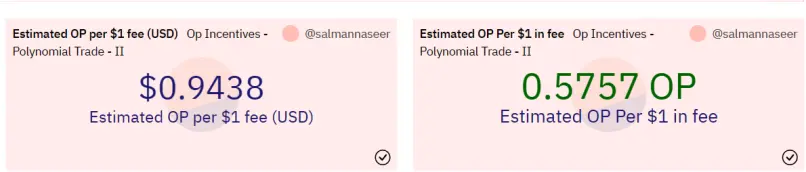
- 0,06$ fee instead of 1$ fee: During OP-Season, your trading fees are compensated through $OP token distribution because you're trading on Optimism. That's great! For now, 94% of every dollar paid as a trading fee on Polynomial will become rewards in the form of $OP tokens. If your trade is executed on the protocol, your reward is ready! If you want to see live statistics about Polynomial, check the Dune Analytics dashboard created by @salmannaseer, here.
- Smart Wallets: All accounts created to trade on Polynomial is a smart contracts. By doing so, Polynomial offers a secure and intuitive experience. Those wallets batch and automates the underlying transactions without compromising security. You can imagine the smart wallets as CEX deposit addresses that never close for withdrawals during volatile market conditions. It lets you deposit sUSD tokens for trading from both Optimism and Mainnet Ethereum. If you've other crypto assets different than sUSD, you're able to swap them into sUSD in the Polynomial Swap section. Please check the guide created on Polynomial Docs for a better understanding.
To be updated, don't forget to follow the official Polynomial Trade Twitter account and join the Discord server. All of the resources I used to create this content are listed below in the 'Resources' section.
*This article is created to spread awareness of Polynomial Trade and its features by utilizing my own experiences. None of the words above contain any kind of investment advice! Please DYOR (Do Your Research) before investing.
**If you are interested in writing articles about ANYTHING on Publish0x, you can follow this link.





