
Read now to hear my thoughts on a popular Bitcoin book that discusses the split that led to Bitcoin Cash breaking off from Bitcoin.
I recently finished reading “The Blocksize War” and, given its intersection with my long-time fascination with the self-sovereignty offered by Bitcoin, I felt like sharing a few of the perspectives I gleaned from the book.
The Blocksize War
For those who are unfamiliar with it, The Blocksize War was written by Jonathan Bier, a long-time participant in the space. The book covers a relatively contentious time for the Bitcoin community, when various factions lobbied for or against proposals to increase Bitcoin’s block size. A number of hard forks of Bitcoin failed before launch, but eventually the conflict did result in the creation of a copycat version of Bitcoin called “Bitcoin Cash”, an event we’ve spoken about previously.
The book covers quite a number of different developments and perspectives that came out of the community’s back and forth, as Jonathan appears to have participated in many of the major conferences held to debate the various positions and had conversations with many influential people among developer, miner, corporate, and other groups on both sides of the conflict.
I won’t cover the nitty gritty details here, as that would seem a bit too book-reportish for my tastes. I do, however, wish to address a pair of the themes that, in my opinion, dominated Jonathan’s recounting of the events that happened during the Blocksize War:
Lend An Ear…Or Don’t
Bitcoin is a melting pot of ideas. As we all know, Satoshi Nakamoto, Bitcoin’s pseudonymous creator, had certain ideas about what Bitcoin could or should be. Of course, as the network launched and brought in an ever-expanding cast of users, even Satoshi’s opinions and expectations may have morphed, at least up until the time Satoshi disappeared from the community.
Each new member of the community has brought their own ideas about how they’d like to build and use Bitcoin. There’s nothing wrong with that. In fact, one of the most poetic aspects of Bitcoin is the reality that the responsibility to decide what Bitcoin is rests on the shoulders of every user. There are no leaders who can force their version of Bitcoin onto the rest of us.
Everyone has their own ideas, and everyone thinks their own ideas are better than everyone else’s. That sentiment certainly seems to have been present during the Blocksize War, so much so that both sides of the conflict may have tuned each other out more than they should have. The lack of open dialogue led to a lot of miscommunication and, eventually, to the division of the community itself.
If I learned one thing from my reading of The Blocksize War, it’s that perhaps our community can grow even stronger and more quickly if we take the time to patiently hear one another out, rather than just assuming right off the bat that we’re right.
Self-Sovereignty Is A Right Worth Fighting For
My comment about patient listening shouldn’t be taken to mean that every idea is good or even worth exploring though. Let’s be clear on that. There are bad ideas, and that’s why it’s so important that the entire community of Bitcoin users be able to create the future of the blockchain, rather than just one individual or group.
In the end, that’s what the Blocksize War was all about. A large group of miners, exchanges, and others wanted to prioritize their short-term profitability over the long-term decentralization of the Bitcoin blockchain. They fought tooth and nail, spending tens of millions of dollars to try to force their view of the blockchain onto everyone else. But they failed, because everyday users were in control and had their own plans for Bitcoin.
That’s what sets Bitcoin apart from every other money or currency in the world. It’s the only monetary network where no one's vote matters more than anyone else’s. A place where everyone is free to decide how they’ll participate, or even if they’ll participate at all.
Our world needs that level of freedom.
Scams.
Rugpulls.
Shady companies that will take away your hard-earned money the first chance they get.
That’s what most content creators in the Bitcoin and Crypto spaces offer their communities in exchange for the *free* content they promote in newsletters, on talk shows, on social media, and anywhere else they can peddle their wares.
YOU DESERVE BETTER.
You deserve quality Bitcoin education that isn’t driven by a need to sell you something that will leave you worse off. You deserve thoughtful analyses of Bitcoin basics and current events that leave out the biases that permeate affiliate-driven content platforms. You deserve a community that puts you first, no matter what.
We’ve built the HiFi Bitcoin community together as a place where quality Bitcoin education comes without any hidden agenda. A place where you come first, always.
If you believe that Bitcoin education should be available to everyone without bias and without ulterior motives, I ask you to please consider supporting me and the work I’m doing for the Bitcoin community through a premium membership. Every contribution increases my ability to cut through the noise and find the truth about Bitcoin with you.
A Special Bonus For Premium Members
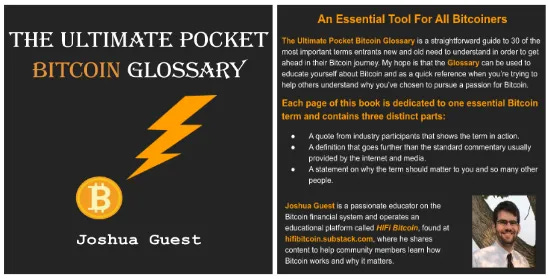
In my new book, The Ultimate Pocket Bitcoin Glossary, I walk you through 30 of the most important terms you need to understand in order to get ahead in your Bitcoin journey. My hope is that it can be used to educate yourself about Bitcoin and as a quick reference when you’re trying to help others understand why you’ve chosen to purse a passion for Bitcoin.
Ready to read it yourself?
Premium subscribers of The HiFi Bitcoin Letters receive access to The Ultimate Pocket Bitcoin Glossary at no extra charge:
Free subscribers and non-subscribers can purchase The Ultimate Pocket Bitcoin Glossary, without the commitment of subscribership, in the HiFi Bitcoin Shop, as a PDF:
Wish You Could Easily Take The Podcast With You?
Can’t Get Enough Bitcoin In Your Life? Follow Me On Social Media:

🙋🏽♂️Did You Enjoy This Edition Of The HiFi Bitcoin Letters?
This 3-question survey is your chance to tell me how I can improve the newsletter for you.
This is not financial or business advice. This newsletter and related content are for informational purposes only. Cryptocurrencies and digital assets can be risky. Always do your own research before making any sort of investment.






