
Read now to learn how Bitcoin is designed to mitigate some of the supposed risks posed by mining pools.
Mining is easily one of the most visible aspects of the Bitcoin ecosystem. The blockchain cannot survive without people willing to trade computing power and electricity to process Bitcoin transactions. Mining is constantly attacked for the amount of energy it uses. And commentators in the news and on social media often share opinions about the latest developments within mining companies and mining pools.
Given the frequent public dialogue about Bitcoin mining, one would think that the process would be rather well understood. For that reason, it’s surprising to see how many people fall for some pretty wild misconceptions about Bitcoin mining. I hope to debunk a pair of the more prominent misunderstandings today:
Misconception #1: Solo Mining Is Impossible
In the early days of the Bitcoin blockchain, mining “profitably” could easily be carried out by personal computers. People quickly realized however that using more powerful computers increased a miner’s chances of confirming a block of transactions and winning the block reward. Manufacturers raced to produce powerful Bitcoin mining machines, giving birth to the ASIC miners of the present day.
Nowadays, the Bitcoin blockchain is protected by hundreds of thousands of ASIC miners, making Bitcoin perhaps the strongest computer network in the world. Each of those ASICs constantly attempts to mine Bitcoin blocks, but only one machine can successfully mine each block, or, in other words, have their block confirmed by the rest of the network.
The fact that only one out of hundreds of thousands of Bitcoin miners can successfully mine a block has powerful implications for Bitcoin miners, especially those who only have a handful of ASICs or less. After all, most people mine on the Bitcoin blockchain in order to earn more in income than they spend in expenses. So if your chances of “winning” are next to nothing, you might run out of money rather quickly.
That reality has given rise to mining pools, which are massive groups of otherwise unrelated miners who work together to mine Bitcoin and share in any rewards the pool brings in. Pool mining is desirable because it typically smooths out a miner’s income, whereas a solo miner could potentially wait decades or longer to successfully mine a block of transactions.
But while solo mining may lead to less consistent income, it’s not impossible to solo mine like many people believe. Don’t forget that only one machine can actually mine each block, and that every machine’s chances of successfully mining a block of transactions are exactly the same whether or not it’s participating in a mining pool.
Misconception #2: 51% Attacks Are A Huge Risk Thanks To Mining Pools
As discussed above, mining pools provide an important benefit by enabling small- and medium-sized mining operations to earn more consistent income than they likely would alone. But a lot of people have come to believe that mining pools make 51% attacks against Bitcoin an almost foregone conclusion.
At any given time, a significant portion of Bitcoin’s hash rate actually is controlled by just a handful of large mining pools. So it’s not hard to see why people believe that one pool could have 51% of the network’s hashrate at some point, or that a group of pools could collude together in order to launch an attack.
There’s an important counterbalance to that risk though, and it’s something we already discussed: pools are made up of individual miners who have no incentive to work together other than to increase the day-to-day profitability of their mining operations. A successful 51% attack against the Bitcoin blockchain would likely decimate its value, which would in turn destroy the value of the pool participants’ earnings, which are all denominated in Bitcoin. In other words, pool participants, who are all completely unrelated to one another, have no incentive to allow their mining income to be destroyed by the pool operator.
If a pool operator were to attempt to 51% attack the Bitcoin blockchain, individual miners, who retain physical access to their machines at all times, could disconnect their machines from the pool or even from the network altogether at any time. In fact, given the general disdain for 51% attacks, pool participants would likely remove themselves from any pool that even got close to having the majority of the Bitcoin blockchain’s hashrate.
Mining Pools: Less To Fear Than You’ve Been Told
Every technological advancement has benefits and drawbacks, and mining pools are no different. But it’s important to realize what risks are real, how much they’ve been exaggerated, and how the Bitcoin blockchain has already been designed to mitigate them.
Scams.
Rugpulls.
Shady companies that will take away your hard-earned money the first chance they get.
That’s what most content creators in the Bitcoin and Crypto spaces offer their communities in exchange for the *free* content they promote in newsletters, on talk shows, on social media, and anywhere else they can peddle their wares.
YOU DESERVE BETTER.
You deserve quality Bitcoin education that isn’t driven by a need to sell you something that will leave you worse off. You deserve thoughtful analyses of Bitcoin basics and current events that leave out the biases that permeate affiliate-driven content platforms. You deserve a community that puts you first, no matter what.
We’ve built the HiFi Bitcoin community together as a place where quality Bitcoin education comes without any hidden agenda. A place where you come first, always.
If you believe that Bitcoin education should be available to everyone without bias and without ulterior motives, I ask you to please consider supporting me and the work I’m doing for the Bitcoin community through a premium membership. Every contribution increases my ability to cut through the noise and find the truth about Bitcoin with you.
A Special Bonus For Premium Members
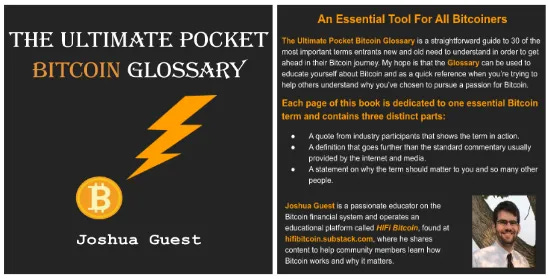
In my new book, The Ultimate Pocket Bitcoin Glossary, I walk you through 30 of the most important terms you need to understand in order to get ahead in your Bitcoin journey. My hope is that it can be used to educate yourself about Bitcoin and as a quick reference when you’re trying to help others understand why you’ve chosen to purse a passion for Bitcoin.
Ready to read it yourself?
Premium subscribers of The HiFi Bitcoin Letters receive access to The Ultimate Pocket Bitcoin Glossary at no extra charge:
Free subscribers and non-subscribers will be able to purchase The Ultimate Pocket Bitcoin Glossary, without the commitment of subscribership, in the HiFi Bitcoin Shop, once it is released as a PDF:
Wish You Could Easily Take The Podcast With You?
Can’t Get Enough Bitcoin In Your Life? Follow Me On Social Media:

🙋🏽♂️Did You Enjoy This Edition Of The HiFi Bitcoin Letters?
This 3-question survey is your chance to tell me how I can improve the newsletter for you.
This is not financial or business advice. This newsletter and related content are for informational purposes only. Cryptocurrencies and digital assets can be risky. Always do your own research before making any sort of investment.






