
What do you think this cartoon means?
Today's cartoon is by Arístides Hernández (Ares), the Cuban cartoonist .
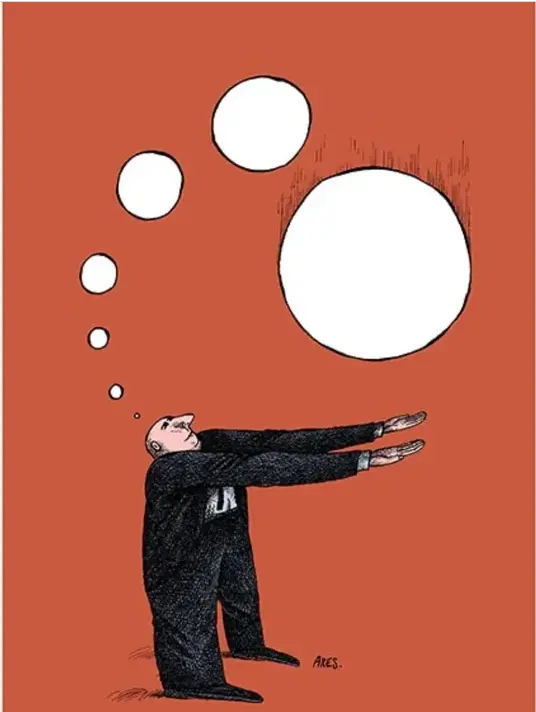
Some cartoons, like this valuable one by Arístides Hernández (Ares), the Cuban cartoonist, might seem very simple when we first see them, and we might think their meaning is easy to grasp. But the more time we spend trying to understand them, the more we realize that their meaning is not so simple, and other interpretations start to arise. The most important message that this cartoon conveys is the law of karma, or the law of action and reaction, or the cause-and-effect relationship. This means that whatever we think about today, we will eventually face the consequences of those thoughts in the near future. In this cartoon, a man is deep in thought, and his thoughts are growing bigger and heavier. The idea of "heavier" is crucial to understanding this cartoon, because the cartoonist is trying to show that, in the future, when these thoughts manifest and embrace the thinker, they will cause trouble and disturbance because of their weight. This is something we can relate to in our everyday lives, where small thoughts begin to form in our minds, and over time, they grow bigger and heavier. Eventually, these thoughts become so large and overwhelming that they paralyze us. Small fears gradually turn into bigger fears, eventually preventing us from even having the courage to leave the house, leading to psychological paralysis.
I consider the man's thoughts in this cartoon to be negative because, in general, most human thoughts, especially in today's world, are negative. When a person gets caught in this cycle of thoughts, they often end up with mental illnesses such as anxiety, depression, obsessive thinking, and many other psychological problems. Additionally, in the cartoon, if we pay attention, the cartoonist shows the last thought as particularly heavy, with the help of specific design choices, including lines that emphasize its weight. This creates a sense of rapid fall, signaling that the thinker will lose balance and be unable to maintain their current state. This psychological cartoon clearly illustrates the human thought cycle—how our thoughts grow over time and how they can spiral out of control, leading us to engage in foolish and automatic behaviors that ultimately bring harm, regret, and loss.
One of our responsibilities as thoughtful humans is to be aware of the content of our thoughts and to know what we are thinking about because, in the end, the results of our thoughts shape our lives. One of the best ways to develop mindfulness is by writing down our thoughts. When we write down our daily thoughts, we can review them at the end of the day and gain insight into their content. This simple act of writing and reading them helps reduce harmful, negative thoughts, and as they decrease, our mental system enters a phase of cleansing.
Another point worth mentioning in this cartoon is that by becoming aware of how our mental system operates, we can use it to our advantage and the benefit of those around us. For example, we can focus more on constructive and creative thoughts that lead to growth and productivity, so that over time, these thoughts will grow in our minds and bring positive, constructive results. In reality, we cannot fight against our mind and thoughts. The more we struggle with them or try to eliminate them, the stronger, more vivid, and heavier they become. So, to change the atmosphere of our minds, we need to focus our attention on positive thoughts and ideas (while still acknowledging the negative ones that exist). As one great Buddhist teacher said, our mind is like a monkey that is constantly jumping around and never staying still. To manage this restless monkey, we need to give it a banana to distract it, so it calms down for a while. That banana is the positive, creative, and constructive idea that will eventually bring us positive and prosperous results.






