
No, its not a joke!
The world's first "poop" database is waiting for its donors. The project was launched to help people with chronic bowel disorders, and a photo of your poop is being transferred to the database for artificial intelligence training.
Artificial intelligence will soon be able to analyze your poop. The project is actually a campaign where artificial intelligence developers aim to collect 100,000 stool photos to create the world's first poo database. The campaign, launched by the microbial health company Seed, will help scientists train an artificial intelligence platform developed at MIT by uploading photos of your feces to the database. The developers who created the database say the fecal photos that will be available to science could help people with chronic bowel disease such as irritable bowel syndrome, which occurs in 1 in 5 people in the US. The project is expected to enable patients to better manage their treatment processes by providing doctors with an extra diagnostic tool. Ara Katz, co-founder and CEO of Seed Health, said: "We don't always think of decaying like daily data. We really take it as a direct output of our bowel health" and stressing that everything is for bowel health and science.
Those who want to participate will go to the project website via mobil phone and click the "I Accept the Dare" button first. Users are then prompted for their email address and time of day (morning, afternoon or evening). Then you can take a photo of your poop and upload it to the system. You can also request that an email reminder be sent to you within the specified time period. Once submitted, the photo is separated from the metadata (your email address and other identifying information), making your donation anonymous and HIPAA compliant.
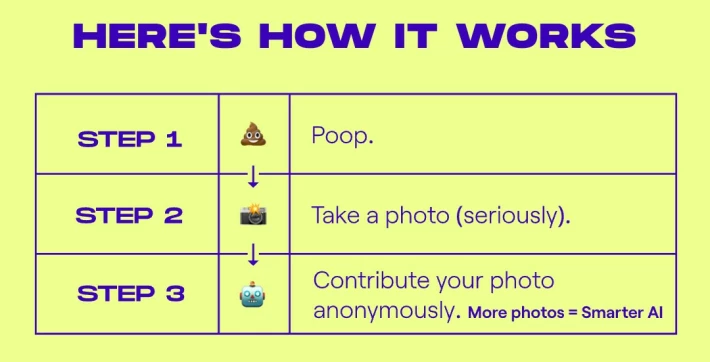
A team of seven gastroenterologists examines your photos and divides your poop into 7 categories defined on the Bristol stool scale. So you can tell whether you're constipated, fiber deficiencies or not. Doctors' opinions about your poop will help train artificial intelligence models. Similar education systems are used to teach how self-driving cars can recognize a tree or cat on the road.
David Hachuel, the founder of Auggi, a research on bowel health, says the aim of the campaign is to make the database an open source tool for academic researchers.
#giveashit






