
What are we going to do in DeFi network today? Let's play Farming today - skip the Novice Village and go straight to be the advanced version of Farmers!
Farming is what I think one of the most important concepts and investment actions in DeFi. This article will take you to rethink the value of money, know about Liquidity Pool, understand what is Farming, and finally check on Alpaca Finance together to experience the feeling of opening a bank. We'll see how other people's transaction become our own passive income.
Please put aside the traditional financial stereotypes and let your mood and brain be in a state of accepting new knowledge. The concepts and systems mentioned next are not intended to promote active investment in DeFi, but to let you firstly understand the new financial possibilities of the next generation, so as not to be at a financial disadvantage under the lack of knowledge.
Cool! let's get started. Alpaca, one of my favorite DeFi projects. But before the real stuff. Let's start by going back to ancient time...
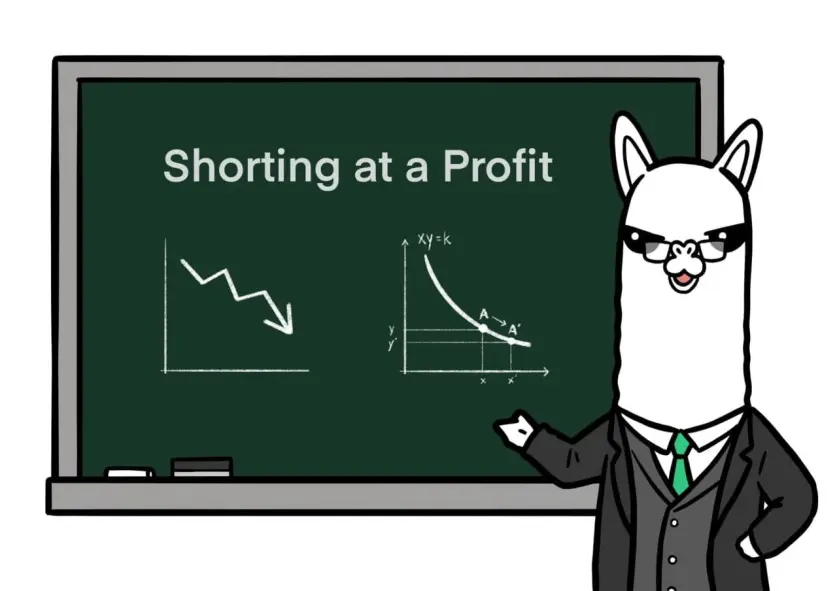
Why is currency valuable?
Once upon a time, people used shells as money to trade and for value storage. Later, people's demand of economy reasons became greater and more enthusiastic, and they switched to metal currencies such as copper coins because of more convenient to carry. More later, portable characteristic of paper money made it be widely adopted. But what makes these coins valuable? The answer is "Consensus".
There are many reasons for the generation of consensus. Raise several evolutionary possibilities:
- The Government (the imperial court) issued an order. The consensus of the majority be regulated by the minority in power.
- Commercial operation. The market is created by the owners of large capital and consensus is established in a way of driving up and shaping.
- Large portion of people adopting and getting familiar with results in consensus on value storage been gradually formed.
The first one can push back the ancient China Qin Dynasty’s unified weights and measures, and the six countries’ miscellaneous currencies were unified by the central government.
The second, also a top-down flow such as the art market created by Sothebys, where the wealthy people determine the value of arts.
The third is the path taken by cryptocurrency. For example, the more people use BitCoin and wider public understanding the better world it can bring, the stronger the consensus will be.
Only with consensus, a currency or token can be used to trade with peace of mind; once consensus is lost, the currency or token is worthless.
African country Zimbabwe let the currency issued by the government lost credibility because of inflation fears mount. High percentage of economic activity have switched to dollar-denominated.
Currencies lose value while losing consensus.
Why banks offer interests?
When people have consensus over the currency value, they wonder if there are other ways to make good use of the currency besides trading. This demand triggered the bank ecosystem which act as a trusted intermediary to assist both borrowers and lenders to meet their needs. Banks give people with spare money more options for storing value.
But at the beginning, people didn't have a consensus. And handing money to strangers made people uneasy. In order to get people used to the existence of banks, the government can use monetary policy to help reach consensus.
Take this interests rate of Cooperative Bank in 80's Republic of China for example. In order to encourage people to deposit, a rate of 9.5% demand deposits and 14% certificate of deposit a year had been declared. Compare with the current low-interests environment... It's incredible!
People who deposit money in the bank do not know to whom the bank will re-lend the funds and to which company. Depositors only want to ensure two things - "Is it secure?" and "what's the interest rate?"
In DeFi world, the ecosystem is quite the same. Take Alpaca Finance as an example, when one deposits money in Alpaca they don't need to know how Alpaca will utilize the funds. Depositors only need to focus on understanding Alpaca's security efforts such as Oracle Guard and Chainlink Integration and the investment ARP/APY they can provide.
Note: DeFi data is written on the blockchain in an open and transparent manner. Therefore in fact, depositors can know how Alpaca utilizes funds and which dApp they interact with.
Liquidity Pool
Let's return to the subject. In Alpaca Finance, we can be both depositors and bank shareholders.
Why we are shareholders? It's because we provide a certain percentage of funds to a "Farm", and the farm’s income will be distributed to depositors proportionally.
And we are depositors. Alpaca will keep our funds in custody, and they will make good use of the money through smart contracts to generate income.
The concept behind the scene is so-called "Liquidity Pool". The simplest explanation should be there are two different currencies, A and B, in the pool. The value of these two currencies is determined entirely based on the amount of each other.
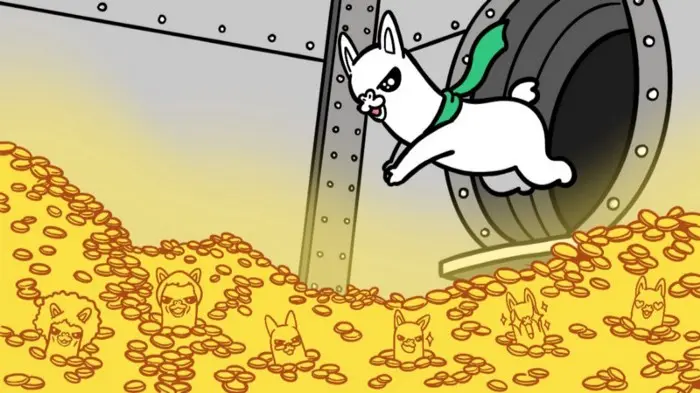
For example, if the ratio of the amount of money between A and B is 1:1, then their value is equal. 1A can be exchanged for 1B.
For another one, if the ratio of the amount of A to B is 2:8 then their value is 8:2. In this case 1A can be exchanged for 4B, which means the value of A is four times that of B.
Revisit the above examples again if you don't fully get the idea. When you understand it, you already get 80% of what I am willing to share. The rest is just extended thinking and flexible use of it. Now let me tell you more about how DeFi & LP works.
The action to "Stake" LP is called "Farming". And "Stack" means put your digital assets in dApps' custody and the assets will be considered not going to withdraw in a short time, it's a comparably stable money.
Firstly, when we conduct currency exchange on DeFi, in most use cases it’s not like stock market that buyers or sellers place orders waiting to be matched. To trade, we put currency A into the Liquidity Pool while taking out the equivalent value of currency B from the pool in a DEX, a.k.a Decentralized Exchange.
Followed by the above transaction, the proportion of the amount of both currencies in the pool changes. And the relative value of both currencies changes accordingly.
Secondly, the larger the LP, the more stable the currency value in it.
Let's imagine there are 1 million A and 1 million B in LP. At this time someone wants to use 100B to exchange for 100A, it can only cause fewer than 0.02% price change that both currency value is almost unaffected. On the contrary, if the amount of A and B is very small, one transaction may cause more than 2-3% price fluctuation.
Furthermore, the competitions between different dApps are like those between banks. Each dApp is striving for capital investment in order to make the Liquidity Pools large enough to make more people willing to trade. And more people means more transaction fees which fertilize the dApp to grow stronger.
Farming
After understanding the Liquidity Pool, the idea of Farming is simple.
The simplest Liquidity Pool is made of two currencies. This currency pair or token pair is called Liquidity Pool Tokens(LPT). For example, in previous article in DungeonSwap players can "Add Liquidity" to create a Liquidity Pool by creating DND-BUSD LPT. The action of handing over the LPT to the dApp for custody is called Farming.
As mentioned before, the larger the Liquidity Pool the more stable the currency price. With large LPs dApp can attract more people to participate. Therefore, dApps often provide outstanding interest rate to attract funds and try to achieve a win-win situation with investors.
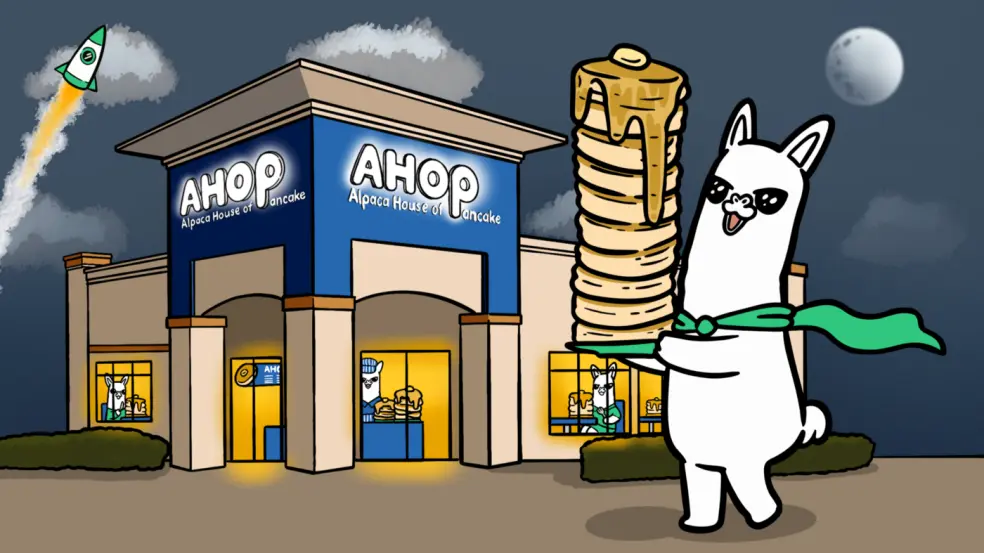
Alpaca Finance
Some people like America Bank and some prefer Citibank. Banks strives to win customers in terms of services and business items.
Similarly, in the DeFi world, each different dApp builds up its own characteristics. In addition to the core financial features and cute images, Alpaca also runs a humorous and knowledgeable Medium blog to educate newcomers to be aware of the possible risks and learn basic DeFi ideas. If you want to be a DeFi farmer, Alpaca is a great choice! Some takeaways:
- Leverage Farming
Generally, we need to prepare two currencies to make LPT such as FORM and BUSD to form FORM-BUSD. Alpaca makes thing easy by lending you currencies so that you can do Farming even if you have only one of them. - High Interest Rates (High APY)
Although the use of leverage means borrowers need to pay interests, the yield obtained by leverage is much greater than the interests. As a whole it is quite beneficial to investors. In addition, Alpaca compound the return every 30 minutes. This is an incredible wealth code. After getting familiar with it, you will feel that traditional finance is really too far behind. - Shorting
In Alpaca many farms offer more than 2x leverage option for investors to choose. The strategy of using 2.5x or higher leverage works as selling the borrowed currency in order to make up 1:1 value of the currency pair. And when closing the farm, Alpaca smart contract will have to buy enough borrowed currency to pay back. This action of selling first and buying later is actually the concept of shorting.
Here to use an actual Alpaca Farming case to explain all the terms:
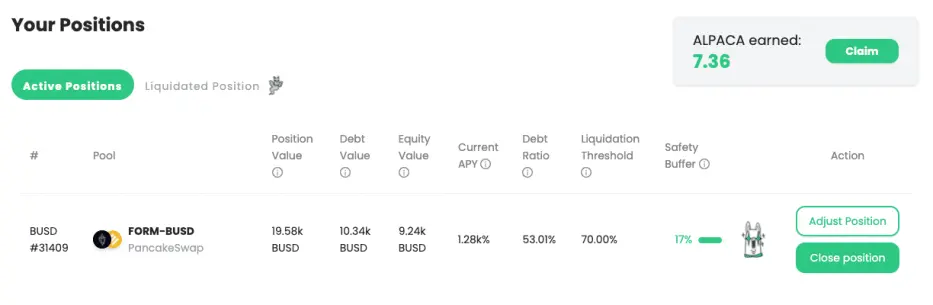
- Position Value The present value of the farm. It's the sum of the value of the FORM currency and the borrowed BUSD currency (on the website, you can see more details when mouseover).
- Debt Value The present value of the debt. It's the sum of the value of the borrowed BUSD currency.
- Equity Value The sum of the estimated currency value that can be received when the farm is closed.
- Current APY The Annual Percentage Yield calculated by compound interest is 1280%. Assuming this interest rate remains unchanged, the total value after investing $100 for one year becomes $1380.
- Debt Ratio The ratio of Debt Value divided by Position Value.
- Liquidation Threshold A threshold which triggers the system forcibly ends the farm.
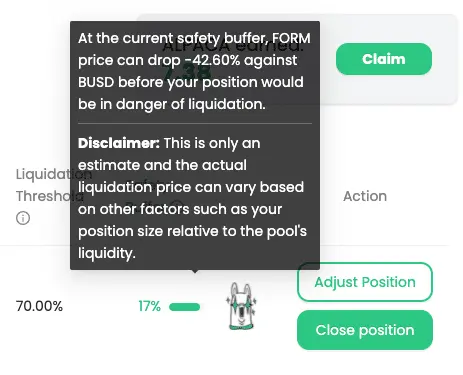
- The Safety Buffer The difference between Liquidation Threshold and Debt Ratio. Farm will be forced to end when it drops to 0.
Finally we need to emphasize the RISKs. For the Safety Buffer 17% in the above figure, it means if the currency value drops another 42.6%, a mandatory termination condition called Liquidation will be initiated. To avoid Liquidation one way is to increase the margin by adding collateral, the other way is to find a good time to close the farm before liquidation happens.
Check out Alpaca Risks documentation for all the risks you need to understand before investing.
Conclusion
Now you can understand why I said "skip the Novice Village and go straight to be the advanced version of Farmers!" at the beginning. The reason is that the yield brought by leverage is amazing. And Alpaca understands the risks posed by leverage and therefore puts a lot of effort into safety by providing Oracle Guard mechanism and writing blog for educational purpose.
Check out the safety ranking sorted out by BSCDaily on 2021/6/25. Alpaca sits top three.
As for yield, even stable currency LPTs like BUSD-USDT farming can achieve an APY more than 30% sometimes under reasonable risk control. This definitely blows the mind of traditional finance investors!
Check out Alpaca Finance, you shouldn't miss it.
Every morning I visit my Alpaca farms, and I smile.
Reference Links
- Alpaca Finance Official Site
- [Blog] Alpaca Finance Medium
- [Community] Alpaca Telegram
- [Community] Alpaca Telegram Announcement
- [Community] Alpaca Twitter
- [Community] Alpaca
- Discord
Thanks for reading
Like & Share if you think this article is helpful. :)





