
Today's potential growth of the financial industry is mainly based on the tokenization of assets. Tokenization creates new opportunities and classes of assets that can be represented by smart securities. Classes that can be tokenized include real estate, original music, cars, gold, airplanes, ships, yachts, collectibles and art.
Just the mortgage debt category, for commercial and residential real estate, represents a market worth several trillion dollars (evaluated by CB-Insights at $9 Trillion). OWNERA Corp., according to their January 2019 report "The State of Smart Securities", evaluates both the global real estate market and the global derivatives market in the hundreds of trillions of dollars, while the gold market is evaluated "only" about $8 Trillion.
As more assets become commercially available, the global market expands.
Furthermore, as new alternative classes of assets are being created, more small businesses can participate in introducing assets in the market, or even creating completely new classes of assets.
Tokenized assets will also allow for smaller investors to participate in trading as new models and platforms are being created to trade and manage these assets. For example, the tokenization of company shares is allowing for smaller investors to enter the corporate equity market through security token offerings (STOs).
The Technology Behind Tokenization
The tokenization of assets is made possible by the blockchain technology. This technology allows for a secure exchange of digital information (tokens) among a network of computers with the guarantee that tokens are correctly associated to one owner, that they cannot be stolen or destroyed by a malicious party, and that token transactions can be verified by any observer.
In addition to tokenization, blockchain technology seeks to improve the use of many distributed services in the fnancial industry, starting from basic fnancial services, such as money transfers and payments.
The potential of blockchain technology has been recognized for several years by many investors and established companies not only in Fintech, but in many other classes of applications.
However, some businesses and financial institutions have been wary of this new technology, partly because of the enormous amount of energy it used and partly because it could be perceived as a threat to their established business. The blockchain potential of peer-to-peer customer exchanges without intermediaries seems to be competing against the provision of services by a traditional business or institution.
As in other fields of innovation, the disruption caused by new technology to existing business models is amply compensated by the increase in new business and the discovery of new business models.
With any change, opportunities are created to expand business by adopting new technologies and improving the way customer services are provided. A company can either recognize the opportunity and adapt to change, or simply lose business.
A New Renaissance
Starting in the 13th century, the Italian renaissance was prompted by the great Italian explorers of that time: Marco Polo, Christopher Columbus, Amerigo Vespucci, Giovanni da Verrazzano, John Cabot and others opened up the routes for the Republics of Venice, Pisa, Genova and Amalfi to trade around the world.

With increased trade, banking became a requirement. Banking was developed in those republics and in close-by cities, notably Florence and Siena. The most famous bank at the time was established by Giovanni Medici in 1397. The Monte dei Paschi bank, with headquarters in Siena, has been operating continuously for 547 years!
As people started exchanging goods around the world, commerce also required better means of mass production and this prompted progress in general.
Similarly today a new renaissance in commerce and banking has started, as goods and services can be exchanged much more easily around the world. People can communicate directly through the Internet and make use of faster and more efficient shipping methods.
Instant voice communication around the world was actually initiated by Guglielmo Marconi in 1901, with his first radio transmission between Europe and North America. And of course telephone communication also spread around the world a hundred years ago.
So why are we expecting a trading revolution now?
Communication Technology
The internet allows for a visual experience, which is much more valuable than just voice or text communication. Today micro-services are offered on the Internet from people around the world.
For example, a graphic designer in Asia can sell its services at a competitive price to a North American company. The company can see the work online and ask for specific changes. The work is delivered through the internet and payment can be made through an international payment company again by entering payment information through an internet service.
The internet features low cost, a visual interface, speed and relatively secure small payments. Web sites can also be programmed to build up and record a reputation of suppliers based on feedback from buyers.
The technology we have at our disposal today can be summarized by the following two functional blocks:
1. Processing power, implied by the use of a computing device.
2. The Internet and cellular networks as a means of communication.
The above functionalities are scalable with technology, as processing power, storage capabilities and communication speeds are continuously improving.
But, however valuable these technologies may be, we experience shortcomings in other areas.
Limitations to Global Commerce
In the near future, with the extension of fast internet services to the southern hemisphere, any person in the world who has access to the Internet, will also want to trade with the rest of the world.
People will want to acquire global reputation and use other distributed global services, such as reservation systems. They will want to be part of the global supply chain for commerce.
They will want to be part of any opportunity that the global market and technology provide.
The functional blocks that need to be further developed for smooth global commerce are:
3. Global addressability and unique identity of each party worldwide,
4. Reliable and verifiable replicated data,
5. Security, provided by mechanisms embedded in the network and transparent to users.
The importance of a unique global identity, without compromising personal information, is only now starting to be recognized.
For example, the EOS network started moving away from user anonymity of public crypto-networks. Gorbyte and Glyph, both companies partnering with the California-based DealBox, a Security Token incubator, are proposing advances in this direction.
Blockchain technology has attempted to solve the last two missing functional blocks (the replication of data and the security aspects), but today's solutions come at a price, both in terms of monetary cost and risk.
Blockchain technology holds great potential and has been re-inventing itself for the last ten years. However, none of its reincarnations have yet achieved full security and scalability at low cost.
Some basic definitions:
- A blockchain network such as the Bitcoin network, is a set of computers communicating through the Internet for the purpose of maintaining a verifiable copy of the same blocks of data (the blockchain). These computers are called nodes of the network.
- The more specific term crypto-network simply indicates that its data is protected by encryption mechanisms both during transmission and when stored on any node.
- The blockchain is an identical sequence of blocks of information replicated on each node of a particular network, protected against change by verifiable encoding mechanisms. Although the blockchain concept is common, there are as many physical blockchains as there are networks. That is, each network maintains its own blockchain. Keep this in mind when thinking about inter-operability.
- A public network can be joined and used by any two peers without permission from an intermediate entity.
- A permissioned network includes trusted entities (intermediate nodes) that verify or permit the operation of other nodes. Such networks are more similar to current proprietary networks.
How do Nodes Cooperate in a Crypto-network?
To ensure the correct replication of the blockchain data on all nodes, each block is assembled and broadcast by one leader-node to all other others. This process is euphemistically called a consensus, when in reality it is a simple strategy for everyone to add the same block to the blockchain: the block assembled by the current leader-node.
This leader-node may be selected at random, chosen or elected in a number of ways. But in all cases the node that assumes this leadership role, even for only one block, expects to be rewarded.
Even in newer networks that do not require miners, a reward must be awarded to verifying nodes, if these are expected to do a good job in verifying transactions.
The scalability problem
After ten years from the appearance of Bitcoin, the first public blockchain network, blockchain technology has not been able to scale and seems to be in a constant state of flux.
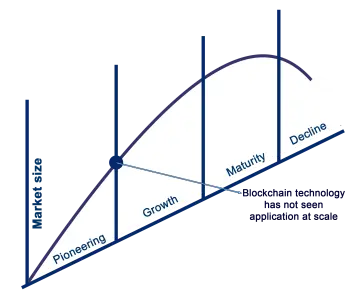
In all current public networks the leader-node needs to broadcast about a Megabyte of information, to all other nodes. As the number of nodes in the network increases to tens of thousands, this broadcasting activity becomes unsustainable.
If a company wants to use blockchain technology and reach the global market, on which blockchain network is it going to run its application?
Bitcoin, and other public networks with a similar design, are still promising new releases to solve their scalability problems.
The number of transactions per second that can be supported by Bitcoin and Ethereum has not increased since their inception. The relatively faster Ethereum, the first network to claim support for distributed applications, can process only about fifteen transactions per second. Even considering its two year old promise to change its consensus mechanism and increase its efficiency by a factor of one hundred, it may be able to support one global payment application. In contrast, just considering the financial industry, there are already plans for several markets where blockchain technology could be applied, including the tokenization of various types of assets and the provision of services using various financial instruments. These are big and important markets.
The low speed of public crypto-networks (their inability to handle many transactions per second) is one of the major factors preventing the application of blockchain technology to these markets.
Newer networks, such as NEO, EOS or Stellar, claim much higher speeds, but compromise on other aspects related to security. For example, users may need to trust some intermediate entity.
Examples of intermediaries in a network are:
- Miners or verifiers, volunteering or engaged to assure the security of the network,
- Special nodes of federated systems that have a stake in the success of the network,
- Nodes elected with some criteria to perform network governance,
- Nodes owned by trusted companies or institutions,
- Special players, such as centralized Currency Exchanges holding user wallets.
What's wrong with Intermediaries?
First of all, it is a question of cost: If the intermediaries are doing useful work, for example verifying transactions, then they need to be rewarded.
It is also a question of trust: Customers using a network with intermediaries need to trust:
- that the intermediaries are not giving preference to certain users or transactions,
- that the intermediaries are not, or or will not be taken over by a malicious attacker,
- that an intermediary's system is not experiencing a blackout, or targeted by a DoS attack, or experiencing a system failure, or other cause that will affect or delay customer transactions,
- that intermediaries' system software and data are reliable, so that data integrity and security are guaranteed,
- that they are really connected to a trusted system and not to an impersonator (i.e., some other system pretending to be a trusted intermediary),
- that no other unpredictable event will happen. Recently, for example, the owner of the Canadian currency exchange Quadriga died. No-one else knows the company's account passwords and as a result millions of dollars of customers' funds have been lost.
Finally, it is a question of data availability. If a network has a privileged or restricted class of nodes managing the blockchain, then the majority of nodes do not have immediate access to the current replica of the blockchain. This precludes the development of many real-time applications, for example automated trading applications.
Wasn't Bitcoin the First Crypto-network without Intermediaries?
This is actually true. Bitcoin started as a public network where everyone with some software understanding could download the Bitcoin node software and issue transactions. The node software would verify other transactions and fully participate in the operation of the network. As any other user of the network, people could count on occasionally gaining a reward, which compensated them for the fees they had to pay to the network for their transactions.
At the time it started, Bitcoin represented the dream of person to person, direct and secure financial interaction. There were some negatives: it was complicated for the average person to use. People had to understand the concepts related to a digital currency, so that they could securely manage their encryption keys. Even so, other networks copied the concept.
But then something happened. This setup also became costly.
The Tendency towards Centralization
In all cases, at least up to now, public blockchain networks have been suffering from a tendency towards centralization implied by their leader-based consensus mechanism and by their requirement to reward some nodes for their special verification work.
The competition towards gaining a reward and assuming a leadership role tends to create networks that become less and less distributed.
As soon as people realized that they could improve their chances of gaining a reward by improving the speed of their computers, a new industry was born, manufacturing special processors for crypto-mining. These special processors were expensive and used a lot of electricity, but more and more people saw the opportunity opened by the mining business. Transaction fees increased. Newer processors became available more frequently. Old processors could not be re-used. For miners, It became a pursuit of seeking higher rewards, to maintain their profits.
Later on, miners realized that they could further improve their chances of gaining a reward, before their hardware became obsolete, by pooling together many such processors. Mining pools were born.
Today, a few mining pools are in control of the major networks.
At the same time users not interested in mining could not see any advantage in keeping up with the miners in assembling blocks, as the probability of a reward dropped to zero. They instead started relying on miners to handle their transactions and condescended to continue to pay transaction fees.
All crypto-networks today suffer from the same tendency towards centralization, even when rewards may not be used to buy faster processors, but for example, to buy a stake in a network.
In fact, some networks have moved towards implementing federated systems of trust, where special nodes have acquired or are elected to positions of responsibility. This seems to be the opposite of the original goal.
Has the Original Goal of Public Networks Been Abandoned?
Essentially all public crypto-networks seem to have abandoned the original goal: the ability of any two people to deal directly with each other without the need to trust an intermediary. The difference between public networks and networks that are owned by a company or a cooperative seems to have vanished.
Given the state of the art, some of the big players, governments, large banks (BoA, JPM, Bank of Canada) and even city-states, usually not the fore-bearers of risky investments, did not shy away from announcing crypto-networks of their own, usually based on a permissioned approach.
The Emergence of Tokens as a Means of Raising Capital
One of the first real applications of the Ethereum network was simple and self-serving. The companies developing applications for the blockchain saw the advantage of creating tokens, defined by a smart contract program on Ethereum, as a means to raise funds. Given the Ethereum infrastructure and Smart Contract interface and language, the creation of a new token became as easy as 1-2-3. Tokens were often presented as coins to investors and Initial Coin Offerings were presented as a quick substitute to IPOs. Investors followed the trend and invested thousands of millions of dollars into thousands of blockchain projects. Two new crypto-networks were also funded this way: Tezos and EOS.
The Investor's Dilemma
By the middle of 2018 it was obvious to most investors that Initial Coin Offerings of tokens, mostly created by decentralized companies were not safe. De-centralized companies were not responsible to any one jurisdiction and presented high risk.
While cooperation and consultation are essential in the development of state of the art software, a complex system cannot easily be designed by a committee or a by group of tech consultants dispersed around the world.
In addition, most of these companies had no original ideas and only used tokens to raise funds quickly and, in some cases, later disappeared from the face of the Earth.
At the same time the Securities Commissions in the US, Canada and Europe were preparing to regulate the industry. It was dubious that the tokens created for most blockchain projects would pass the Howey test as a utility. It was much more likely that this type of fundraising would be classified as a security offering.
Where would investors go to reduce their risk and remain at the forefront of blockchain technology?
Many serious financial analysts around the world prepared the way for security tokens that would only be sold to accredited investors in compliance with the national security commissions. Companies like TokenFunder and iComply in Canada, Polymath (Barbados), DealBox, Manhattan Street Capital, CoinList, the Argon Group, TEMPLUM, STATIS, and others in the US lead the way for openly compliant token offerings.
Now, after this re-adjustment, Investors have somewhere to turn to for extra security, but they are still puzzled by one of the original questions: Is the de-centralized ledger technology worth the interest it has raised?
The cost factor
You may remember when we used to pay exorbitant fees for telephone calls. The internet technology has progressively scaled and allowed companies to provide not only free voice communication, but also video conferencing essentially for free. Of course people are paying for internet infrastructure through their Internet Service Providers subscriptions.
Similarly, users will expect to receive blockchain-based services over the Internet for free. But if blockchain applications need to pay fees for every transaction, plus costly fees for running as "smart contracts", in order to maintain the rewards to the verifiers or the intermediate systems, how are companies going to be able to leverage this technology? How are public blockchain networks going to compete with private or federated blockchain solutions that are faster and do not require smart contracts?
Cost is another factor that slows down financial institutions from adopting public blockchain solutions, and hinders their ability to change from old proprietary architectures.
Their current choice may be between joining blockchain projects, that use a federated, permissioned approach, such as Ripple or Hyperledger, or waiting for the technology to settle.
We have seen how the financial industry already has some use cases for blockchain technology.
Other industries are designing literally hundreds of blockchain applications, including distributed applications that need to exchange large quantities of data, another limiting factor of current networks.
The old argument that blockchain technology is a solution in search of a problem seems now to have been reversed. Applications of blockchain technology seem to be ahead of the technology that inspired them. We now have the financial industry and development companies ready with applications, in search of a blockchain network able to run them at a reasonable cost.
How Distribution Relates to Progress
Improvements in IT and networking technology are related to the concept of distribution.
Computer technology started with a centralized architecture and applications. Some very big business applications today are still architecturally centralized, even if they can connect to users anywhere using the Internet. While the Internet, as a communication medium, has been at our disposal for many years, the problem of distributing secure, verifiable information in real time to multiple locations was first solved within proprietary networks where physically separated computers or nodes could trust each other.
In public networks, the limitations to global commerce mentioned earlier were not addressed until the advent of crypto-networks implementing the blockchain concept.
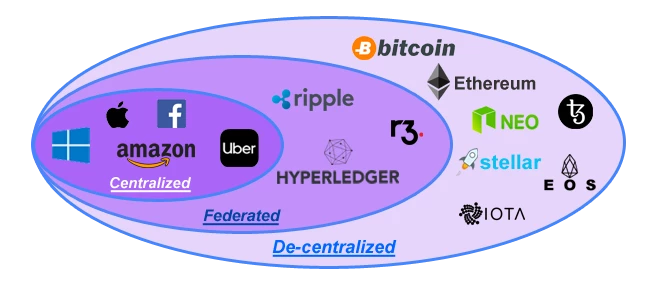
The progress from centralized, to federated and decentralized is conceptualized in the diagram below:
The following diagram illustrates the slow progress that led to decentralization of the fintech industry:
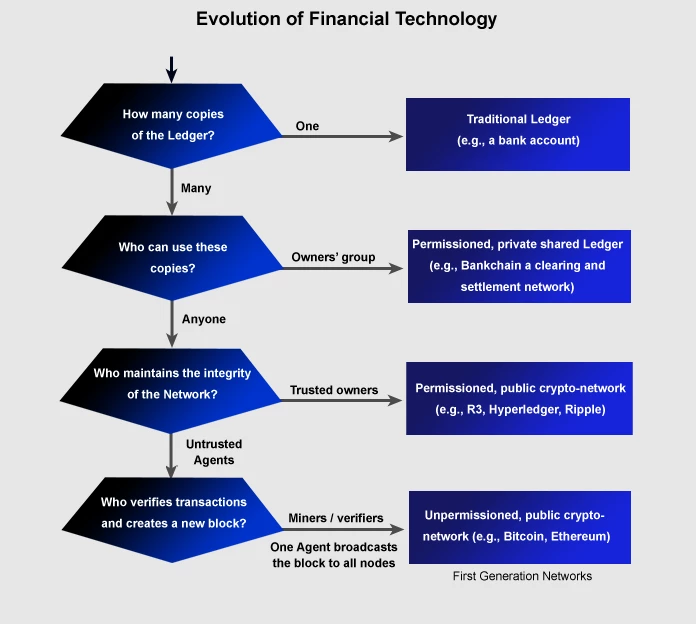
We have seen how decentralized crypto-networks, in the diagram indicated at the bottom right of the previous diagram as "First Generation Networks", have not been able to provide all the blocks needed for future global commerce. What is on the horizon?
The Next step: Stochastic Crypto-networks
Almost every application today has some degree of distribution. We live in an interconnected world. De-centralization can only go so far.
In the field of computer communication we started research on distributed network architectures forty years ago! That's an enormous time in the technology timescale. Why are we still talking about de-centralization with crypto-networks, instead of distribution?
The vision of a fully distributed crypto-network with no special intermediate nodes and not owned by any entity is much closer than you may think. Fully distributed solutions can be classified as blockchain-based such as GNodes introduced below, or solutions handling individual transactions, such Holochain or possibly IOTA, if they can get rid of their central coordinator.
The stochastic model, where the network is continuously and dynamically re-configuring, is resilient to possible attacks.
Gorbyte, a Toronto research and development company specialized in blockchain technology has created a US subsidiary and partnered with DealBox and TokenIQ to introduce a second generation blockchain architecture based on a stochastic model and a majority agreement.
The majority agreement mechanism is fully distributed and much more efficient than current leader-based consensus mechanisms.
GNodes, developed by Gorbyte, is the first of a new generation of blockchain-based crypto-networks that will operate stochastically. It overcomes the boundaries of decentralization by using a fully distributed design where every node runs the same node software.
The network has no miners or verifiers, but every active node participates in the verification of transactions and in ensuring the security of the network.
It re-ignites the dream of the initial Bitcoin implementation, but avoids any tendency towards centralization, as it has no intermediaries and grants no rewards. Thus its network operation cost is zero. It can provide basic financial services to its users at no cost and can be very competitive when running distributed applications.
Other attempts to use a distributed architecture for secure replication of data have so far produced only solutions that are either permissioned, such as Ripple or EOS, or solutions not based on the blockchain concept at all.
GNodes is the first fully distributed, blockchain-based, public crypto-network.
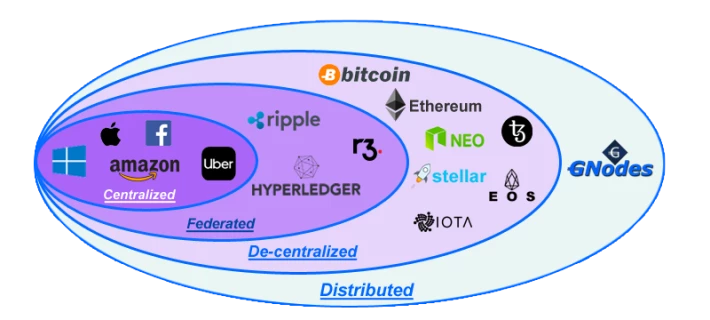
Thanks to the visionary work at Gorbyte we can now add the long expected "distributed" set of crypto-networks to our previous diagram.
The Last step in the Evolution of Financial Technology
Financial technology can expect to run its future applications in a better, faster, and cheaper distributed operating environment.
The following diagram shows how Financial Technology can now evolve one more step by using a distributed, public crypto-networks:
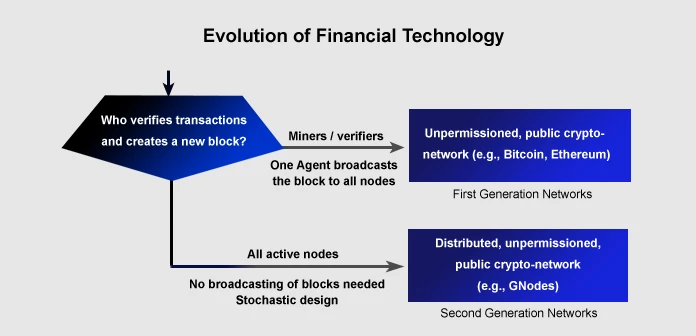
A Distributed Operating Environment for Future Applications
The GNodes design is not leader-based. GNodes can scale and can support future applications, including those that need to exchange very large quantities of data.
GNodes is modeled as a distributed operating environment, that is it is similar to an operating system running on a million mobile or personal devices around the world owned by the very users of the network. The network has no controlling or special nodes and it is not owned by any company.
It can provide users who may be physically remote, immediate access at no cost to the same, secure, verifiable data.
Consider what the Internet has done for the IT industry. It allowed people and companies to interact with each other and access information transparently on a global scale.
GNodes similarly pushes forward the boundaries of distribution in the areas of data replication, unique identification and security.
Its enriched functionality includes the functional blocks necessary for all distributed applications.
The availability, as part of the GNodes environment of additional distributed functionality standardizes and simplifies the development of distributed applications and provides a better, faster and cheaper platform where these can run.
Impact on Fintech
As mentioned at the beginning of this article, the market for blockchain-based smart securities worldwide is many trillions of dollars.
However, the second generation blockchain technology will lead to applications much more useful than just financial transactions recorded on a de-centralized ledger.
For example, financial institutions will be able to create virtual private blockchain networks providing immediate services to their customers with an implied transparent access authorization system requiring no passwords or personal information. The type and number of services that can be provided is only limited by the imagination. At the same time, both the service provider and its customers can use other applications on the broader public blockchain network to securely interact with the rest of the world.
All network users will have an implied unique identification associated to their node address that cannot be stolen by attackers or impersonators, as it is recorded and signed on the blockchain. Users will be able to build a reputation associated to their unique ID.
Users will be able to trade financial instruments or smart securities, counting on distributed, secure, verified, unchangeable information immediately available to anyone on the network, independently of location or intelligent device used.
General Application Market
In addition to Fintech, the market for blockchain-based distributed applications includes any existing application and any application imaginable, from reservation systems to supply chain, from AI to Superconnectivity with IoT, from unpermissioned social media to a myriad of future applications impossible to anticipate.
Stochastic, fully-distributed crypto-networks will soon revitalize the blockchain industry, disrupt crypto-mining industries, reduce energy utilization, provide an alternative to current crypto-networks and effectively revolutionize the distributed application world.






