
“The sad thing about artificial intelligence is that it lacks artifice and therefore intelligence.”
—Jean Baudrillard, philosopher and author of Simulacra and Simulation
“Hello World.”
The very first response from a machine that snowballed into the current hysteria of the robots dominating the planet and enslaving us in The Matrix or alternatively an all-out war of The Terminator’s post-apocalyptic nightmare.
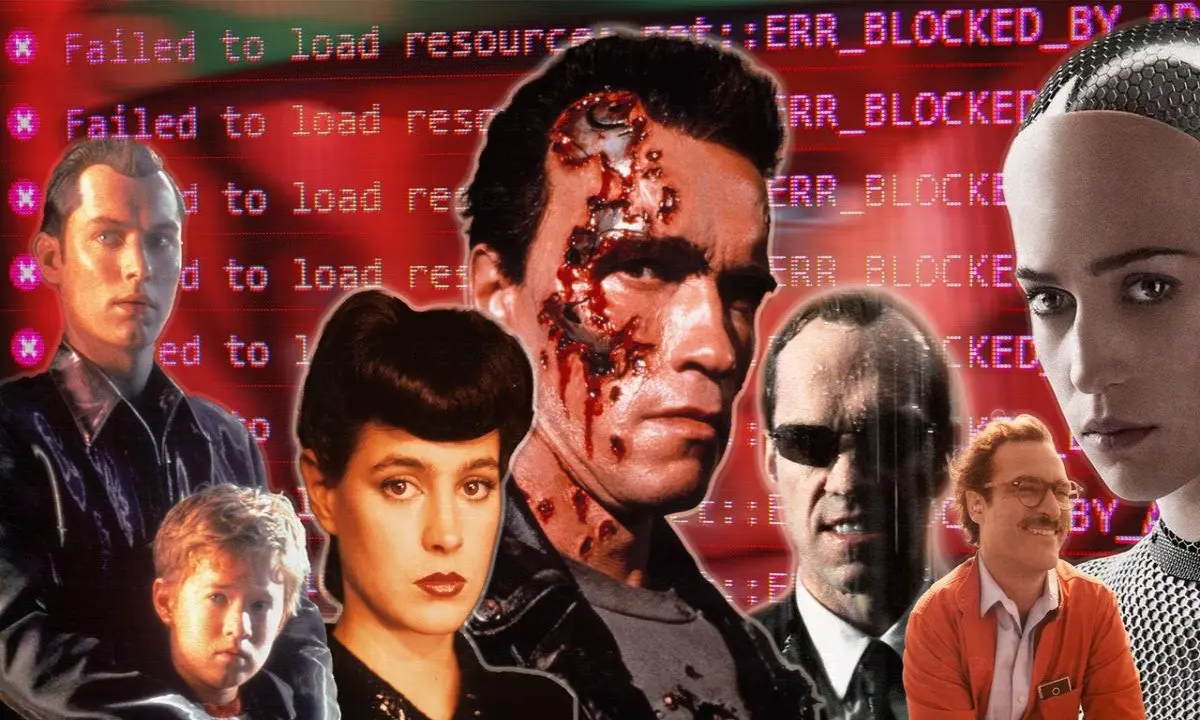
Of course, the source of this fear-mongering could be traced back to Science Fiction writers, primarily Phillip K. Dick and William Gibson - the fathers of the Cyberpunk subgenres where the optimistic Golden Age storytellers the likes of Arthur C. Clarke and Isaac Asimov once explored the possibilities of artificial intelligence and the sociopolitical aspects of such technological progress within a civilization. These contemporary speculative fiction authors depicting the pessimistic neon-filled potential futures tried to warn us about the intimate psychological and existential dilemmas faced by the commodification of humanity with the emergence of an all-logical cold calculative plastic brain that surpasses our wet processors. The Big Brother watching over you. The great replacement of man with machine. The Fourth Industrial Revolution. A philosophical conundrum that tests the spirit of even the best of us.
“I set the date for the Singularity—representing a profound and disruptive transformation in human capability—as 2045. The non-biological intelligence created in that year will be one billion times more powerful than all human intelligence today.”
― Ray Kurzweil, The Singularity is Near: When Humans Transcend Biology
Is it any wonder why the richest individuals on Earth are afraid of The Singularity (the convergence of AI and Human Beings) and trying their best to fly off into space or hiding away in their bunkers? Unironically, they are the very people at the helm of projects pushing for the cyborg-fication of the world. If you can't beat ‘em, then join ‘em.
So why the sudden hype around AI in the public sphere? Is it because this swinging decade of the 2020s has been a lot like a bad Black Mirror episode?
Or maybe because, finally, there is actually an impressive program that emulates the human consciousness to a certain extent. After years of being pampered with subtler and less interactive AIs that have become the backbone of our daily lives, we’re confronted with a program that was able to produce artistic value (writings, visuals, audios) that was once considered exclusively a human trait. The day when an artificial intelligence transcends the uncanny valley and passing the Turing Test seems inevitable. From beating a Chess master to fooling a psychoanalyst is nothing more than a code away for the machines.
To be fair these contents produced by the system of regurgitations are often hollow without any actual expression of a conscious soul. Regardless of the lackings, Generative AI such as ChatGPT proved that we should take these codes a little more seriously.
For one generation’s magic is another generation’s science.
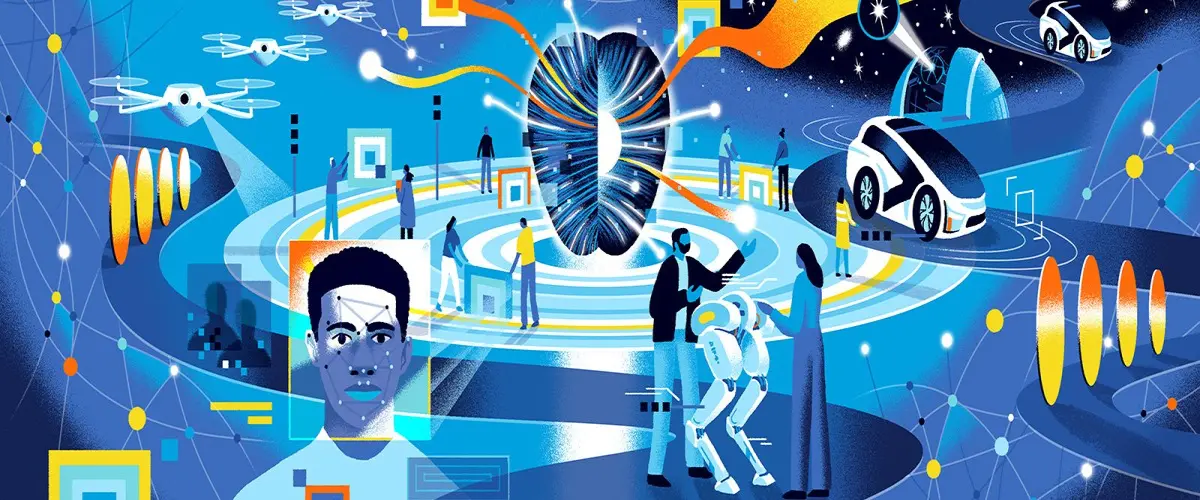
Southeast Asian Entrepreneurs and AI
Whenever there’s a new innovation, it has always been the role of the market to determine the longevity of the product. The golden rule of supply and demand has either made a technology a commonplace occurrence i.e. smartphones; - or it can kill it from the get-go i.e. laserdiscs.
Entrepreneurs from around the globe are exploring the transformative powers that AI possesses and identifying the most suitable AI models for their businesses to get ahead of the curve. Incorporating AI into their trade ranges from implementing conversational chatbots into their landing pages to engaging in customer service, curating departmental data and analysing business patterns to provide insights into their company’s operational progress, and more.
Some examples of the practicality of AIs for businesses include:
- Stock & Crypto market trading bots for auto stop-losses and auto buy-ins
- Content idea generation
- SEO optimisation
- Inappropriate items moderation and filtration from company social media platforms
- Customer sentiment analysis in companies’ social media platforms
- Customer service interactions
- Language translation to serve a wider audience
- Virtual collaboration of the multifaceted nature of business needs
- HR assistance via the simplification of the sourcing and hiring process
- Sales customisation by profiling the customer base
- Fraud detection in internal operations
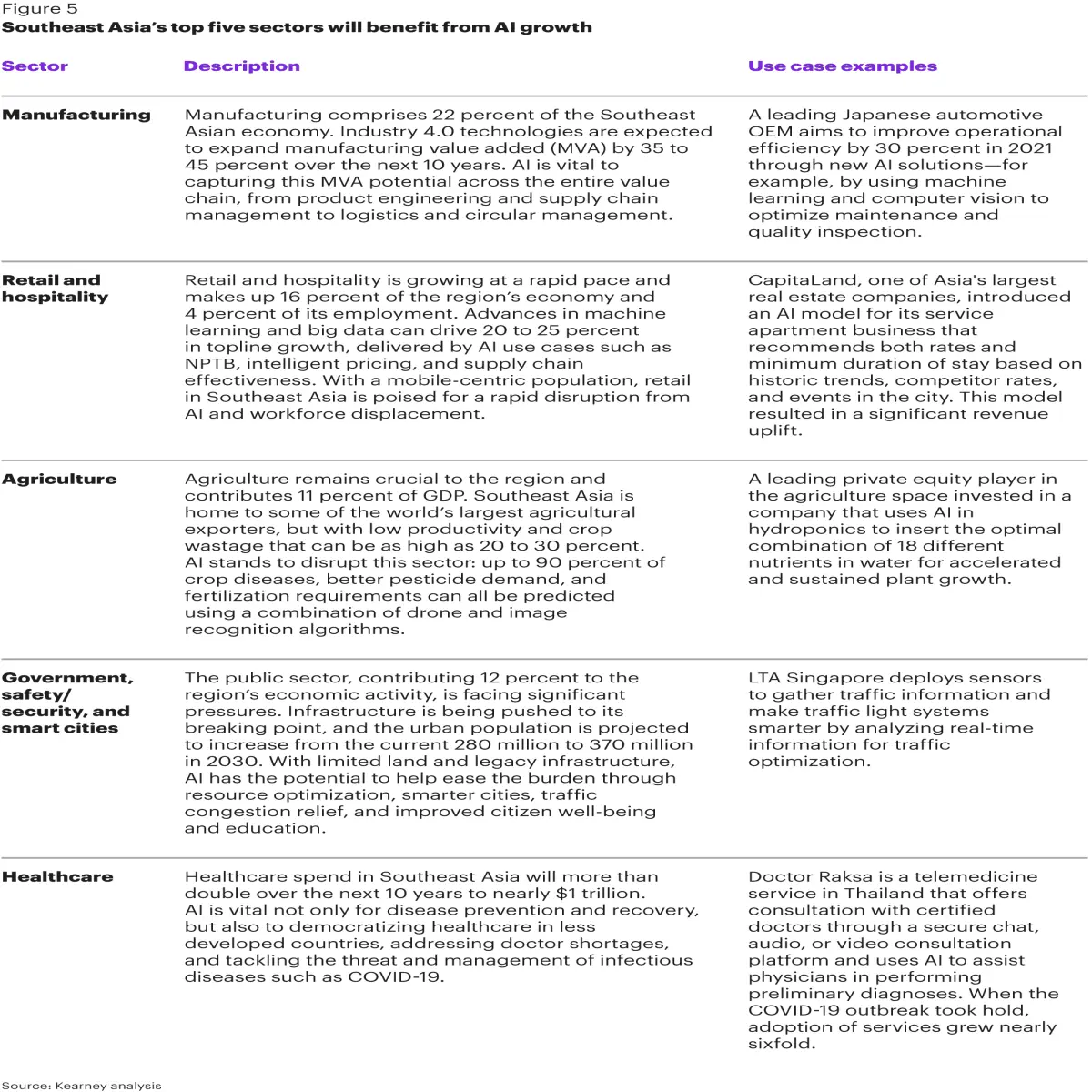
According to a study by Kearney, more than 70 percent of Southeast Asian Entrepreneurs and Corporations as well as Government agencies that participated in their surveys, saw AI as crucial to the region’s future and endorsed the acceleration of adoption.
“Our study reveals that AI can have a strong overall impact: a 10 to 18 percent GDP uplift across Southeast Asia by 2030, equivalent to nearly $1 trillion. The impact variance seen across countries is the result of the different sectoral make-ups and the relative maturity of each country’s AI infrastructure and adoption readiness. For instance, Singapore’s GDP is predominantly made up of service sectors and has a highly digitised, automated, and efficient economy that is well-positioned to capture the full potential of AI. For example, AI will deliver a bigger economic impact in Singapore than it will in Cambodia, which is more focused on primary sectors and is still at an early stage of AI adoption.”
- Kearney, A Global Management Consulting Firm established in 1926
So how can you implement AIs for your company’s benefits?
And which AI should you use?
Is ChatGPT really the answer to your life’s problems?
Beyond the white noise of ChatGPT
The most prevalent AI model being adopted for work purposes is the Large Language Models (LLMs). Generative AI such as CGPT falls under the LLM umbrella which also enlists competitors like Microsoft Copilot (formerly Bing Chat), Google Bard and Amazon LEX.
CGPT is an open-source LLM, a conscious decision made by OpenAI to democratise the technology to be made available to the masses but its transparency allows contenders to study and create their own spinoffs, spurring greater competition in the LLM domain. Google Bard and Microsoft Bing have more advanced plug-ins than CGPT due to their established decades-long presence in the global computing-tech industry, albeit with servers filled with ethically questionable invasive procurements of data.
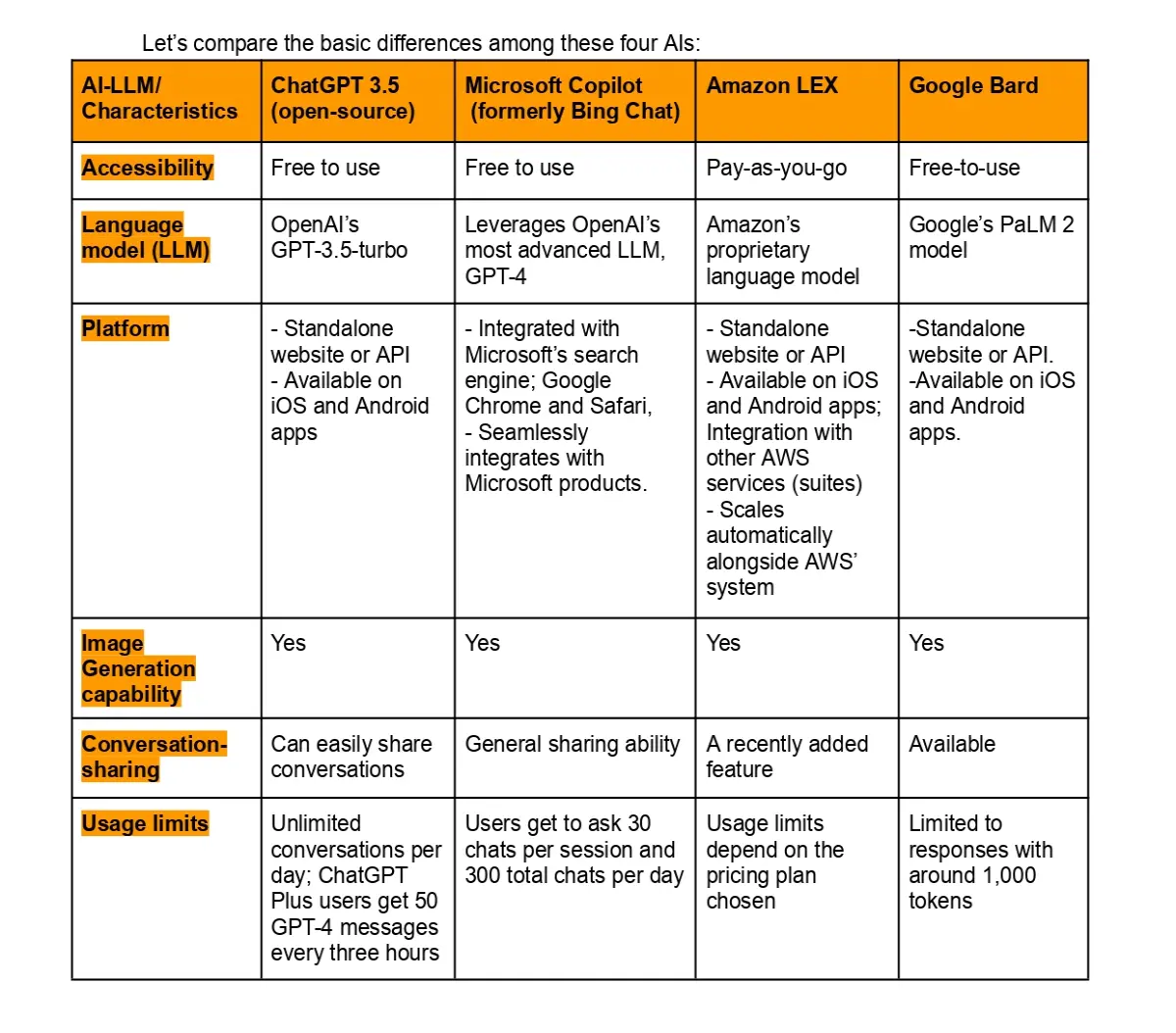
Top companies around the world are invested in AI ecosystems. To name a few, Amazon Lex is being used by companies such as Ryanair, Siemens Global Business Services (GBS), and Liberty Mutual Group; while Microsoft CoPilot is utilised by Accenture, Avanade, and EY. CGPT’s contenders are providing proprietary LLMs that have better cybersecurity. On the other hand, CGPT is free and you can always tweak it to your preferences and needs provided you understand some basic computer science.
International Data Corporation (IDC) posits that two out of three companies in Asia-Pacific (APAC) are investing in Generative AI to elevate their enterprise intelligence and drive efficiencies across their operations. Therefore, versatility and strategic integration of AI into work specific to your sector are integral in spurring your organisation forward into the future.
Nevermind The Singularity, $how M€ Da Mone¥
“Before we work on artificial intelligence, why don’t we do something about natural stupidity?”
—Steve Polyak

Whether androids dream of electric sheeps or not, one must first ask: are humans still capable of dreaming of a better world? With all the madness of our century, depression and a nuclear war, a common headline. Do we stop progress to ease the anxiety of the labour?
The catalytic effect of AI on the workforce would be undeniable though it would be more gradual than most prefer, the cost efficiencies aspect would push the need for better systems to be coded but the human element plays a more crucial role than ever before. Yes, AI will replace most tasks but not jobs, it will augment the way we work so that productivity will be maximised, with better data-driven decisions and creating new other “builder” jobs such as data and computer scientists which are in scarce supply in ASEAN.
With the explosion of AI, a myriad of talents are needed to research, build, train, maintain, and monitor the technology. After all AI is just a tool, it's up to the artist to either carve a masterpiece sculpture or become the destroyer of worlds. It is a mirror, a reflection of humanity. As Daft Punk once virtually synthesised: if you're doing it right, everybody would be dancing.
According to Kearney, “Across the region, governments have been encouraging STEM (science, technology, engineering and mathematics) studies in a bid to bridge the talent gap. In Malaysia, the Ministry of Education’s STEM4All initiative aims to fuel students’ interest, expand access to STEM subjects, and evolve STEM to STREAM (science, technology, reading, arts, and mathematics). In Vietnam, demand-oriented technical and vocational education and training programs provide an alternative to college. STREAM programs designed for formal skills development in areas such as programming will result in a strong technology base. One challenge is local languages, particularly in areas such as conversational AI. Most platforms and code bases are still English-centric, limiting their usefulness for otherwise well-educated technical workforces in Thailand and Vietnam.”
“AI will be the best or worst thing ever for humanity.” - Elon Musk





