
@tslaming
@godspeedhub
People call it a miracle like Jesus 😂
In the world of advanced phased array antennas, thousands of front end modules are wired together in a massive serial chain. It is a masterpiece of engineering right up until a single microscopic solder joint fails or a module goes deaf. In a standard daisy chain configuration, one broken link severs communication to everything downstream.
The classic engineering fix is to add dedicated diagnostic pins and extra routing. However, in the ruthless math of aerospace design, every extra wire adds weight, complexity, and new points of failure. Rather than solving a hardware problem with more hardware, SpaceX found a hybrid loophole.
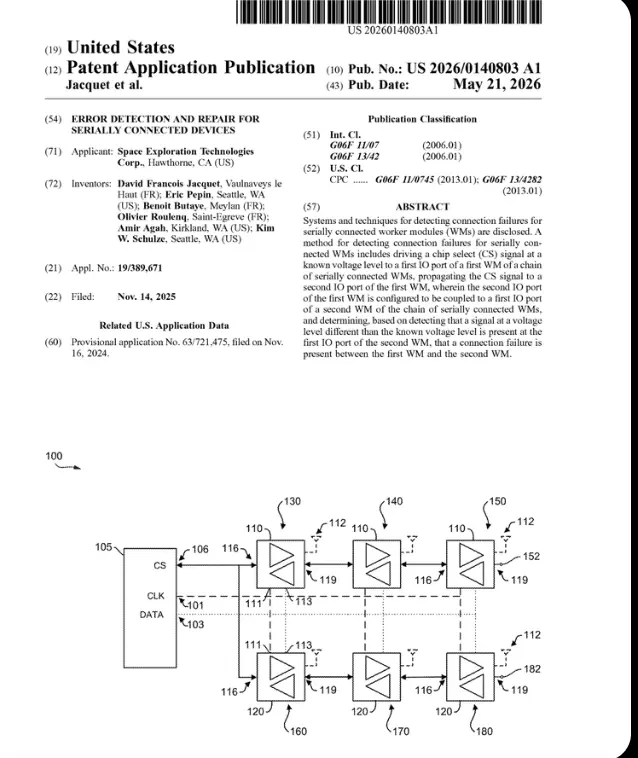
Detailed in the technical schematics of patent US 20260140803, the aerospace giant has embedded a hidden logic framework right into the silicon. They have transformed the standard communication protocol into an active radar for hardware faults. The system manipulates internal resistors and uses temporary identification numbers as mathematical error codes. This allows the command module to pinpoint physical breaks and instantly reroute signals around the damage.
To fully appreciate why this embedded logic is such a massive breakthrough, we first need to understand exactly how these massive arrays are wired together and why they are so vulnerable to begin with.
⚖️ The problem: The domino effect of daisy chained arrays
Phased array antennas, which are flat panels that steer radio signals electronically without any moving parts, achieve their incredible data speeds by clustering thousands of tiny chips together. These chips include front end modules that actually transmit and receive the radio waves, along with analog beamformers. You can think of analog beamformers as digital lenses that focus those scattered radio waves into a tight, invisible beam pointed directly at a satellite.
To control this massive army of silicon, engineers arrange the chips into long, serial branches where they are wired one right after the other. In a perfect world, this keeps the architecture clean. Commands and clock signals pass sequentially from a main controller down the line. These clock signals act as a digital heartbeat that keeps all the chips synchronized so they fire at the exact same millisecond. The instructions pulse through one chip to reach the next like an electrical bucket brigade.
The fatal flaw in this design is its complete lack of isolation. If a single microchip along a branch sustains thermal damage in orbit or suffers a microscopic solder crack on a consumer rooftop, it becomes a digital dead end. Because every downstream module relies entirely on its upstream neighbor to pass along instructions, a lone failure blinds the entire remaining segment of the array. The main command module is left completely in the dark, unable to communicate with the surviving chips or determine exactly which link in the chain broke down.
This complete loss of visibility is exactly what the aerospace giant set out to eliminate.
💡 SpaceX's solution: An active radar built into existing lines
To exploit this silicon loophole, SpaceX transforms its standard communication lines into a diagnostic radar that hunts for internal wounds. Instead of relying on separate, dedicated test lines, the system repurposes the chip select signals that already route through the array.
These chip select signals are specific electrical pulses normally used to wake up a particular chip and tell it to listen for incoming commands, acting much like a tap on the shoulder in a crowded room. The main controller broadcasts a known voltage pattern down the branch, and every worker module along the path is tasked with checking the signal state. You can think of these worker modules as the individual microchips performing the actual heavy lifting for the antenna.
Digital communication is fundamentally just a fast sequence of high and low electrical voltages. If a module expects a crisp, low voltage level from its neighbor but reads a high voltage instead, the hidden logic layer inside the chip immediately flags an anomaly. This transition from basic signal routing to active monitoring allows the array to spot electrical degradation long before it causes a complete system blackout.
Building an early warning system is impressive, but creating one that does not require an entirely new and expensive hardware ecosystem takes serious engineering discipline.
📡 Standard protocols: Hijacking established industry standards
This diagnostic framework does not require custom, highly exotic physical wiring to achieve its real time monitoring. SpaceX built the entire error detection architecture to run directly on top of a standard two wire serial interface. This type of connection uses just two physical wires to send data back and forth one piece at a time, acting much like a simple, single lane highway for digital information.
The patent explicitly notes that the system plays nicely with mainstream telecommunications protocols, which are the universally accepted sets of rules that allow different electronic devices to speak the exact same digital language. Specifically, it works with the MIPI System Power Management Interface. This is a common industry standard used to tightly coordinate how power is distributed inside complex electronics.
It also supports the MIPI Radio Frequency Front End protocol, which serves as a standard rulebook for controlling the specific hardware components that handle wireless radio signals. By hijacking these established industry standards, SpaceX can deploy this self healing framework across massive consumer production lines using off the shelf hardware layouts.
However, speaking the right digital language is only the first step. To actually hunt down a fault, the main computer needs a way to control the flow of the conversation across the entire array.
🔗 Signal routing: Orchestrating the flow with dual configurations
To trace a fault through a maze of identical components, the system needs precise control over how signals move from chip to chip. The architecture achieves this by dynamically switching each module between two operational states, pass through mode and daisy chain mode.
In pass through mode, a module acts like a simple repeater. It achieves this by rebuffering incoming data, which means it actively cleans up and strengthens the electrical signal before immediately throwing it to the next chip. This allows the system to broadcast global commands to the entire antenna simultaneously, much like a public address speaker projecting a single announcement to a whole stadium at once.
When the command module triggers a diagnostic cycle, the chips twist into daisy chain mode. You can think of a daisy chain as a sequential setup similar to a game of telephone, where a message must be processed by one participant before it is handed off to the next. In this state, a chip clamps the incoming signal. This clamping means the chip electrically blocks the signal from moving forward, refusing to pass it downstream until it completes its own local instruction. This tactical clamping forces commands to march through the network sequentially, allowing the controller to audit the health of each chip one by one.
So how exactly does a microchip clamp a signal or run these localized health audits? The secret lies in the microscopic electrical components hidden deep within the chip itself.
⚙️ Internal architecture: The electrical levers inside the silicon
The physical mechanism behind this trick lives inside a dedicated circuit block called the failure module. You can think of a circuit block as a specific neighborhood of microscopic components baked directly into the silicon, which is the base material that all microchips are made from, of every single worker chip.
This module features a bidirectional buffer flanked on both sides by a network of weak pull up and pull down resistors. A bidirectional buffer acts like a two way electrical gateway that allows digital traffic to flow smoothly in either direction. The weak pull up and pull down resistors are tiny electrical components designed to gently nudge a wire's voltage toward a high or low level when no other strong signal is actively pushing it.
These resistors act as small electrical levers that the chip can toggle on command. By manipulating these internal gates, the chip can artificially warp its voltage states. This controlled warping occurs directly on its input and output pins, which are the physical metal legs that connect the microchip to the rest of the circuit board. Manipulating these pins creates controlled micro tests, allowing the system to verify whether the physical copper wire connected to its neighbor is truly intact.
Once these micro tests are complete, the chip needs a way to communicate the results back to the main controller without using any dedicated diagnostic wires.
🧮 Diagnostic math: Decoding the phrases of a chip's death report
When an error is detected, SpaceX forces the broken component to write its own digital autopsy report using its temporary identification number, which acts like a digital nametag assigned to each chip, as a mathematical error code.
During a diagnostic sweep, which is essentially a system wide health check, the main controller manipulates the network voltages and orders the chips to run a gauntlet of internal tests. Every time a module fails a specific voltage test, its internal logic increments its ID address. This simply means the tiny computer brain inside the chip adds one to the number on its digital nametag.
The final resting value of that ID number becomes a highly specific diagnostic signature. If a chip finishes the test sequence with a final ID of one, it tells the main computer that a pin is stuck high. This means the electrical connection is trapped in an active state, acting very much like a light switch physically jammed in the on position.
An ID of two indicates a pin is stuck low, meaning the switch is broken in the off position and cannot register a signal. A final ID of three signals a worst case scenario, an open circuit. An open circuit occurs when there is a literal break in the physical trace, which is the microscopic copper highway carrying data between components, severing the connection entirely like a collapsed bridge. The command module decodes these numerical values to understand the exact nature of the failure without any physical diagnostic tools touching the board.
This mathematical approach brilliantly solves the problem of broken physical connections. But what happens when the wire is perfectly fine, and the chip's internal software simply crashes?
🔍 Pinpointing failures: Identifying the deaf links
Physical wiring issues are only half the battle. Sometimes the copper is intact, meaning the physical metal pathways on the circuit board are perfectly unbroken, but a software glitch or a radiation strike freezes a module's brain. A radiation strike happens when high energy particles in the harsh environment of space slam into a microchip and temporarily scramble its internal processing.
SpaceX catches these silent errors by issuing a global broadcast command. This is a single digital instruction sent out to every component on the network at the exact same time, acting much like a loud announcement blared over a public address system. This command orders every chip in the array to update its unique identifier, which is the specific digital address used to tell one chip apart from another.
Because a frozen or glitched module is effectively deaf to the network, it will miss the cadence and fail to update its slot. The command module scans the resulting ID map, which acts like a digital roll call showing the current status of every chip in the system. It immediately spots the chip that failed to change its number and flags the exact coordinate of the logic failure. A logic failure indicates a digital crash where the physical hardware is entirely undamaged, but the internal computing brain has simply stopped working and processing information.
Finding a software glitch is relatively straightforward because the rest of the serial line is still intact and communicating. But if a physical wire actually snaps, the controller loses contact with everything past the break, requiring a totally different tracking strategy.
🔄 Reverse propagation: Echo locating the dead zone
If a forward signal, which is a digital message traveling in its normal intended path from the main computer to the end of the line, hits a broken link, everything downstream of that break becomes a black hole of communication. The term downstream simply refers to all the chips that sit further down the wire past the point of failure. To peer past this wall, SpaceX engineers a clever flip in the network's geometry.
The system orders the surviving, accessible modules to switch into a reverse propagation direction. This is a special mode where information is forced to flow backwards up the chain instead of its usual forward path, acting much like cars directed to drive the wrong way down a one way street.
Instead of pushing signals down the line, the chips reverse their internal buffers. These buffers are essentially the tiny electrical holding areas inside the microchips that normally catch and pass along data. By reversing them, the chips can drive a test voltage, which is a deliberate burst of electricity used specifically to check the health of a wire, backward from the tail end of the chain. By measuring exactly where this reverse echo drops off, the controller can isolate the boundaries of the dead zone, cleanly mapping out a failure even when the primary communication line is severed.
Once the exact boundaries of the dead zone are mapped, the system must act quickly to rescue the stranded chips before the antenna loses a noticeable amount of data capacity.
🛠️ Automatic healing: Re-patching the broken math
Pinpointing the dead module is worthless if the rest of the surviving chips remain cut off. To heal the link, the command module executes an automated logical bypass, which acts as a digital detour that routes information around the broken hardware without needing any physical wire repairs.
The controller targets the last known functional chip sitting just upstream of the failure zone. Upstream simply refers to the components located immediately before the break on the data pathway. The controller then commands its serial port, which is the specific electrical gateway used to send and receive data one piece at a time, to go active.
This surviving chip takes over the role of a localized router, acting as a temporary command center that manages and directs data traffic for its immediate neighbors. It uses this new role to drive a fresh electrical wake up call past the dead module to alert the isolated chips trailing behind it.
The system then runs a modified identification sequence. This is a special software procedure that assigns brand new digital nametags to the surviving components to properly re-map the remaining hardware. This clever software bypass saves the rest of the antenna branch, which is a single line of connected chips within the larger radar panel, from becoming dead weight.
Sometimes, though, the hardware damage is not a clean break that can be easily bypassed. In more complex scenarios, a chip might only be partially damaged, requiring a more nuanced survival strategy.
📶 Partial degradation: Surviving on split pathways
In high throughput applications like Starlink, which involve moving massive amounts of digital information at incredibly fast speeds, these worker modules are often tasked with handling multiple data beams at the same time. These beams are essentially separate, invisible streams of internet data targeted at different locations simultaneously.
The chips manage this through split, parallel signal paths. These paths act much like a multi lane highway where different streams of electrical traffic travel side by side within the same microchip without intersecting. SpaceX ensures that a failure on one pathway does not kill the entire chip.
If the internal failure logic catches an open circuit on the first data beam line, it isolates that specific routing block. You can think of a routing block as a dedicated digital intersection responsible for managing traffic for that specific lane. Once isolated, the chip throws a local diagnostic flag, which acts as an internal digital warning sign alerting the main computer to a highly specific localized issue rather than a total system failure.
The chip disables its compromised beam circuitry, effectively shutting down the microscopic electronic components dedicated solely to that broken pathway, but keeps its secondary and tertiary data paths running at full throttle. This graceful partial degradation ensures the antenna keeps fighting and transmitting data. This engineering concept means the hardware is explicitly designed to keep functioning at a slightly reduced capacity instead of shutting down completely when an error occurs. It ensures the array remains online, even when sustained hardware damage chips away at its maximum capacity.
This ability to dynamically adapt, heal, and survive partial damage is not just a neat engineering trick. It is the foundational technology that makes SpaceX's global ambitions possible.
🚀 How this patent contributes to SpaceX's now and future
This patent highlights exactly how SpaceX manages the staggering scale of its Starlink network. As of mid 2026, SpaceX operates a mega constellation of over 10,200 active satellites in low Earth orbit, providing high speed internet to more than 10,300,000 paid subscribers globally.
The company is currently manufacturing an average of 70 new satellites every single week to keep up with demand and expand the network. With millions of consumer dishes and thousands of satellites relying on complex phased array antennas, hardware faults are a statistical certainty. By embedding self diagnosing and self healing capabilities directly into the silicon, SpaceX ensures their hardware can survive the harsh environment of space and the rigors of mass production without requiring human intervention.
Furthermore, stripping away physical diagnostic wires directly cuts weight and manufacturing costs. Every gram saved on a microchip translates to lighter circuit boards, lighter satellites, and ultimately cheaper launch costs. For a connectivity business that generated $11,400,000,000 in revenue in 2025, maximizing hardware lifespan and automatically bypassing dead chips directly boosts profitability.
In the future, as SpaceX deploys its newly authorized 15,000 second generation satellites, this embedded fault tolerance will be absolutely critical to maintaining a reliable network. Beyond internet service, this intelligent diagnostic framework could easily be adapted to rocket avionics, lunar landers, and the internal networks of the Starship vehicle. It ensures critical systems stay online and functional even when individual components fail, paving the way for truly resilient hardware in deep space.
@tslaming/@godspeedhub
Fan of Tesla 🛞 SpaceX 🚀 and Neuralink 🧠






