
On October 15, 2026, Tesla unveiled its pre-production prototype of the second-generation Roadster at the SpaceX test facility in McGregor, Texas. The event came after nine years of anticipation and delays. The first Roadster prototype was unveiled back in November 2017, with production originally scheduled to begin in 2020.
The presentation had initially been scheduled for October 1, 2026, but was postponed by two weeks due to weather conditions. An open-air venue was reportedly required to demonstrate the platform's unique capabilities.
The company presented three vehicle configurations, each with significantly different performance characteristics and propulsion systems.
The Performance version is a two-seat, road-going model. Its claimed acceleration time from 0 to 60 mph (approximately 96.5 km/h) is less than 1.6 seconds.
The Thrust version is equipped with ten high-pressure cold-gas thruster nozzles. Its claimed acceleration time from 0 to 60 mph is 0.81 seconds. During the demonstration, the unmanned vehicle reportedly performed a series of controlled jumps, briefly lifting off the ground.
The extreme, single-seat Rocket version features an expanded thruster system and is available by special invitation only. Its claimed acceleration time from 0 to 60 mph is 0.59 seconds.
There is currently no independent verification of these acceleration figures. The numbers cited above reflect the manufacturer's claims, which should not be confused with independently verified test results. The Thrust and Rocket versions are positioned as track-focused and experimental models, respectively, while their regulatory status and eligibility for public-road use remain unclear.
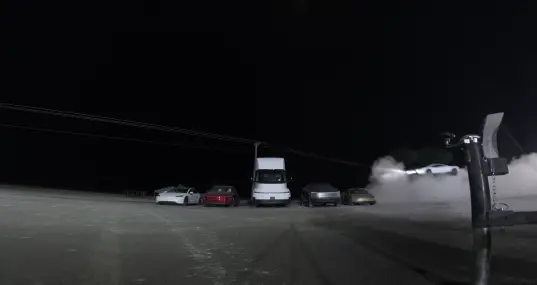
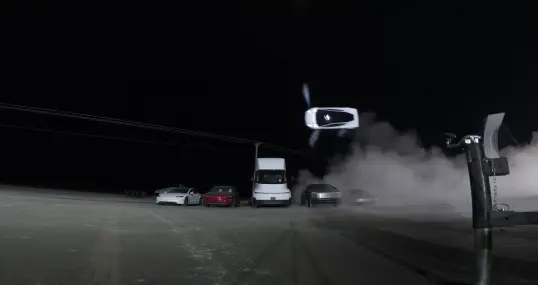

To demonstrate maximum downforce, Tesla used a fan system integrated beneath the vehicle. The system creates a low-pressure area beneath the car, allowing it to generate additional downforce. During the demonstration, the prototype drove onto a curved ramp and remained attached to it in a fully inverted position.
Fan-generated downforce has been used in motorsport for decades. Therefore, the main point of interest is not the underlying physical principle itself, but how such a system could be integrated into a road-car design.
The company's stock performance presented a more complicated picture than the media excitement surrounding the demonstration. Following the initial news, Tesla shares reportedly rose by approximately 5% at one point during trading. However, those gains faded by the end of the session, while the stock's overall weekly performance showed a decline of nearly 8%. This illustrates why a company's market performance should be evaluated over a broader period rather than judged solely by its immediate reaction to a high-profile event.

The start of Roadster production has reportedly been pushed back to 2028.
The Roadster remains a low-volume halo product. For Tesla's long-term financial performance, scaling its Full Self-Driving (FSD) technology, developing the Cybercab robotaxi program, and commercializing its Optimus humanoid robots are likely to be far more consequential.
Tesla's third-quarter financial report is scheduled for October 21. The report should provide an important indication of the company's underlying financial performance. In my next article, I plan to examine Tesla's quarterly financial charts, revenue figures, and broader automotive market trends using reported financial data.
The spectacular nature of the presentation does not eliminate the many questions surrounding the practicality of this vehicle. Personally, when I first saw the demonstration video, I actually thought it was AI-generated. It looks genuinely impressive, but in my opinion, this car is primarily spectacular as a showpiece. For everyday road use, it seems like a rather questionable proposition.
First, there is the issue of safety. If a vehicle can literally lift off the ground using rocket thrusters, what happens if the system activates at the wrong moment or the driver loses control? The car could fly into another obstacle or cause an accident involving other road users.
Second, the vehicle would carry high-pressure gas cylinders capable of storing gas at extremely high pressures. If the reported pressure figures reflect the actual design, we are talking about hundreds of bars, potentially around 100 times the typical gauge pressure inside a car tire. And yes, I understand that high pressure alone does not automatically make a system dangerous. However, personally, this kind of setup does not inspire much confidence, especially when considering that the vehicle is potentially intended for use in real-world conditions rather than exclusively on a test track.
During the presentation, the thrusters were also described as a way to improve the vehicle's acceleration. But in my opinion, it would make more sense to focus on tires, suspension, aerodynamics, and active downforce systems rather than introducing such a complex propulsion system. These are technologies that directly influence grip, handling, and vehicle stability.
Another important point is that the compressed gas is consumed with every burst of thrust. This is not free acceleration: the supply is finite, and the system must eventually be refilled. All of this adds complexity, and maintaining the system could be expensive. It raises a perfectly reasonable question: are all these compromises really worth it for the sake of a few spectacular maneuvers?
Of course, these are just my personal thoughts, and I am not claiming that the technology itself has no engineering merit. On a closed test track, such systems can be interesting for experimentation and for demonstrating what is technically possible. But public roads are an entirely different environment, where you have to account not only for a vehicle's capabilities but also for driver error and the safety of everyone else.
Therefore, in my view, the second-generation Roadster currently looks more like a demonstration of Tesla's and SpaceX's technological capabilities than a rational vehicle for everyday use. The presentation is spectacular, and the technology is certainly interesting, but the practicality of such a system for ordinary road use remains highly questionable. Thank you to everyone who took the time to read my article. Have a great day!






