
In the Solar System, all objects on a certain size, including planets, are rounded. These include the great satellites of the planets Titan and Moon, as well as Makemake and Eris in Ceres, Vesta, Psyche and Kuiper Belt in the Asteroid Belt. Have you ever wondered why the planets are round?
1. Nebula?
According to the Nebula hypothesis, which is the most widely accepted model of planetary formation, our Solar System began as a nebula (nebula) in its formation process. According to the hypothesis, an event that caused the collapse of the nebula occurred about 4.57 billion years ago. Though it is not clear about this event, it is thought to have been caused by the influence of a supernova shock wave. The shock waves caused a gravitational collapse in the center of the nebula.
As a result of the gravity collapse in the center, the materials began to accumulate in more dense regions. When denser areas were attracting more material, momentum conservation increased pressure and heat. Most of the material was gathered in the center to form the Sun. The remaining part of the material flattened around this object and formed a disk form.
2. Terrestrial Planet, Gas Planet ...
Eventually, the planets were the result of the gravity effects of these disks, resulting in more gas and dust attraction to them. Due to the high boiling points, metals and silicates are solid at closer distances to the Sun. These planets are Mercury, Venus, Earth, and Mars, and these planets are called terrestrial planets.
In contrast, giant planets such as Jupiter, Saturn, Neptune, and Uranus are formed where the volatile compounds are cold enough to remain solid. The glaciers that form these planets are found in greater quantities than the metals and silicates that make up the terrestrial planets. So, they can grow to catch hydrogen and helium atmospheres.
Why are the larger objects in the form of spheres rather than other shapes? The answer is related to a concept known as hydrostatic equilibrium.

3. Hydrostatic What?
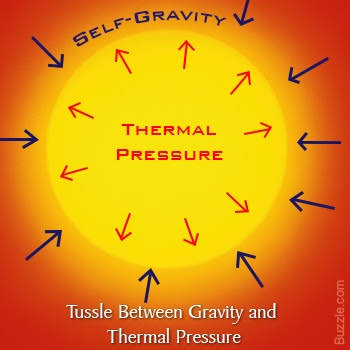
Hydrostatic equilibrium refers to the balance of a planet's external thermal press and the pressure created by the inward weight of the planet. Therefore, the object tries to bring itself to the most appropriate shape. Depending on the densities of the objects less than 1000 km in diameter, the form in which the internal and external forces are most effectively balanced is a 'sphere'.
On the other hand, the question "Why planets should be round?" Was discussed in the International Astronomical Union in 2006. And finally, it was accepted that an object must be global in order to be able to assume its planetary status.
References






