
What is cryptocurrency?
Cryptocurrency is a digital payment system that doesn't rely on banks to verify transactions. It's a peer-to-peer system that can enable anyone anywhere to send and receive payments. Instead of being physical money that is carried around and exchanged in the real world, cryptocurrency payments exist purely as digital entries to an online database that describe specific transactions. When you transfer cryptocurrency funds, the transactions are recorded in a public ledger. You store your cryptocurrency in a digital wallet.
Why get Crypto name this currency?
Cryptocurrency got its name because it uses encryption to verify transactions. This means advanced coding is involved in storing and transmitting cryptocurrency data between wallets and to public ledgers. The aim of the encryption is to provide security and safety.
Market Share
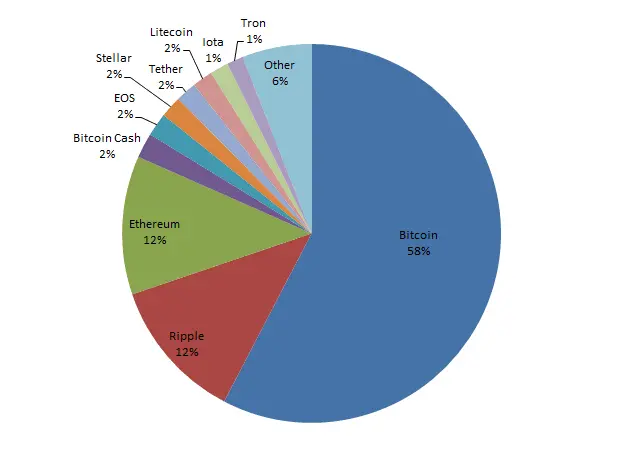
Top 10 cryptocurrencies by market capitalisation
-
Bitcoin (BTC) $128bn.
-
Ethereum (ETH) $19.4bn.
-
XRP (XRP) $8.22bn.
-
Tether (USDT) $6.4bn.
-
Bitcoin Cash (BCH) $4.1bn.
-
Bitcoin SV (BSV) $3.4bn.
-
Litecoin (LTC) $2.6bn.
-
EOS (EOS) $2.4bn.
Bitcoin (BTC) is a consensus network that enables a new payment system and a completely digital currency. Powered by its users, it is a peer to peer payment network that requires no central authority to operate. On October 31st, 2008, an individual or group of individuals operating under the pseudonym "Satoshi Nakamoto" published the Bitcoin Whitepaper and described it as: "a purely peer-to-peer version of electronic cash, which would allow online payments to be sent directly from one party to another without going through a financial institution."
Ethereum (ETH) is a smart contract platform that enables developers to build decentralized applications (dapps) conceptualized by Vitalik Buterin in 2013. ETH is the native currency for the Ethereum platform and also works as the transaction fees to miners on the Ethereum network.
Ethereum is the pioneer for blockchain based smart contracts. When running on the blockchain a smart contract becomes like a self-operating computer program that automatically executes when specific conditions are met. On the blockchain, smart contracts allow for code to be run exactly as programmed without any possibility of downtime, censorship, fraud or third-party interference. It can facilitate the exchange of money, content, property, shares, or anything of value. The Ethereum network went live on July 30th, 2015 with 72 million Ethereum premined.

XRP is an independent digital asset that is native to the XRP Ledger. With governance and fast transaction confirmations, XRP is said to be the most efficient settlement option for financial institutions and liquidity providers seeking global reach, accessibility, and fast settlement finality for interbank flows.
According to Ripple, those who use the digital asset XRP to source liquidity can reportedly do so in seconds. The team at Ripple hopes to enable the world to move value like it already moves information on the web today.
Tether (USDT) is a cryptocurrency with a value meant to mirror the value of the U.S. dollar. The idea was to create a stable cryptocurrency that can be used like digital dollars. Coins that serve this purpose of being a stable dollar substitute are called “stable coins.” According to their site, Tether converts cash into digital currency, to anchor or “tether” the value of the coin to the price of national currencies like the US dollar, the Euro, and the Yen.
Tether (USDT) is issued on the Omni, TRON, and ETH blockchains.
Bitcoin Cash (BCH) is hard fork (a community-activated update to the protocol or code) of Bitcoin that took effect on August 1st, 2017 that increased the block size to 8MB, to help the scale the underlying technology of Bitcoin.Nov 16th 2018: BCH was hard forked again and split into Bitcoin SV and Bitcoin ABC. Bitcoin ABC became the dominant chain and took over the BCH ticker as it had more hashpower and majority of the nodes in the network.

Bitcoin SV stands for Satoshi Vision.
Stemming from Bitcoin Cash, BSV is a hard fork (community-activated update to the protocol or code) established as distinct from BCH after the network upgrade scheduled for November 15th, 2018 resulted in a hash war determining the chains would be split. According to their website, the Bitcoin SV project is primarily backed by CoinGeek Mining with development work by nChain.
Litecoin is a peer-to-peer cryptocurrency created by Charlie Lee. It was created based on the Bitcoin protocol but differs in terms of the hashing algorithm used. Litecoin uses the memory intensive Scrypt proof of work mining algorithm. Scrypt allows consumer-grade hardware such as GPU to mine those coins.

EOS.IO is a blockchain protocol powered by the native cryptocurrency EOS. The protocol emulates most of the attributes of a real computer including hardware (CPU(s) & GPU(s) for processing, local/RAM memory, hard-disk storage) with the computing resources distributed equally among EOS cryptocurrency holders. EOSIO operates as a smart contract platform and decentralized operating system intended for the deployment of industrial-scale decentralized applications through a decentralized autonomous corporation model. The smart contract platform claims to eliminate transaction fees and also conduct millions of transactions per second. EOS (EOS) is software that introduces a blockchain architecture designed to enable vertical and horizontal scaling of decentralized applications. The EOS software provides accounts, authentication, databases, asynchronous communication and the scheduling of applications across multiple CPU cores and/or clusters.






