
How do we know where we are in the adoption of cryptocurrencies? What do people think about it and how they use blockchain, cryptocurrencies and all their tools?
It is not always easy to see clearly. Yet an excellent study by ‘Consensys’ sheds light on the trends in 2024 and their evolution. Here are some key figures that will help you understand the issues and the general public’s opinion about cryptocurrencies in the world. Let’s first look at what people think of traditional finance, these mechanisms and the management of internet by large companies (Facebook, Google,...). We will then look at the level of public awareness regarding blockchain and their use of cryptocurrency.
Here is what people generally think of the use of their data on the internet by the big digital companies.
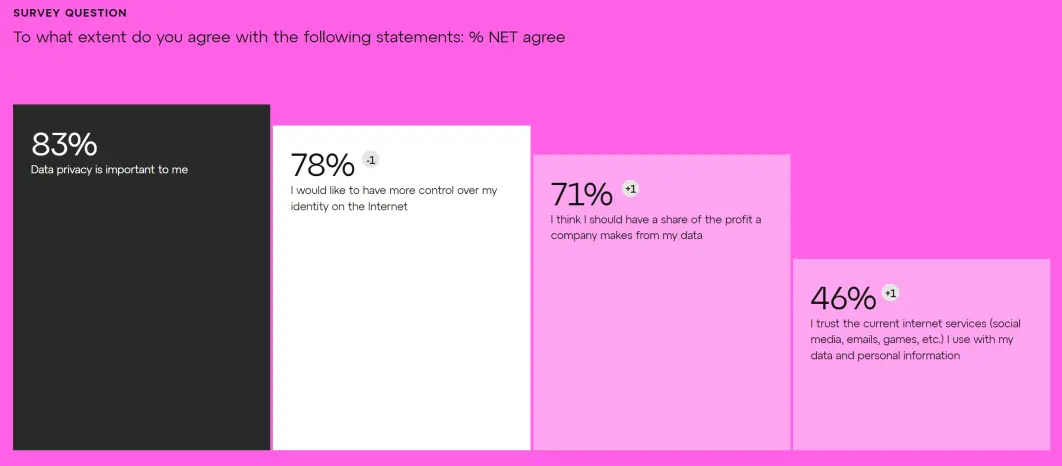
As you can see, the vast majority of people think that data is not being used properly. The desire for good protection of their privacy seems to be a determining element in their psychology. Many believe that their privacy needs to be better protected and that the revenues generated from their data should be shared.
The study also looked at what people thought about the fact that more than 20% of adults in the world do not have access to a bank account.
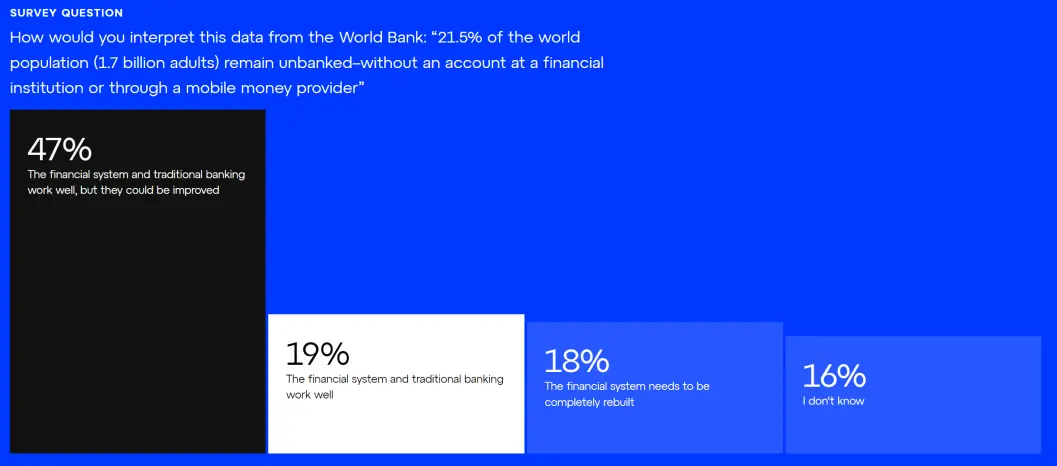
Overall, a large part of the population believes that the monetary system is working well but needs to be improved. Only a small minority think it works well or is totally redone.
And cryptocurrency in all this, what do they think about it? What concepts do they associate it with?
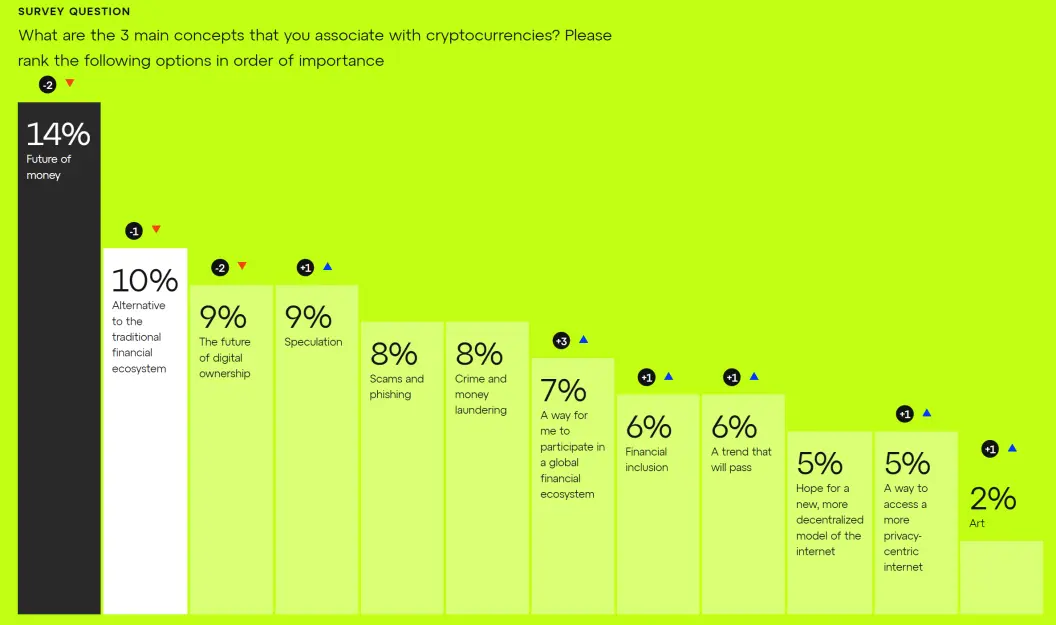
The trends are fairly well distributed even if one emerges. Cryptocurrencies are the future of currencies. However, this represents only 14%. It should be noted that the inclusive side and being able to participate in the financial ecosystem are up sharply compared to 2024. The massive influx of institutional investors is certainly contributing to this. The scam side is perhaps maintained at 8% of trends because of the recent explosion of projects Meme coin. Difficult to say because we do not have more precise statistics on this subject. Here are the statistics related to this subject.
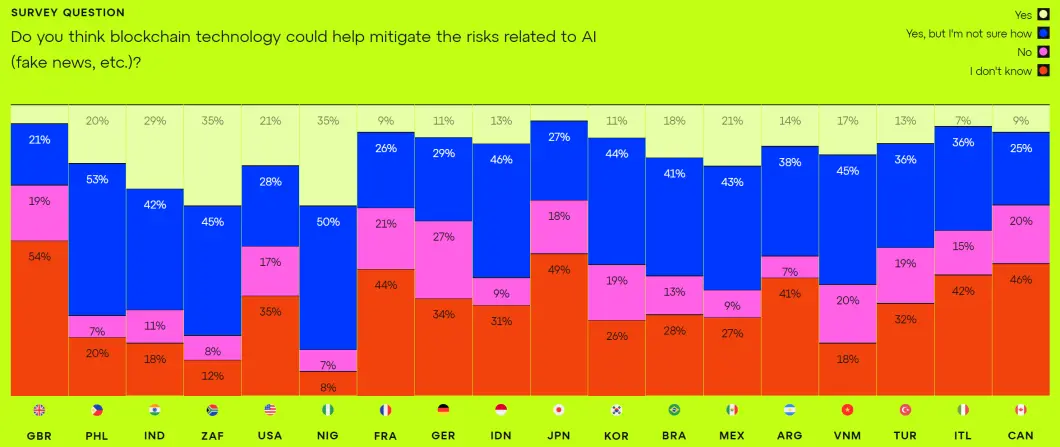
As regards the vision of digital ecosystems that can be improved, the answers are very interesting.
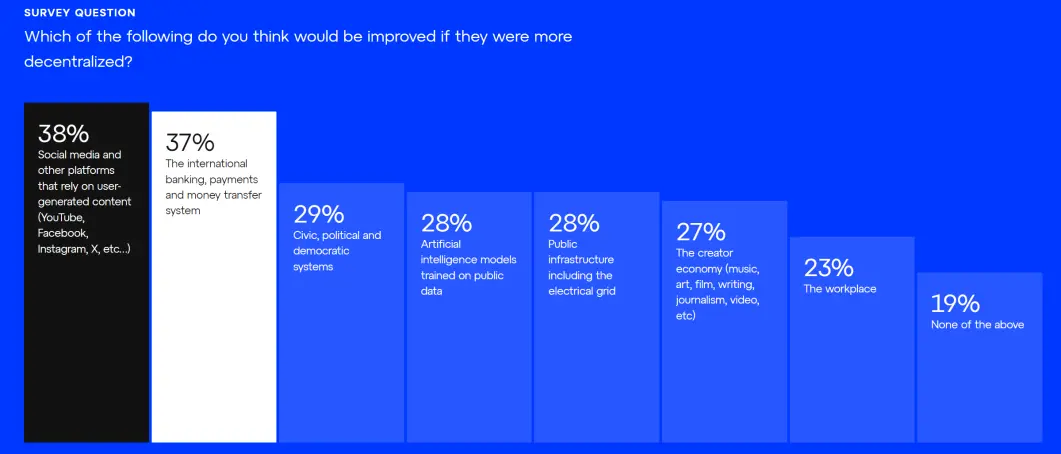
Social networks and payment systems are largely in the lead. Many believe that blockchains could be improved substantially. AI is making its appearance in this ranking in a good position, although it is a fairly new societal topic. As you can see, the public seems generally positive about the possibilities of improving everyday tools through blockchain. But are they able to define clearly what it is?
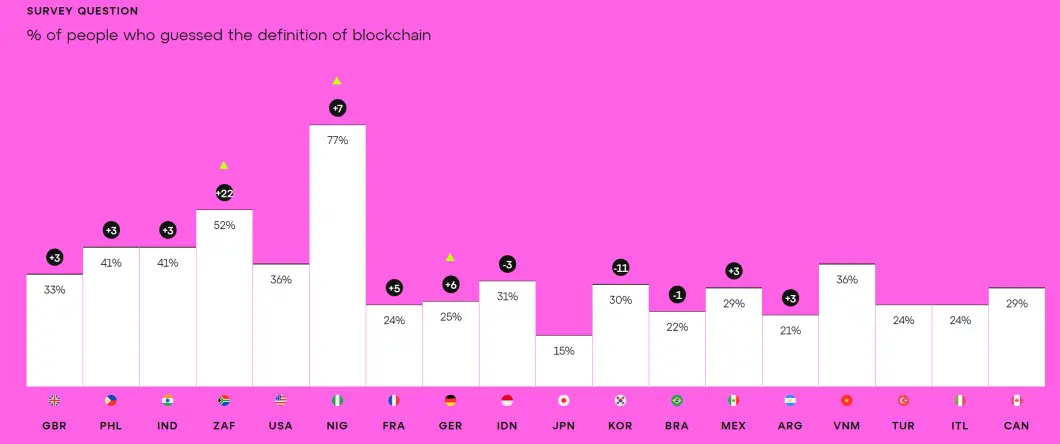
On average in most countries, 32% of people know how to define a blockchain correctly. In Nigeria, this statistic rises to 77%. This is explained by the advance that the country has in terms of adoption of cryptocurrencies either in its legislation or in these uses. It’s also a good benchmark to see where other countries are. The conclusion: there is still work to be done. Fortunately, this percentage is increasing. Surprisingly, it is in Europe that the trend seems to be strongest despite a lack of clear regulation in most EU countries. La tendance au Nigeria et en Afrique du Sud est isolée du reste du continent africain.
What about cryptocurrency ownership and use? A good way to understand the frequency and volume of cryptocurrency usage and adoption is to look at the number of wallets held by citizens in a region.
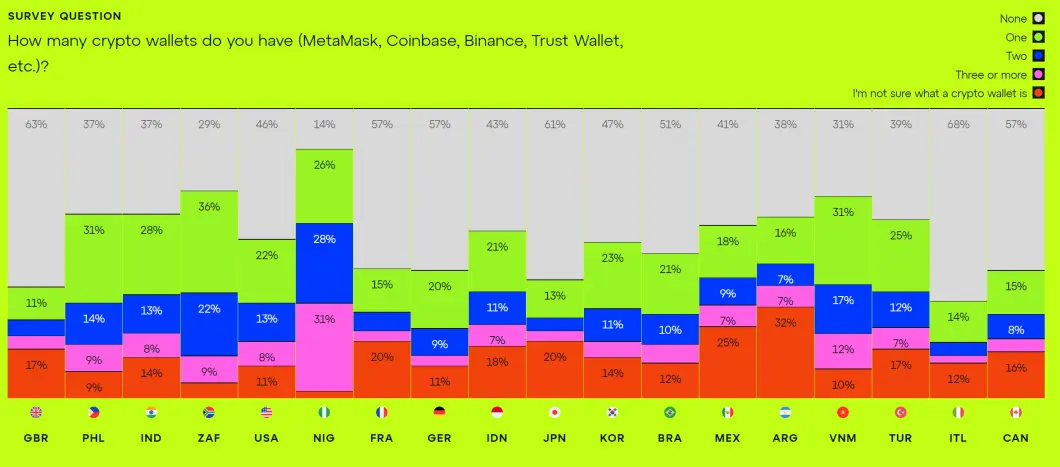
It is easy to see that developed countries have a large part of their population who do not hold any wallet. Emerging countries perform well, with almost one in two people having at least one portfolio. Nigeria is once again at the top of the ranking. Regardless of the geographical area, very few citizens have at least 3 cryptocurrency wallets which suggests that most are limited to simple transactions. I draw this conclusion because if you try a lot of projects like me, you will very quickly accumulate a dozen cryptocurrency portfolios. The margin of progression on use cases is therefore certainly high even for cryptocurrency holders and this also in countries where the holding rate of a minus one portfolio exceeds 50%. The scope for improvement therefore seems to be still enormous.
As for stablecoins, they seem to have gradually made their way into the ecosystem.
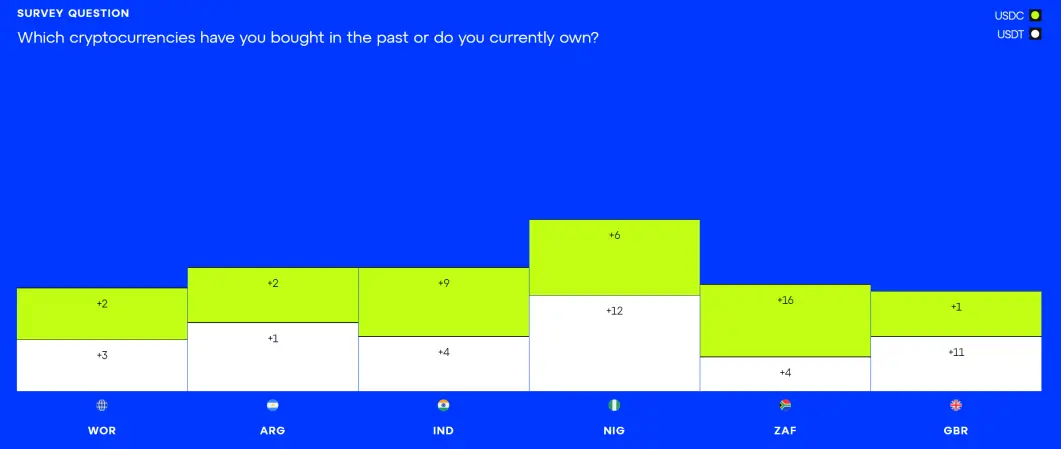
Their use is now very common even if exchanges directly with traditional currencies remain frequent.
I leave the conclusion to the very good survey of the Consensys team and invite you to consult it if you want to deepen. The link is in the resources for this article.
Crypto, web3 and blockchain adoption continues to grow as concerns decrease and crypto is increasingly seen as part of the future. Further, the public has concerns that many respondents believe blockchain may be able to address, like data privacy, value creation on the internet, confidence in the traditional financial system, and malicious content generated by artificial intelligence.
Overall, the 2024 data shows a populace concerned with the current financial system and the influence of big tech companies, including artificial intelligence. People in a number of countries are increasingly interested in cryptocurrency, both in terms of ownership and other web3 activities and uses that continue to mature, including web3 wallets and stablecoins.





