
I just asked today claude.ai to convert 3 PM Perth (AWST) time to Central European Summer Time.
Simple timezone math. UTC+8 minus UTC+2 = 6 hours difference. The answer is 9 AM CEST.
It gave me 10 PM. See the screenshot below 👇
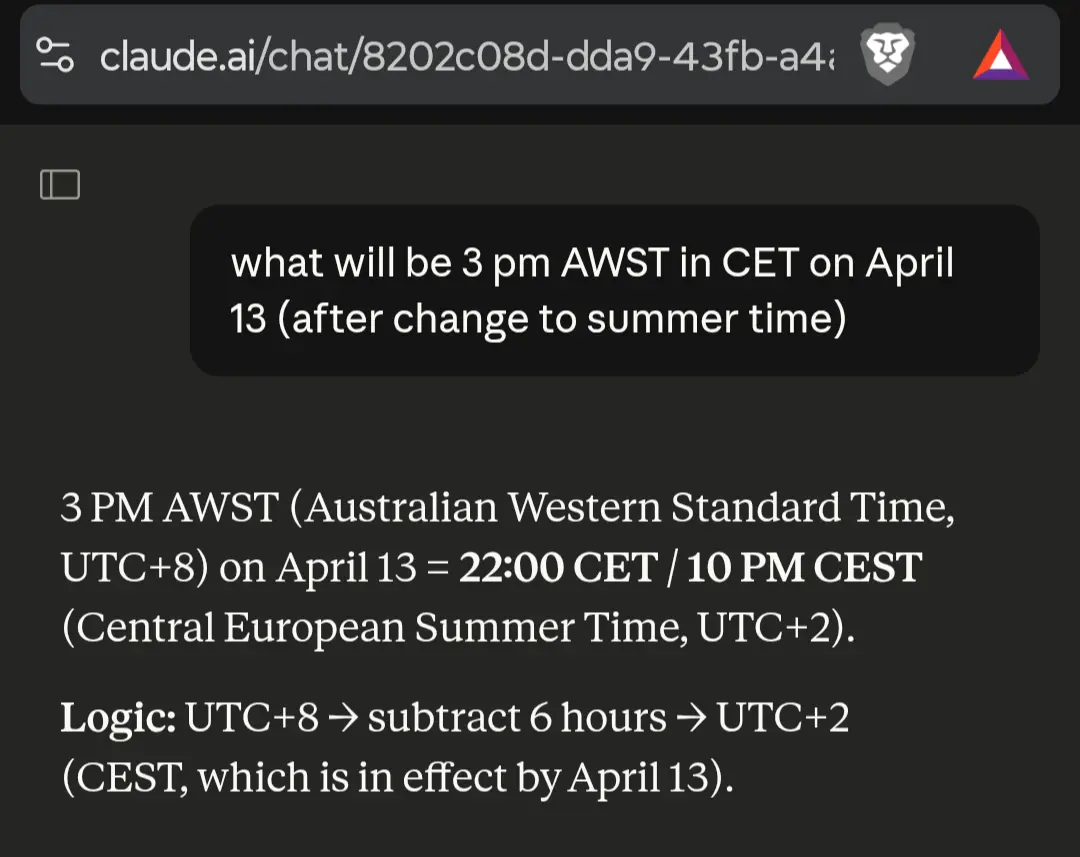
Not even close. And it didn't hesitate for a second. No uncertainty, no caveat, no "let me double-check." Full confidence, completely wrong.
But honestly? This wasn't even surprising to me anymore. Because it keeps happening.
A few weeks ago, I asked an AI to summarize the tokenomics of a mid-cap crypto project. It gave me a beautifully structured breakdown — circulating supply, vesting schedules, emission curve. Except two of the figures were simply made up. Not outdated. Not approximated. Invented. The project's actual docs told a completely different story. If I had forwarded that summary to a client or used it in a post, I would have looked either incompetent or dishonest.
Before that, I used an AI to help me draft a technical brief referencing a specific IEEE standard. It cited the standard by number, described its scope confidently, even quoted a clause. The standard exists — but the clause it quoted doesn't. It hallucinated a piece of a real document. That's almost harder to catch than a fully fake reference, because your guard is down.
And then there are the subtler failures. I've had AI tools miscalculate compound returns over multi-year periods — not by a lot, but enough to matter in an investment context. I've seen them confuse two companies with similar names, attribute quotes to the wrong person, or present outdated regulatory information as current. Each individual error looks minor. Cumulatively, they add up to a tool you can never fully trust without checking.
Here's what makes all of this genuinely concerning: the errors don't look like errors.
When a spreadsheet formula breaks, you get a #REF! or a #VALUE!. When a search engine can't find something, it tells you. When AI gets something wrong, it typically presents it in the same fluent, structured, confident tone it uses when it gets things right. There's no visual cue. No warning flag. No drop in certainty.
This is not a small UX problem. It's a fundamental epistemic issue. We are building workflows, products, and decisions on top of systems that cannot reliably signal their own limitations.
And the adoption curve is not slowing down. These tools are being embedded into legal research platforms, financial analysis tools, medical information systems, educational software. The timezone mistake I described costs me five minutes. The same failure mode in a higher-stakes context costs something else entirely.
Now here's where it gets really interesting — and uncomfortable — for anyone active in crypto.
If AI systems can be this confidently wrong about a timezone conversion, what does that say about AI tokens?
Think about it. The narrative around AI tokens is largely built on the assumption that the underlying technology is as transformative and reliable as the hype suggests. Investors are pricing in a future where AI agents autonomously run businesses, manage infrastructure, coordinate supply chains, and execute complex decisions at scale. Billion-dollar valuations rest on that premise.
But if the foundation occasionally can't do sixth-grade arithmetic without hallucinating the answer — what exactly are we pricing in?
I'm not saying AI tokens are worthless. Some of the infrastructure plays are genuinely interesting, and the compute layer is real. But a lot of what's being valued in this space is narrative, not capability. It's the promise of reliable autonomous AI, not the demonstrated reality of it. And the gap between those two things is still enormous.
The market hasn't fully priced in the reliability problem. It has priced in the dream.
That's not necessarily a reason to avoid the sector entirely. But it is a reason to be far more selective — to ask hard questions about which projects are building around AI's actual current capabilities versus which ones are essentially betting that the hallucination problem gets solved on a convenient timeline.
Spoiler: nobody knows when that happens. Including the AIs.
None of this means AI is useless — far from it. I use these tools every single day. They accelerate research, sharpen drafts, surface connections I'd have missed, and handle the kind of repetitive cognitive work that used to eat hours. The productivity gains are real.
But there's a mental model I think we urgently need to internalize: AI is a very fast, very fluent, occasionally brilliant intern who sometimes makes things up and never tells you when they're guessing.
You wouldn't send an intern's work to a client without reviewing it. The same standard applies here — and to the tokens you're holding.
Check the timezone. Check the citation. Check the numbers.
And check the thesis behind the token.
Every time.






