
As mentioned in my previous article, the upcoming Ethereum Merge is a real technical challenge, and hence, it could fail. All the large investors are getting ready for this possibility and have started to invest into other coins and tokens, in case of. Today, we are going to explore Solana (SOL).
Why Solana (SOL) is an alternative to Ethereum (ETH)
Both of these blockchains are competing to be the world's top smart contract blockchain, which allows decentralized applications (dapps) to run on the blockchain - e.g., DeFi (Decentralized Finance) protocols including lending platforms, like Aave on Ethereum or Solend on Solana.
Ethereum network currently does about 15 Transactions Per Second (TPS) while Solana could do 50,000, although the current TPS is much lower. However, Vitalik Buterin (co-founder of Ethereum) recently explained that the Ethereum road map, including the Merge, will allow Ethereum to utltimately reach 100,000 TPS:
At the end of this road map, Ethereum will be a much more scalable system. By the end, Ethereum will be able to process 100,000 transactions per second.
Regarding the average transaction fee, which has been one of the major drawbacks of Ethereum, it is currently about $0.8 for Ethereum whereas it is about $0.00001 for Solana. Therefore, this transaction fee has significantly decreased for Ethereum, and if it had to increase again, there would still be the possibility to use layer-2 chains like Optimism. In the case of Solana, the very low transaction fee can be a drawback since it makes it easier to attack.
The number of validators on Ethereum 2.0 Beacon Chain (which will replace the Ethereum POW chain after the Merge) is currently over 400,000, while there are currently less than 2,000 validators on Solana. However, the main problem of Ethereum staking consensus is the minimum threshold of 32 ETH which urges the small ETH holders to stake through pools like Lido, Binance or Kraken:
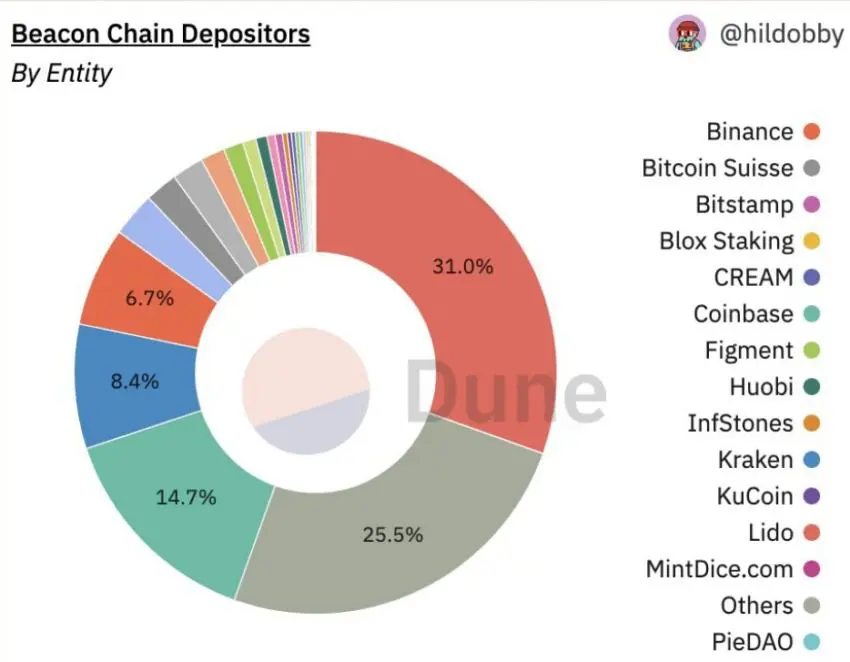
According to a blockchain expert (link below), over 66% of the Beacon Chain validators, represented by only 4 entities (including Binance), would adhere to OFAC regulations, i.e., to the regulator sanctions. After the Tornado Cash event, it sounds that Ethereum 2.0 is not as decentralized as it looks. That's why Solana could have an advantage there, despite all the critics about its centralization, since Solana allows small holders to stake directly on the blockchain, unlike Ethereum.
How Solana (SOL) price could evolve in the near future
No forecast can be guaranteed. However, it is worthwhile to look at the trend:

We can see on the 4 hour chart above that SOL price currently shows a bearish trend, bringing it down to $34.5. If it hits this bottom a few times without breaking it down, one option could be to consider $34 as a support and hence to start accumulating SOL through DCA (Dollar Cost Averaging).
How to make money with Solana (SOL)
Once you own SOL, you can stake it on Solana blockchain, which uses a proof-of-stake consensus, with an average return of 5% per year. It is the most secure solution. There is an unstaking period of a few days, until the end of the epoch. Therefore, if you need liquidity, you will have to wait a bit before using it. Another option is to use liquid staking through Lido or Marinade Finance, or to invest it into lending protocols like Solend or Mango Markets.
In summary
Solana (SOL) seems to be a long term alternative to Ethereum (ETH) since it still needs some improvements to really compete against ETH, for instance by improving its decentralization and stabilizing the network - there have been too many outages recently. Once these issues are fixed, it will make sense to invest more massively into SOL. In the short term, one can still bet on the fact that whales will switch to SOL if any issue occurs with the ETH Merge...
Disclaimer: this article does not contain any financial advice. The information is provided for general informational and educational purposes only.
Please find below a few links to earn a few coins...






