
# 🔴 Card Spotlight #18: Professor X — The Founder of the Dream
-----

*He built the school. He dreamed the dream. He gave mutants a home when the world wanted them gone. Eighteen spotlights in, it’s finally time for the man who started it all.*
-----
## The Dream Begins Here
We’ve spent a lot of time in the X-Men’s world across this blog. **Wolverine** in Post #2. **Magneto** in Post #6. **Storm** just yesterday in Post #17. We’ve explored the berserker, the revolutionary, and the goddess. But there’s one man who connects all of them — one man without whom none of their stories would exist in the way they do.
**Charles Francis Xavier. Professor X.** The founder of the X-Men. The dreamer at the center of Marvel’s greatest ongoing story about prejudice, acceptance, and what it means to fight for a world that fears you.
We touched on his relationship with Magneto back in Post #6 — two friends who chose completely different paths. Today we tell *his* side of that story in full. And we dig into one of the most debated, most feared, and most fascinating cards in all of Marvel Snap. 🔴
-----
## Who Is Professor X?
**Charles Francis Xavier** was born into privilege — the son of a wealthy nuclear researcher, raised in a mansion in Westchester, New York. But privilege didn’t shield him from pain. His father died when he was young, his mother remarried a cruel man named Kurt Marko, and Charles grew up navigating a household full of resentment and emotional abuse.
What set Charles apart from everyone around him was his mind — not just his extraordinary intelligence, but his **mutant telepathic ability**. From a young age, Charles could read minds, project thoughts, and sense the emotions of everyone around him. In a world that didn’t yet know what mutants were, a child who heard everyone’s thoughts and felt everyone’s feelings was deeply, profoundly alone.

That loneliness shaped everything about who Charles Xavier became. He understood — viscerally, unavoidably — what it felt like to be different in a world that didn’t understand you. When he eventually learned that there were others like him — other mutants, scattered across the world, hiding their abilities, living in fear — he made a decision that would define his entire life:
He would build them a home.
### The Dream
Xavier’s vision is deceptively simple and radically ambitious at the same time: **peaceful coexistence between mutants and humanity**. Not mutant supremacy. Not war. Not hiding. Coexistence. A world where mutants and humans live together, each understanding and respecting the other.
He founded the **Xavier School for Gifted Youngsters** — outwardly a private school for exceptional students, secretly a training ground for young mutants to learn to control their powers and, if they chose, to become X-Men. The school was built on the belief that the best way to earn humanity’s trust was to *protect* humanity — to show the world that mutants weren’t threats but heroes.
The X-Men were born from that belief. Cyclops, Jean Grey, Beast, Iceman, and Angel in the original lineup. Wolverine, Storm, Colossus, and Nightcrawler in the revamped team. Dozens more over the decades. All of them shaped by Xavier’s dream, all of them fighting for a world that sometimes hated them for it.
### The Complicated Legacy
Here’s where Professor X gets genuinely interesting — and genuinely controversial. Because the comics have never allowed Xavier to be a simple hero. Over decades of stories, the cracks in his dream have been exposed again and again.
Xavier has used his telepathy to alter memories and suppress knowledge when he felt it was for the greater good. He has kept secrets from his students that they had every right to know. He has made unilateral decisions — sometimes catastrophic ones — based on his belief that he alone could see the full picture. The **House of X / Powers of X** storyline by Jonathan Hickman exposed just how far Xavier had gone in his manipulations, revealing long-buried secrets that recontextualized decades of X-Men history.
Is Xavier a hero? Absolutely. Is he also a deeply flawed, sometimes arrogant man whose certainty in his own vision has caused real harm? Also yes. The greatest X-Men stories have always held both of those truths simultaneously — and that tension is what makes him one of Marvel’s most endlessly fascinating characters.
### The Magneto Question — Revisited
We covered Magneto’s perspective back in **Post #6** — a man whose Holocaust survival shaped his belief that peaceful coexistence was a fantasy that history had already disproven. Coming back to that now with Xavier’s story in full context makes both men richer.
Xavier *knows* what Magneto experienced. His telepathy means he has felt the depths of Erik’s trauma directly. And yet he still believes in the dream. Not because he’s naive — but because he has *chosen* to believe it, despite everything. That choice, sustained against all the evidence and pain that Magneto represents, is either Xavier’s greatest strength or his greatest delusion. Possibly both.
It’s one of the most profound philosophical debates in all of comics — and it has never been fully resolved. Because in real life, it hasn’t been either.
### On the Big Screen
**Patrick Stewart** gave one of cinema’s great performances as Professor X across the original X-Men trilogy and *X-Men: Days of Future Past* — bringing weight, warmth, and quiet authority to the character that made him iconic. **James McAvoy** portrayed a younger Xavier in the prequel series, showing the idealist before the wheelchair and before the losses that would test his dream most severely.
With the X-Men now entering the MCU, a new chapter for Charles Xavier is on the horizon — and fans everywhere are watching closely to see who takes up the mantle next.
-----
## Professor X in Marvel Snap
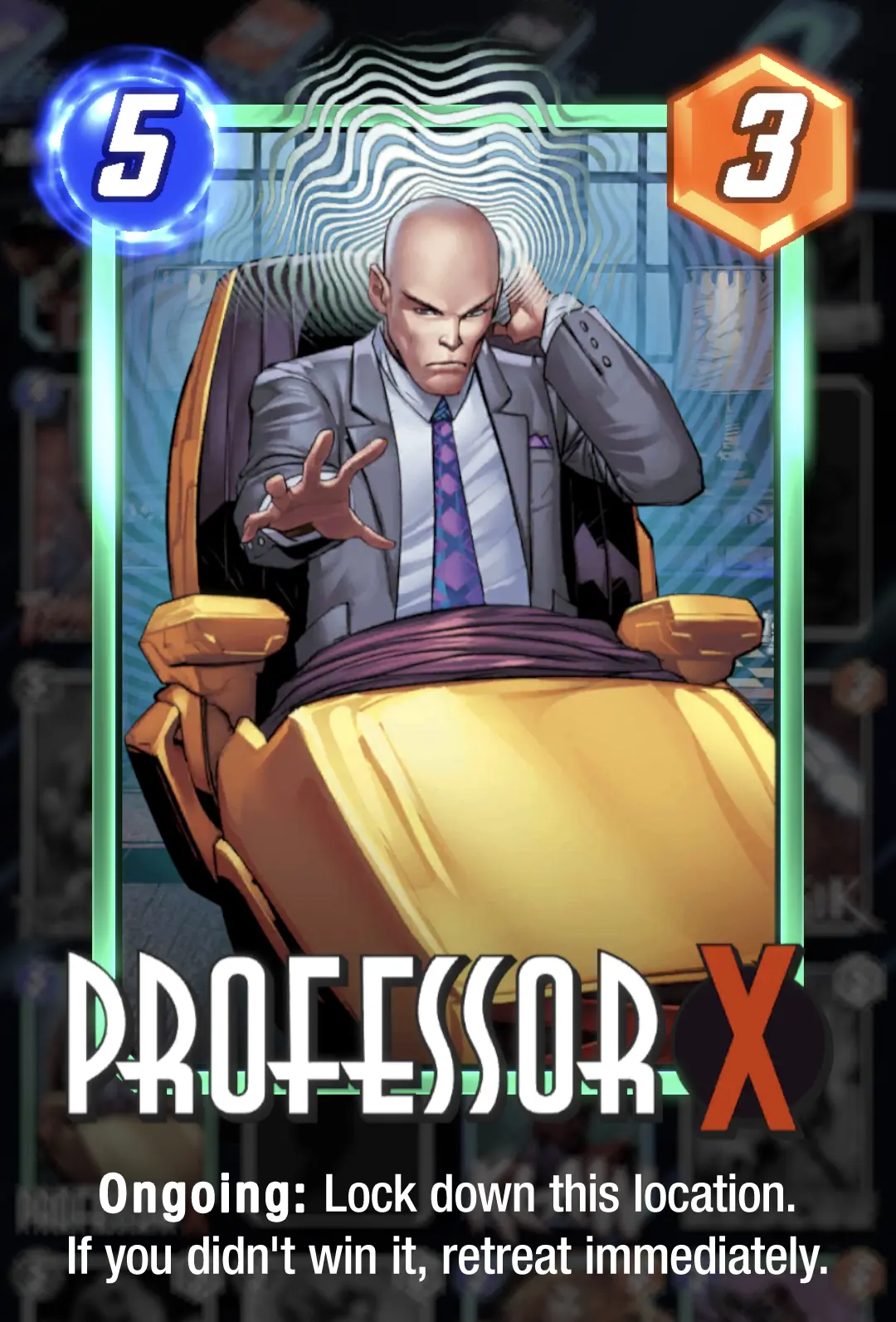
Professor X in Marvel Snap is one of the most discussed, most feared, and most carefully balanced cards in the entire game’s history. His original card has been a design challenge for Second Dinner since launch — because an ability that completely locks down a location is, by its very nature, extremely difficult to balance.
Professor X is a Series 1 card — meaning every player gets him for free early in the game. He costs 5 energy and has 2 Power, with the Ongoing ability: “Moving is the only way to add or remove a character from here.”
Two Power for 5 energy is terrible on paper. But his ability is one of the most oppressive in the game. Drop Professor X at a location and it is **completely sealed**. Cards cannot be played there, moved there, or generated there. Cards cannot be destroyed, switched sides (blocking Viper and Green Goblin), or moved away from that location by any card effect. The only exception is movement cards — cards that physically move themselves.
Whatever Power exists at that location when Professor X lands is essentially locked in permanently. No Iron Man doubling. No Magneto pulling cards away. No Shadow King wiping stats. No Killmonger destroying your cards. The location is yours — or theirs — exactly as it stands.
The strategic implications are enormous. Build a dominant position at one location, drop Professor X there, and you’ve guaranteed that location for the rest of the game. Your opponent cannot respond, cannot counter, cannot adjust. The location is done.
### 🔧 The Nerf History — A Design Headache
One of the biggest questions that both Marvel Snap developers and players have had since the beginning of the game is how to balance a card like Professor X. The team has tried balancing Charles Xavier’s stats, but the stats aren’t the issue — it’s his effect of completely locking down a location.
Second Dinner has wrestled with Professor X more than almost any other card in the game. Too strong and he makes lockdown decks oppressively unfun to play against. Too weak and one of the game’s most thematically perfect cards becomes unplayable. His current form — 5-Cost, 2-Power — represents their best attempt at finding a cost that makes committing to his lockdown feel like a meaningful sacrifice of energy rather than a free win.
The most significant rework came in the June 13, 2024 OTA patch, where Second Dinner attempted a solution that fundamentally changed how Professor X worked — specifically to address how he interacted with the lockdown archetype alongside Storm. The community’s reaction was fierce, with many arguing the change went too far. It sparked one of Marvel Snap’s most heated balance debates.
His current form is the result of years of iteration — and he remains one of the most skill-testing cards in the game to use correctly, because committing 5 energy to lock a location you’re already winning requires reading the board state with precision.
## How to Play Professor X Today
**Original Professor X — The Lockdown Core** — As we covered in Storm’s post yesterday, the classic Professor X + Storm combo is one of Marvel Snap’s most iconic two-card lockdowns. Storm floods a location on turn 3. Professor X seals it permanently on turn 4. Whatever you have there at that moment is locked in — game over for that lane. Fill the rest of the deck with power-building cards to dominate the other two locations.
**Original Professor X — The Spider-Man Setup** — Combine with our very first spotlight, **Spider-Man** from Post #1 (his original lockdown version), for a triple-layered location control strategy. Storm closes the door on one location. Spider-Man temporarily locks another. Professor X seals the one that matters most permanently. It’s a deck that methodically removes your opponent’s ability to play the game location by location.
**Professor X — X-Men Energy Engine** — Build a deck full of X-Men cards: Storm, Wolverine, Cyclops, Marvel Girl, Beast, Colossus. Stack them at Professor X’s location for escalating energy bonuses every turn, then use that extra energy to drop massive finishers ahead of schedule. The energy ramp this creates can be genuinely game-breaking when the location cooperates.
**Best Synergy Cards — Original Professor X:**
- **Storm** — The perfect setup for Professor X’s lockdown. Close the door, then weld it shut.
- **Spider-Man** — Layered location control across multiple lanes
- **Magik** — Adds a turn 7, giving you more time to build power before Professor X seals the location
- **Cosmo** — Blocks opponent’s On Reveal responses after the lockdown lands
- **Iron Man** — Double your power at the location *before* Professor X seals it permanently
**Best Synergy Cards — Professor X X-Men:**
- **Storm** — An X-Man who generates energy bonus AND controls locations
- **Wolverine** — An X-Man who regenerates and grows, feeding the energy engine
- **Cyclops** — A classic X-Man with solid base stats for the energy ramp
- **Marvel Girl / Jean Grey** — Prevents opponents from playing their most expensive card at a location
- **Beast** — Returns cards to hand with reduced cost, great for replaying X-Men at Professor X’s location
-----
## The Verdict
Charles Xavier built his dream on a foundation of hope, sacrifice, and an unshakeable belief that two groups of people who feared each other could learn to live together. It is a beautiful dream. It is a complicated dream. And it is, as the comics have shown again and again, a dream worth fighting for — even when it’s hard, even when it fails, even when the man at the center of it is imperfect.
In Marvel Snap, his original card asks you to do something similar — to commit, to lock in, to trust that what you’ve built is enough and hold your ground. His X-Men card asks you to believe in your team, to surround yourself with allies, and to let their combined strength lift everyone higher.
Two cards. One man. One dream. 🔴
-----
*Thanks for reading Card Spotlight #18! Are you a Professor X lockdown player or do you prefer the X-Men energy engine version? And what’s your favorite Professor X story from the comics or films? Drop it in the comments!*
*— **Seven-NATE-Nine***
-----






