
I wrote this rather longish article as some kind of an introduction to the book „Viveka – the voice of inner Guru“ (not yet available in English). I am aware that the article's content can be complex and hard to follow at times, but if you want to understand how the words we use enslave us, and how they can be used to liberate us, it will be worth your effort.
***
In spiritual circles, it is not very popular to speak prizeworthy about the mind. The mind is the divinity worshiped by science, not spirituality. Moreover, many spiritual teachers will say that the mind is not suitable for exploring deeper truths about life. In this article, I will try to show you what great potential our mind has. You might find out that it is exactly the mind who will reveal the final truth about the world you are in.
To do that, I might call upon the sources of ancient spiritual knowledge. However, I find it more appropriate to call upon the very subject of this description – the mind itself.
To understand the value of the mind, you don't need special knowledge, nor the belief in some authority (in that case, it would not be the matter of the mind, but the matter of faith). What you need is simple and clear LOOKING into what you already know and see.
Before I begin, let me tell you that the above description of necessary "tool" (I'll repeat: "simple and honest looking in what you already know and see") is at the same time the description of forgotten skill called viveka. Viveka is the discriminative power of the mind, and since that power can be improved through practice, the same name – viveka – describes the very process of improving, as well.
Concepts and vasanas
First, you have to understand that our mind, to work and fulfill its function, uses concepts. Concepts are some kind of inner symbols. When I wrote "symbols," I didn't mean outer signs (for example, the letters we use are outer symbols), nor did I meant that concepts have allegorical meanings. "Mental symbol" or concept is something the mind uses to do its job – to think.
Symbols mind uses to think we can not see or feel directly, except when we think about them. Neuropsychology and similar sciences until now could not find the correlates of thoughts in the neurons or other material parts of the brain. It is even questionable if the thinking process can be connected to a certain type of activity of the neurons. For example, our memory is not located at someplace in the brain. There is no neuron, nor neural activity, that can be connected with the memory of your grandmother. So, where is that memory? Science is not even close to answering such questions, but what we know for sure is that our awareness and its content are something much more complex than, for example, the processor and the memory blocks of modern computers.
On the other hand, even though we do not understand what is going on in our brains, we use them in practice. Our mind handles many concepts. We learn. We think.
Vasana is the term I like to use to point out the staff of our mind, the concepts or the symbols necessary for us to think. It is the word from yoga and it is best translated as "mental pattern". It is not only one thought but usually a series of thoughts. In the book "The Elimination of the Karma Factor" I also used the term TACK (thoughts-action-circumstances-knowledge), to describe the consequences of thinking patterns in our mind.
So, we think by using vasanas, concepts or mental patterns. When you thought: "Today is a beautiful day. After lunch, I will go for a walk.", you joined at least five vasanas, five concepts in two simple sentences. Day, beautiful, lunch, time, walk. To do that, you had to learn the meaning of each of those words, and with it each of those concepts. Learning the language goes parallel with learning the concepts. Those two are inseparable, but nevertheless, different. If you were born in China, the words would be different, but the concepts would be the same. Viveka is concerned with concepts, but it has to use words, just as you have to speak some language to think about concepts.
However, note that linguistics can have some influence on the concepts. You probably know that the expressions in one language can be more practical for certain concepts. German, for example, is a sharp, precise, technical language. French or Italian can be more suitable for poetry, and so on.
Modern global culture also influences the concepts behind the words. "Like" and "Share" have familiar meanings, but on the internet, they could be interpreted slightly differently. With new concepts, we need new words or different interpretations of the old ones.
And that brings us to the insight into the strength and weaknesses of our minds.
The Strength of the Mind
The strength of the human mind is in its ability to create more and more complex concepts. This ability is born from the kind of "selfrefferal" quality of the mind; it can think about itself and thus creates closed circuits or loops. Based on old vasanas, the mind can create new ones. It always comes back to itself, checks what it knows and upgrades that knowledge with new concepts. The linguistic creation of new words follows that process.
Due to that ability we don't have to explain EVERY concept we have learned so far. For example, we don't have to explain what we mean when we say "automobile" (starting from explaining the concept of a vehicle, the weel, the engine... or even the materials used for creating the automobile). Once we have learned what is "the automobile", it stays as a concept in our mind to be used by the mind when needed.
The existence of that complex concept enables us to communicate. Without significant SKIPPING of lower-level meanings necessary for understanding the upper level, we practically could not communicate with each other. All our communication, even the simplest one, would be prolonged and time-consuming, (You remember Ents from The Lord of the Rings? Every sentence of entish language was enormously long because they were not skipping over the lower level meanings and included concepts. The net result: Ents needed a lot of time to express the simple idea, such as "We live in a dangerous time. We have to go to war.")
However, the strength of our mind at the same time reveals its weakness. The concepts are inside of our mind, and we can compare them ONLY using the linguistic form – words.
The Weakness of the Mind
Look at the following chart:
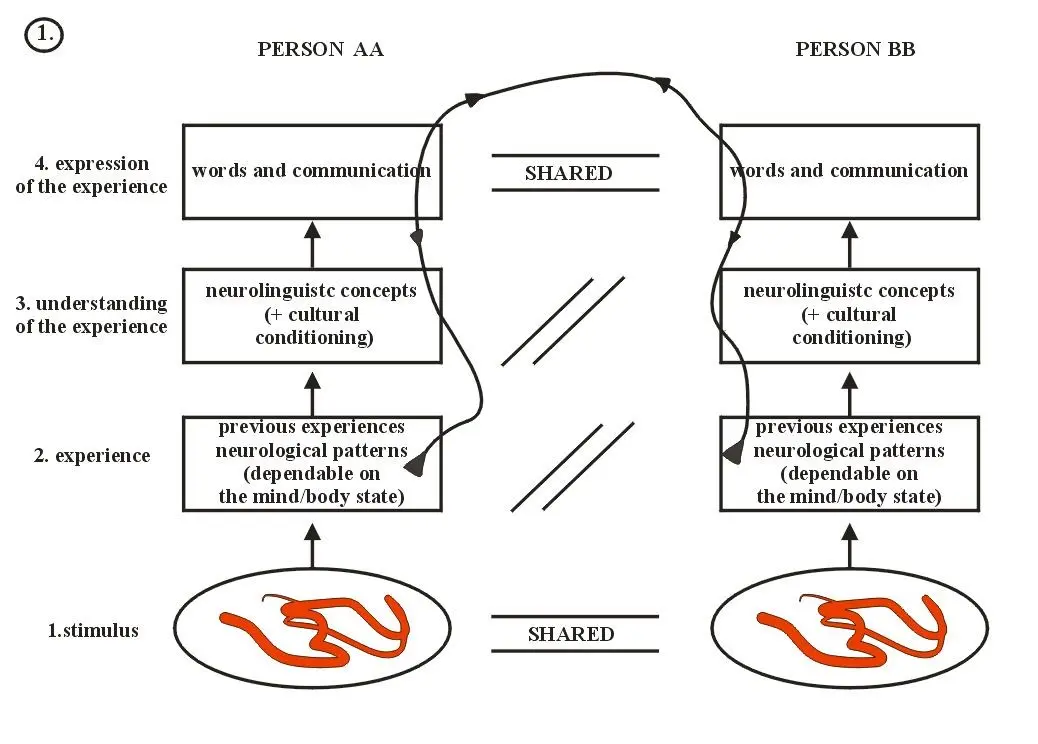
Person AA and person BB share the experience. Let's say it is a simple experience such as "swimming in the sea".
Vasanas or concepts necessary for us to think about that experience are created around our impressions about it (and, of course, are dependant on neurological patterns created by previous experiences – for example, of the experience with water in general). Further, those concepts are under the influence of social and cultural customs (for example, how our society views the usage of water – it is not the problem now but a couple of hundred years back, swimming or bathing was not considered healthy, especially for the woman).
And, finally, persons AA and BB use the same words and communicate with each other. It may be that there are some differences between their inner understanding of the concepts (levels 2 and 3, which are not shared). Still, the idea is simple enough and the communication is acceptably correct.
"Acceptably" is quite important here, because it is clear from the chart that communication can not be complete nor accurate. The inner differences do not allow it. We just accept that the communication is "good enough". That is practical, and we use that practicality.
Some philosophers, such as Jacques Derrida and his deconstructionism, are convinced that real communication between people is not possible, exactly because of the mind's ability to skip the constituents of the concepts and the ability to create new vasanas, new concepts; the abilities that enabled us to think and communicate in the first place.
If we stick to simple ideas, communication will be good enough. Acceptable, but not accurate. We simply can not reach another person's mind, so the real meanings and subconcepts of the words are beyond our understanding. The accurate idea beyond "swimming in the sea" pronounced by another person will remain unknown. We are saved by the fact that we literally share some experiences, and when we talk about them, they seem similar enough, so we do not ask for detailed explanations.
But, when we face more abstract ideas, we have to ask about them!
What somebody means when s/he says "freedom"? What exactly does it mean when that person says "God"? Beauty, culture, truth, creation, sin, joy, passion, opinion, politics, morality, honesty, necessity...
There is not much hope that our linguistic expressions will adequately transfer our experience.
Nevertheless, those expressions – words – are the building blocks of our communication, philosophy, literature, arts... Actually, if that unclearness would not be here, we would not have our specific human culture full of creative misunderstandings. There would be no dramas expressed so eloquently in arts, but also there would be no great tragedies, maybe even no wars. They are both the consequence of the same strength and the weakness of the human mind – the building of complex concepts and skipping of the lower-level meaning of those concepts.
Inaccuracy of the words
If we take into account the understanding of the strength and weaknesses of our mind, the linguistic expressions – the words – are seemingly non-accurate hosts or carriers of the concepts. However, they are the only means for us to think about or with concepts. Everyone who has the experience of thinking in more than one language clearly understands that linguistics is more than just a form.
But then, in practice, when people talk (and think) they are utterly non-accurate. Sometimes it is due to ignorance or wrong understanding of ideas, but mostly it is due to the conceptual mess in their minds. We use words as we find fit in certain moments and we are usually not consistent in expressing the concepts with words.
The quilt is only partially ours; partially it is the nature of human language. We have more than one word for each concept, and the same words sometimes have more than one meaning. If we add the problem of the context (the influence of the meaning of other words on the meaning of a particular word) the result can be a considerable bedlam.
That is the reason why we don't trust words. Their meanings can be bent, spun, understand differently. It is possible to lie unnoticed. It is possible to speak the truth, but nobody will hear it.
Science tries to solve that problem with logic. However, logic is not interested in the content but in the rules of making correct conclusions. Logic is a tool for making a conclusion but does not have anything to do with the meaning of the conclusion itself.
In spirituality, that problem is solved only with silence. It has been said that words do not communicate the experience of life correctly and that it is better not to rely upon them. And if it is so, there is no use of relying on the mind, too.
The Golden Line Connecting Concepts and Words
But then, our mind has a part in everything we do. Is the connection between the concept and the word so unreliable? Or we just made it that way?
The answer to that question would require much more space than this article, maybe a book or two. I will not go into details here, but instead, I will just lay down for you the golden line which connects concepts and words. That golden line is the basis of the discipline and the skill of viveka.
Viveka considers the connection between concepts and words to be direct and that the complexity and unclearness of the meanings belong to other factors and not concepts or words by themselves.
Those "other factors" are known under the name of "mistake of the mind" or, in Sanskrit, pragya aparadha.
I explained earlier what is "conceptual skipping" and how the ability to upgrade the present concepts makes our thinking and communication possible. We CAN (and many times we do) accept the wrong upgrade by not asking how this new complexity came about.
If we held strictly and directly to the connection between words and ideas, that mistake would not be present. But, we do not do that. We accept what is not obvious; in our new concepts, we build in feelings, reactions, instincts, culture, social indoctrination, etc. The resulting patterns are our beliefs, and those beliefs are constantly breaking the direct connection between ideas and words. The net result is that words can mean literary anything.
I will try to give you an example of simple pragya aparadha or the mistake of the mind.
The sentence: "The politicians XY always tells the truth" is based on a conceptual mistake. It is unlikely that the concept "always" is used correctly here, for it is unlikely that any man would really always tell the truth and never ever pronounced any lie at all.
However, in everyday communication, such a statement could be acceptable. The politician XY may be the person who in his political carrier didn't lie about anything of real importance. However unlikely that is for a politician, it may be acceptable. The idea is communicated on the level of "good enough". But, if we would take it on the level of viveka (strick connection between concepts and words) then it is plainly incorrect.
That non-accuracy becomes the basis for building other constructions, ending up in serious illusions like " Politician XY always tells the truth, so you have to believe what he is saying now."
Let's say that you can confirm that whatever politician XY said in the past was true. Ok, that is what you know. But, that does not necessarily imply that you have to trust him now. In practice, people do that – they believe based on experience (so, they accepted something as good enough, reasonable to believe, etc.). Try to notice that the "necessity to believe him now" is not implied in concepts, in words you hear or think, but in your previous experiences (patterns in your mind). That is called pragya aparadha – the mistake of the mind. The mind thinks it is logical, reasonable and obvious. But it isn't. The words do not carry that meaning. The wrong interpretation of the words comes from somewhere else, not from them.
That is the way we build numerous construction. We believe in them, and we do not question their origin. The words, however, are not guilty of that mistake. They innocently offer their content. It is ours if we want it. Usually, we go for the superimposed projections, not for the clearness of the meaning.
Viveka goes for clearness. It is not concerned with our beliefs or that what seems to be present, but not by virtue of the words. However, you have to be aware that viveka would not improve our communication! If you would hold on to viveka in everyday talks, you would end up in funny situations depicted for example, by globally popular "sociopath", dr. Sheldon Cooper from the TV series "The Big Bang Theory". He listens to what has been said, not what you meant by it. We find that entertaining, because all other people, we included, suppose that behind spoken words people have many unspoken thoughts and ideas we, as socially adapted, consider self-evident. Sheldon, in his accuracy in interpreting what has been said, disregards social and purely human constructions, thus often exposing them as artificial and unnecessary.
Viveka is not meant to become a new communication paradigm. What it can do is to remove unnecessary constructions from our minds. Words do not contain them. Constructions (conceptual skipping, omitting, and adding of meanings) can exist only in our minds. If we succeed in connecting the concepts and words (thoughts) firmly, the places we made mistakes become visible. The mind can not slip so easily anymore from accuracy to non-accuracy. The mistake of the mind is corrected.
To achieve that, you need practice. It is necessary to remove the old habit of skipping, jumping, supposing, believing, etc. That habit is often invisible, and even if you expose it once or twice, it has a tendency to repeat itself again and again.
However, finally, if we do that right by consistently and repeatedly removing the mistake over some period of time (meaning if we truly develop viveka in our mind), the result will be unexpected: the words we use can liberate us from the chains of the illusion.






