I love shrimp 🦐
They're protein-packed fireworks, bursting with flavor, quick to cook, and far more exciting than the dry, monotonous chicken breast.
But the crypto ocean isn't just about the small fry. It's also about the whales.

And when whales move, everyone feels the current.
Crypto Whale Watching
Picture standing on the deck of a boat, scanning the horizon, when a dark shape rises from the deep. The water shifts. A massive creature breaks the surface, reminding you how small you are compared to the ocean.
I haven't seen a whale in person, so I can only imagine.
Whales as major players in the crypto ocean hold large amounts of cryptocurrency, which gives them the power to either disrupt or stabilize the market ecosystem. The OG crypto whale Satoshi Nakamoto holds a million BTC in a single wallet that has remained inactive since 2009. This amount is 5% of all Bitcoin that will ever exist.
Active whales include early adopters, exchanges, venture capitalists, founders, institutional investors, and even governments.
The trades these whales do can foreshadow price swings, liquidity shifts, or institutional moves, if we can separate the noise from the real signals. Cryptonator's discusses this quite thoroughly, so if you want to read more on that, check out his guide. It's in his Junk Box.
Whale Alert tracks these large transfers and publishes them in real time, making it easier to spot unusual activity before the market fully reacts. One such activity is when large amounts are moved away from large exchanges.
I wrote about a whole week's outflow from OKEX (now OKX) on Publish0x recently, which you can read about *here. Notice that I mistakenly calculated the total outflow to an inflated number. After rechecking the tweets from Whale Alert, I realized that there was only one transaction coming out of OKEX and that was 4,996 BTC.
The other 4,690 BTC was coming into OKEX from an unknown wallet. That's a life-changing 300,586,912 USD difference.
Thus, the total outflow that week should have been 8,751 BTC.
Having made this silly gaffe, I started to look into the kind of transactions Whale Alert was flagging and why they're considered out of the ordinary.
The Transactions Worth Examining
1. Dormant Wallets Waking Up
One of the most dramatic events tracked was when a dormant wallet that has been inactive for years suddenly awakens. In some cases, this may mean old funds were recovered. It could also reflect strategic repositioning, estate transfers, or long-term holders deciding to finally move coins.
Just recently on July 27, a dormant account with 2000 ETH ($3.83 million) suddenly came back to life after sleeping for 11 years.
This followed an earlier 2000 ETH dormant wallet, reported to have woken up on July 21.
Back in 2015 when these wallets were funded, it was worth $620.

Many such dormant accounts have started waking up one by one this year. A wallet that's been dormant for 10.8 years containing 10,000 ETH in April; addresses with 2,000 ETH, 790 ETH and 400 ETH in May; 401 ETH in March; and 99 ETH in February.
On the Whale Alert stack these dormant ones will have a ZZZ mark.
When a wallet wakes up after 10, 11 years, the market naturally starts asking why.
2. Exchange Outflows (Coins Going Out)
Large transfers from exchanges to unknown wallets often attract the most attention online. These movements can suggest that whales are pulling assets off exchanges. This may point to accumulation or long-term storage.
However, it's not always straightforward. The coins could be headed to cold storage, an OTC desk, a custody provider, or another controlled wallet.
Exchange outflows often reduce immediate sell-side liquidity, which is why traders treat them as potentially bullish signals.
3. The Movements of Stablecoins
Large stablecoin transactions can be especially important. When huge amounts of USDT or USDC are minted, burned, transferred, it can signal changes in market liquidity.
Because stablecoins often behave like the crypto market's cash layer, when large amounts move, it may suggest capital is (1) being prepared for deployment, (2) withdrawn from circulation, or (3) repositioned across exchanges and chains.
When new stablecoins are minted, it's like printing money. When they're burned, it's like money being pulled out of circulation. This is similar to how central banks influence economies.
4. Cross-chain Swaps
Another category is cross-chain movements. When whales move funds between Ethereum, Tron, Solana, other chains, it reveals where liquidity is likely being parked.
A whale moving stablecoins from Ethereum to Tron may be seeking lower transaction costs, while swapping to Solana could suggest confidence in that ecosystem's activity and momentum. These cross-chain transfers may reflect speed, fees, yield opportunities, or ecosystem preferences.
5. Corporate Moves
Not every large wallet belongs to a mysterious crypto native. Some can be tied to exchanges, custodians, or funds. Their movements are slow, heavy and intentional. Often signaling rebalancing or treasury operations rather than speculation.
The Ranks of Bitcoin Holders
A whale alert doesn't necessarily tell you whether a whale is buying or selling.
It doesn't show intent. It doesn't tell you whether a whale is preparing to trade or simply reorganizing.
It just shows the splash.
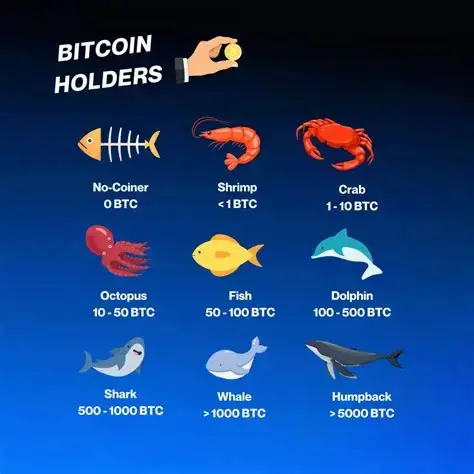
If you found this post insightful or just want to support a fellow shrimp in the crypto ocean, kindly upvote.
Drop your thoughts in the comments. Are you a shrimp, a dolphin, or a whale when it comes to Bitcoin?
Also, follow my journey on Hive, or Steem, or Blurt, where I explore how blogging itself can earn crypto 🌊





