
This week's info post is about the "Copy Trading" category on my updates.
- Copy Trading is my ONLY category that has a minimum investment. I wanted everything to work whether you have $10 or $10,000 but MEXC puts a minimum of $30 on copy trading (currently). [Edit: they've updated that to $50]
- Anyone who's been following my posts knows that my returns from copy trading are impressive (50% profit in the last month), so I suspect many of you are champing at the bit, desperate to know who I'm copying, how I'm set up, and so on.
- I'm going to potentially bore you with this post first, explaining the dangers and how I got bollocksed, to make sure you understand that this is a risky business. Please don't ignore it. :)
I'm not sure who first popularised copy trading - perhaps eToro? - but the idea is simple and very, very tempting.
I mean, why go through all the trouble of learning to trade - learning technical analysis, learning fundamental analysis, spending hours examining charts, reading news, trying to figure out where the markets are going - when you can just copy a professional's trades and give them a percentage of your profits?
It's the TradFi "investment advisor" without the suits, without the phone calls, without the BS clever talk to convince you to put money where you shouldn't, because you're copying their trades. You win when they win, you lose when they lose. They care because they're invested in it as much as you are.
Except most aren't.
And that's why copy trading really, really sucks unless you're very, very lucky.
(Or know someone who lost $4,000 learning how not to do it.)
I'm not going to explain how to set up copy trading on MEXC, as they have excellent guides. Basically, you choose "lead" traders to follow, decide how much to put in, set your parameters (I'll look at that both this week and next), and start it running.
Most importantly, copy trading on MEXC is futures trading - shorting or going long, betting on whether the price goes down or up (respectively). That kind of trading is beyond my understanding and skill, but the details of how it works are less important than one vital fact: it's leveraged trading.
Leverage means each trade is multiplied by 2, 7, 10, 100, 200 or however many times (up to 500 on MEXC), and every market movement is amplified accordingly.
And yes, that's where the danger lies.
You might see ROI numbers that are barely believable on a lead trader's stats: 2,000% profit or loss, 3,000%, 5,000%:
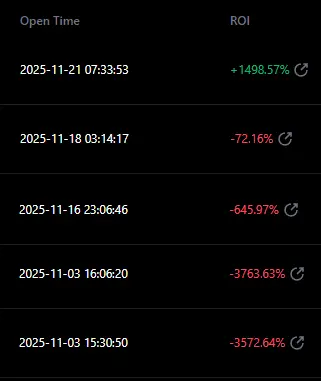
You might also see impressive charts and ROI numbers on the list of available traders, many of which are manipulated and misleading.
Frankly, it's a minefield.
How I Lost $4,000
I have an extremely bad habit of half-arsing things. In other words, I see something that looks good, do a little research and jump in.
I should do more research than I do, and that's how I got painfully screwed by copy trading.
I lost over $4,000, more than 25% of my entire investment, most of it in a single week.
I now understand why that happened and can share it with you, so you can avoid it. Hopefully.
1. I put almost my entire investment into copy trading. That's just stupid. And it's why I now have 3 categories. I am very thankful that I got out with as little damage as I did... 25% is painful but at least I didn't lose everything through my own idiocy.
2. I didn't test new lead traders for at least a month. Most of the bad ones will fail dramatically within that time, though you can never (ever) be completely sure. I was impatient and gave them a week or two, which is far too little time.
3. I put too much into copying when testing. I should have limited each lead to the bare minimum ($30 right now) even if their profile says something else. It's all based on percentages anyway, so I should've ignored their "minimum $500" nonsense and tested them with a tiny amount. I'd still have seen the wins and losses. And they can't drop you, as far as I'm aware, so screw them and their minima.
4. I should have noticed that there's a setting to force "isolated" or "cross" margins in the copy trading setup. Isolated margin means that you can only lose the money you put into the position (or add later); cross margin opens up your entire copy trading balance for use. I should've considered limiting them to isolated margin in testing, though that's more of an issue when you're putting more than $30 in, and can severely skew testing accuracy. As long as you test thoroughly (as far as possible), it's not so important.
5. I didn't sufficiently investigate each trader's lead trade history, showing all their wins and losses for 180 days, which is obviously useful. It also shows you how frequently they trade and shines a revealing light on all those people with impressive 1,500% ROI... who actually did one trade months ago where they bought BTC or ETH in a dip, it pumped and they sold (or are still holding) and haven't traded a single thing since. They just wanted to appear on a top traders list, rather than actually trade, and are consequently as useful as a chocolate teapot.
6. I didn't realise the importance of the amount of money they're playing with. Someone who's invested $50 is less likely to worry about losing everything than someone with $50,000 invested. There's a frighteningly large number of so-called professional traders who crash and burn every couple of weeks, wait a bit, rename their account and start again. So they lost $50, so what? So their $50 might be your $500 or even your $5,000, that's what.
7. I didn't verify how much of their total fund they put into each trade. If you're going to lose 5,000%, even temporarily, you'd better not be putting more than 1.5% of your total investment into that trade. And it'd better be the only trade. Someone who puts 0.5% into each of 3 trades is much better than someone who dumps 2% into the same 3 trades - unless they're all isolated margin and closely monitored, you risk losing everything in the latter.
8. I believed profiles more than I should, especially when I know the internet is a gigantic pile of garbage and lies. "I'm a professional trader since 2015, this is how I support my family." Yeah, and I'm Jennifer Lawrence. Honest. Look at the data, not the spiel.
9. I learned too late that a lot of lead traders use it for bad purposes, abusing existing systems. For example, there's a consensus on Reddit that suggests professionals use the system for "exit liquidity". I have no idea how they do that, but I understand the concept of Wall Street frat bros screwing people out of their hard-earned crypto to exit a coin without losing their own money. Finance scumbags are, as we all know, a common breed.
And on top of all that, I couldn't figure out good stop-loss settings - and still can't. Crypto's so volatile that I think you just have to throw in and cross your fingers, with copy trading especially when there's leverage involved. MEXC only allows a 100% ROI stop loss maximum and many traders drop under there before a rebound, so I'm still uncertain how it's useful. Same goes for TP, of course, though you can always set that at 10,,000% or something (but then why would you stop there?!).
What Happened
With all those mistakes in mind (and any others I forgot for now), I piled a bunch of money into copy trading. I split it between 10 different traders, with anything from $100 to $2,500 in each, depending on how they looked when I did my half-arsed research.
And everything went really well for a little while. Some crashed out quickly and I lost $100. Others did well and I was up about $3,000 in total.
Then there was a dip.
And the wheat separated from the chaff.
Unfortunately for me, the chaff had a lot of my money. And lost it all because prices dropped under their liquidation thresholds and they weren't watching (or simply decided not to bother getting out before losing everything).
The wheat - a single good trader - had the rest. Their loss was temporary and well-managed: they had very large, safe margins, small percentage trades, bought in some more at much lower prices to expand their positions, and ensured it remained survivable until the dip passed (as it did).
Imagine logging in to your exchange account and seeing this:

And that, dear reader, is why I wrote a massive long post about the dangers of copy trading.
Next week, I'll look at Copy Trading again, covering my approach, my settings, some traders to avoid, and - most important of all - the lead trader I follow and trust. And who hasn't let me down in 3 months.
Have you tried copy trading? Had any luck? Follow anyone great on MEXC? Go on, share your wisdom!






