
We have all been there. You pay a hefty monthly bill for high-speed internet, but you only use it to stream videos or scroll through social media for a few hours a day. The rest of the time, that expensive bandwidth just sits there, completely wasted. The same goes for that powerful gaming laptop or PC gathering dust in the corner, or the extra storage space on your hard drive that you never fill up.
What if your hardware could pay for itself? What if you could rent out that unused digital space to global users and get paid every single month?
This is no longer a wishful thought. It is exactly what DePIN is doing right now. It is one of the fastest-growing trends where crypto meets the physical world, and it is changing how we think about tech infrastructure.
What on Earth is DePIN?
DePIN stands for Decentralized Physical Infrastructure Networks. Don’t let the long name scare you; the concept is incredibly simple.
Think of it as the Airbnb or Uber of technology. Uber does not own a massive fleet of cars; it connects people who need a ride with people who own cars. Airbnb does not build hotels; it connects travelers with people who have empty rooms.
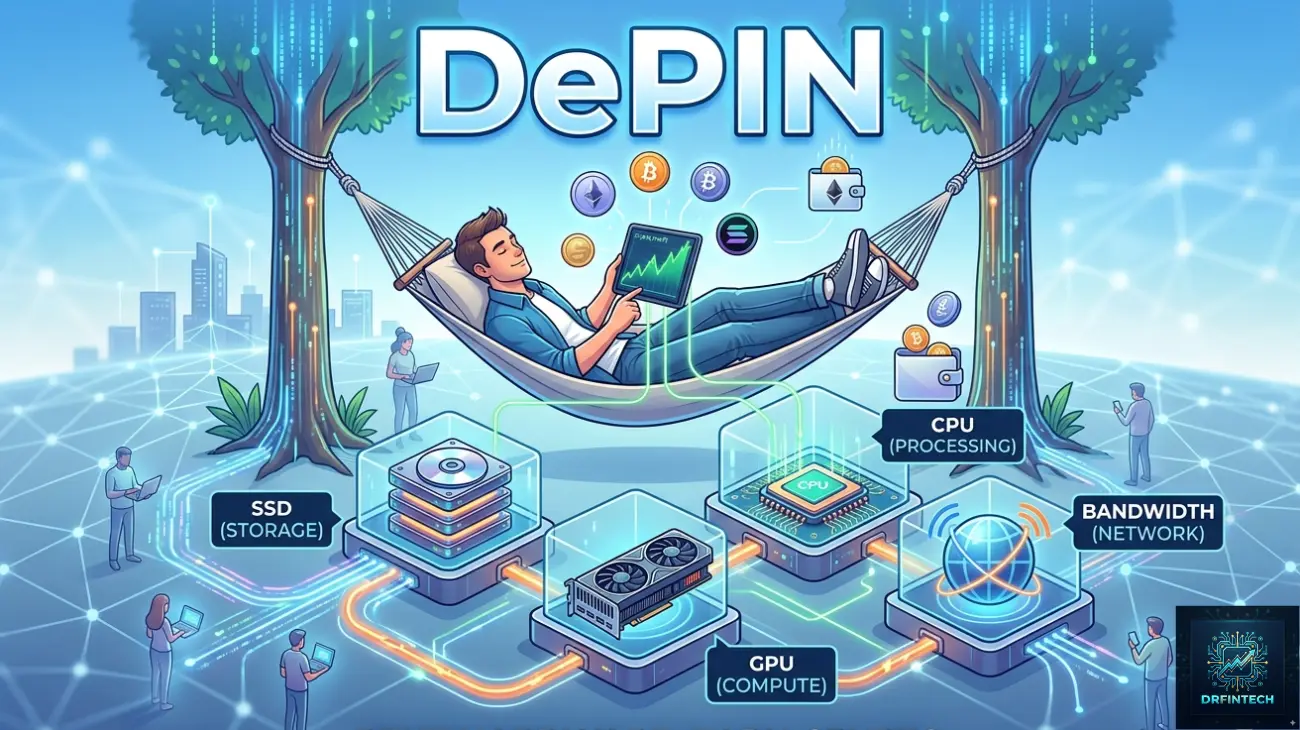
DePIN applies this exact same crowd-sourced model to hardcore digital infrastructure. Instead of relying on a few massive tech giants to build all the world’s servers, internet nodes, and storage facilities, DePIN rewards regular people with crypto for sharing the physical hardware they already own.
The Big Problem with Big Tech
To understand why this is a massive shift, we have to look at how the internet runs today. Right now, a tiny handful of trillion-dollar corporations control almost everything. If a startup wants to launch a new app, host a website, or train an AI model, they have to pay massive fees to companies like Amazon Web Services (AWS), Google Cloud, or Microsoft Azure.
This centralized setup creates a few major issues:
-
Monopoly Pricing: Because these giant companies control the market, they can charge whatever they want. Small businesses get priced out easily.
-
Single Points of Failure: When a major cloud server goes down, half the internet breaks with it. We see this happen multiple times a year.
-
Privacy Concerns: Your data is stored in massive, centralized warehouses owned by single entities. You have to blindly trust them not to look through it or leak it.
DePIN cuts these corporate middlemen completely out of the picture.
How DePIN Works in the Real World
Instead of one company building a billion-dollar data center, a DePIN network connects thousands of independent laptops, hard drives, and routers owned by everyday users across the globe.
Let's break down how this works across different sectors:
1. Cloud Storage (Renting Your Hard Drive)
Imagine you have a 2-terabyte hard drive, but you only use half of it. Through a DePIN storage network, you can rent out the remaining 1 terabyte. When a business wants to store a file, the network breaks that file into tiny, encrypted pieces and scatters them across hundreds of independent hard drives like yours. No single person can read the file, making it incredibly secure. You get paid in crypto tokens just for keeping your drive online.
2. Compute Power (Renting Your GPU)
With the rise of artificial intelligence, the demand for graphic processing units (GPUs) has gone through the roof. AI companies need massive computing power to train their models. If you own a high-end gaming PC, your GPU spends most of its day doing nothing. A compute-focused DePIN allows AI developers to tap into your graphics card when you aren't gaming, paying you for your processing power.
3. Wireless Networks (Renting Your Bandwidth)
Some DePIN projects focus on creating decentralized internet or cellular coverage. Users buy a small hotspot device, plug it into their home internet, and share coverage with nearby smartphones or smart devices. Every time a device connects to your hotspot and uses data, you earn crypto rewards.
Why is Everyone Talking About It Now?
The real magic behind DePIN is the economic incentive. Building physical infrastructure is incredibly expensive. If a new company wanted to compete with Google Cloud, it would need billions of dollars just to buy land and servers before making a single penny.
DePIN solves this through token incentives. Projects don't need billions of dollars upfront. Instead, they tell the public: "Help us build this network by connecting your devices, and we will give you our network's native crypto tokens."
As the network grows and more businesses start using it because it is cheaper than Big Tech, those tokens become more valuable. It is a win-win situation. The network gets built for free, companies get cheaper services, and everyday people get a steady stream of passive income.
The Challenges: It's Not All Smooth Sailing
While the potential is massive, we have to keep our feet on the ground. DePIN is still a young industry, and it faces some real hurdles before it can completely replace traditional cloud networks.
First, there is the issue of reliability. If an enterprise business uses a decentralized network to run its website, it needs a 100% guarantee that the servers won't go offline. But what happens if a teenager sharing his gaming PC suddenly pulls the plug to move his desk? DePIN protocols have to build strict penalties and redundancy systems to ensure that if one node drops off, another instantly takes its place.
Second, the user experience can still be a bit tricky for beginners. Setting up software to share your internet bandwidth or linking a crypto wallet to collect storage rewards can feel overwhelming for non-technical users. For DePIN to go truly mainstream, the setup process needs to be as simple as downloading a mobile app.
Final Thoughts: The Future is Shared
DePIN is shifting the balance of digital power. It takes the heavy infrastructure that used to belong exclusively to corporate billionaires and hands it over to the global community.
It turns your household electronics from personal expenses into money-making assets. Whether you want to share a slice of your hard drive, let an AI model use your gaming rig, or share your Wi-Fi with your neighborhood, DePIN is opening up a completely new way to interact with the digital economy.
The next time you look at your router or your computer blinking in the dark, remember: that little machine could be earning your next investment while you sleep.





