
On August 6, 2026, a quiet line item in a securities filing became the most important liquidity event of the year. SpaceX insiders, employees, and early investors were finally allowed to sell. Not a trickle. Not a test. Up to 911.5 million shares became eligible for trading in a single day.
To understand why this matters for your Bitcoin, consider the float. Before Thursday, the number of SpaceX shares available for public trading sat below 280 million. The unlock added more than three times that amount in one stroke.
Wall Street is covering this as a stock story. Analysts are modeling price targets and supply curves. What almost nobody is discussing is where the money goes when it leaves SpaceX. Because it does not simply vanish. It rotates. And Bitcoin has become one of the largest rotation destinations in modern finance.
Here is what is actually happening, why the mechanics are more forced than most realize, and how to read the signals that tell you whether capital is flowing toward crypto or away from it.
What Just Happened on August 6
SpaceX went public earlier this year in what became the largest IPO in history. The company raised roughly $75 billion at a valuation near $1.75 trillion.
Most IPOs use a standard 90-to-180-day lockup. SpaceX did not. The company designed a staggered schedule that spreads insider selling across multiple dates. On August 6, the first major tranche opened. Insiders could sell up to 20% of their eligible holdings. An additional 10% early unlock was possible if the stock traded 30% above its IPO price for five of ten consecutive days before earnings. That did not happen.
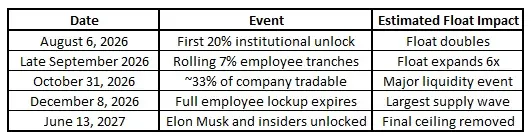
So the first wave is 20%. But here is what the headlines miss. The unlock schedule continues. Additional 7% employee tranches hit the market monthly. By October 31, roughly one-third of the company will be tradable. By December 8, the full employee lockup expires. Elon Musk himself, who controls 85.1% of voting power, cannot sell a single share until June 13, 2027.
This is not a one-day event. It is a six-month liquidity wave. And waves have ripples.
The Mechanics Nobody Explains
Most coverage of the SpaceX unlock focuses on supply and demand. More shares for sale means lower prices. That is true but incomplete. The more important story is why insiders sell, and why some of them have no choice.
The Tax Bill That Forces Selling
When restricted shares vest or lockup periods expire, the IRS treats the fair market value of those shares as ordinary W-2 income. For a SpaceX engineer who has been with the company since 2015, that tax bill can run into seven figures.
These employees do not sell because they dislike SpaceX. They sell because the tax withholding is automatic and non-negotiable. A portion of every unlocked position must be liquidated just to pay the government. This creates programmatic selling pressure that has nothing to do with the company's fundamentals.
Think of it like a mortgage escrow. The bank takes the money whether you want to pay property taxes or not. In this case, the IRS takes its cut whether the employee believes SpaceX is headed to Mars or not.
The Three Groups of Sellers
Not all insiders sell for the same reason. Understanding the difference helps you predict the speed and size of the outflow.
Group One: Early Employees These are the engineers and technicians who joined before 2020. Their cost basis is negligible. Many have waited over a decade for liquidity. Their motivation is diversification. They will sell steadily, not in a panic, but relentlessly. A home purchase here. A retirement account there. It adds up.
Group Two: Pre-IPO Institutional Backers Venture funds and private equity backers are tied to performance tranches. They can unlock 20% now, with a bonus 10% if certain price targets are met. These sellers are more price-sensitive. If SpaceX drops below their model, they may hold. If it holds steady, they will distribute to their limited partners.
Group Three: Recent Hires and RSU Holders These employees have the smallest gains but the most immediate tax bills. They are the most likely to sell 100% of their unlocked shares immediately just to cover withholding and take some cash off the table.
The Staggered Schedule Ahead
Here is the timeline that matters:
Why This Matters for Bitcoin
Most analysts are treating the SpaceX unlock as an isolated stock event. That is a mistake. The same capital pools that bought SpaceX at IPO are the ones that have been buying Bitcoin ETFs, holding Ethereum, and trading altcoins. When a $1.75 trillion position becomes volatile, rebalancing happens.
The Liquidity Cascade Framework
Here is how the cascade works in practice.
An investor holds a portfolio that is 60% tech stocks, 20% crypto, 20% bonds. SpaceX enters that tech allocation. The stock becomes volatile as insiders sell. The investor's target allocation drifts. To rebalance, they trim the volatile tech position and add to underweight assets.
Where does the trimmed capital go? Increasingly, into Bitcoin. Not because the investor suddenly loves crypto. Because Bitcoin has shown lower correlation to tech stocks in 2026 than at any point in the past five years. It functions as a separate bucket.
The cascade has three steps:
- Forced selling in SpaceX (tax, diversification, LP distributions)
- Portfolio drift (tech allocation exceeds target due to volatility)
- Rebalancing inflow (capital moves to underweight non-correlated assets, including Bitcoin)
This is not theory. JPMorgan analysts noted in late July that Hyperliquid ETF demand had stalled, while traditional Bitcoin ETF flows remained stable. Institutions were rotating away from complex structured products toward simpler direct exposure.
Historical Precedent: What Previous Unlocks Did to Crypto
The market has seen this movie before. The ending changes, but the plot is consistent.
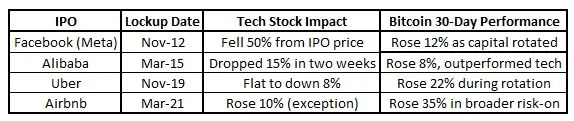
The pattern is not that Bitcoin always rises during tech unlocks. The pattern is that Bitcoin becomes a relative winner when tech volatility spikes. Investors do not abandon risk. They redirect it.
Three Scenarios for the Next 90 Days
No one knows exactly how the SpaceX unlock will play out. But we can map the probabilities using three scenarios. Each has clear triggers you can monitor.
Scenario One: The Rotation Trade (Probability: 40%)
What happens: SpaceX experiences orderly selling pressure. The stock dips 10% to 20% but finds support from index fund buying. Institutional investors trim tech exposure and add to Bitcoin ETFs. Bitcoin holds $64,000 and grinds toward $70,000.
Why it happens: Nasdaq-100 inclusion is the hidden floor. As SpaceX's float expands, the stock qualifies for major index inclusion. Passive funds must buy billions in shares regardless of price.
This programmatic buying absorbs insider selling. The stock does not crash. It churns. And the capital that leaves active tech positions rotates into Bitcoin.
Triggers to watch:
- SpaceX volume spikes but price holds within 15% of IPO
- Bitcoin ETF inflows turn positive after two weeks of flat flows
- Stablecoin exchange balances decline (capital moving off exchanges into positions)
Scenario Two: The Risk-Off Dump (Probability: 30%)
What happens: Selling overwhelms index buying. SpaceX drops 25% or more. The decline triggers margin calls in leveraged tech portfolios. Investors sell everything, including Bitcoin, to meet collateral requirements. Bitcoin breaks $60,000 and tests $57,500.
Why it happens: If the first wave of selling triggers stop-losses and algorithmic de-risking, the cascade becomes self-reinforcing. Crypto is still treated as a risk asset by many systematic funds. In a broad deleveraging, correlations spike toward one.
Triggers to watch:
- SpaceX drops more than 20% in a single week
- Bitcoin ETF outflows exceed $500 million in three days
- The VIX (volatility index) spikes above 30
- Stablecoin balances on exchanges rise sharply (flight to cash)
Scenario Three: The Absorption (Probability: 30%)
What happens: SpaceX churns sideways in a wide range. Index funds buy exactly as much as insiders sell. Bitcoin is unaffected. The market waits for the December unlock before making a directional bet.
Why it happens: Staggered unlocks spread selling pressure over time. If each tranche is small enough, natural buyers (index funds, retail dip-buyers, international investors) absorb the supply without drama.
Triggers to watch:
- SpaceX volume remains elevated but price stays range-bound
- Bitcoin correlation to Nasdaq stays near zero
- No significant ETF flow changes in either direction
The Signals to Watch
You do not need to predict the future. You need to watch the right indicators and react faster than the crowd.
The Stablecoin Canary
Stablecoin balances on exchanges are the single best real-time indicator of whether rotation into crypto is happening. When balances drop, capital is moving from stablecoins into Bitcoin and altcoins. When balances rise, investors are fleeing to cash.
In the 30 days before the unlock, $2.3 billion in stablecoins left exchanges. That sounds like rotation. But context matters. The article noted this could signal institutional abandonment rather than repositioning.
Watch the next two weeks. If stablecoin balances continue falling while Bitcoin holds $64,000, the rotation is real. If balances rise while Bitcoin drops, the risk-off scenario is winning.
SpaceX Volume and Insider Filings
SEC Form 4 filings disclose insider sales within two business days. Watch for clusters of selling from early employees. If you see ten or more Form 4s per week, the selling is broad, not isolated.
Also watch SpaceX daily volume. Pre-unlock, average volume was roughly 15 million shares. If volume spikes above 50 million consistently, the selling wave is active.
Bitcoin ETF Flow Divergence
Bitcoin ETF flows are your institutional sentiment gauge. If ETFs see inflows while SpaceX sells off, institutions are rotating. If ETFs see outflows alongside SpaceX weakness, the risk-off dump is underway.
Currently, traditional Bitcoin ETFs have maintained stable flows even as specialized crypto products stalled. That is a constructive signal.
What You Should Actually Do
Theory is useful. Action is what protects your portfolio.
If You Hold Bitcoin
Do not panic-sell into SpaceX volatility. Historical precedent favors Bitcoin as a relative winner during tech liquidity events. The more likely risk is selling your Bitcoin at $62,000 only to watch it grind to $70,000 as rotation capital arrives.
Consider this framework:
- If Bitcoin holds $60,000 through August 15: The market is absorbing the event. Hold or add on dips.
- If Bitcoin breaks $58,000 with rising stablecoin balances: The risk-off dump is active. Reduce altcoin exposure, keep core Bitcoin position.
- If Bitcoin ETF inflows turn strongly positive while SpaceX churns: The rotation trade is confirmed. This is the scenario where Bitcoin outperforms.
If You Hold Altcoins
Altcoins are higher-beta assets. In Scenario One (rotation), they lag Bitcoin initially but catch up. In Scenario Two (risk-off), they get destroyed. In Scenario Three (absorption), they drift.
The safest approach is to raise your Bitcoin-to-altcoin ratio until the SpaceX direction becomes clear. Bitcoin dominance typically rises first during uncertainty. Altcoin season follows later.
If You Hold SpaceX Stock
The post-unlock period has historically been the best entry window for strong companies. Facebook fell 50% after its unlock before becoming a ten-bagger. Uber churned for months before its pandemic rally.
If you believe in SpaceX's Starlink cash flows and Starship timeline, the August-to-December period may offer the best prices you will see for years. The accumulation phase, not the panic phase, is where long-term value is built.
The December Cliff
Most coverage focuses on the August 6 unlock. Smart money is already modeling December 8.
That is the date when the full employee lockup expires. The remaining bulk of Class A shares hits the market. By then, the initial 20% will have already been absorbed or sold. The December wave is larger and less predictable because it involves employees who have never had liquidity before.
If August goes smoothly, December becomes manageable. If August creates a negative feedback loop, December becomes the capitulation event.
And then there is June 13, 2027. Elon Musk's 366-day lockup expires. He controls 85.1% of voting power. The market will spend the next ten months debating whether he will sell. That debate itself will create volatility.
Key Takeaways
- SpaceX unlocked 911.5 million shares on August 6, 2026, more than tripling the public float.
- Much of the selling is tax-driven and programmatic, not discretionary. Employees must sell to cover withholding.
- The unlock is staggered through December 2026, with Elon Musk locked until June 2027.
- Nasdaq-100 inclusion will create mechanical buying that may absorb some selling pressure.
- Historical precedent shows Bitcoin often benefits from tech sector liquidity events as capital rotates.
- Three scenarios exist: rotation into Bitcoin (40%), risk-off dump (30%), or neutral absorption (30%).
- Watch stablecoin exchange balances, SpaceX volume, and Bitcoin ETF flows to identify which scenario is active.
- Do not panic-sell Bitcoin. The more likely mistake is exiting before rotation capital arrives.
- Altcoins are higher risk during this period. Raise Bitcoin allocation until direction clears.
- December 8, 2026, is the next major unlock date. June 13, 2027, is the final one.
FAQ’s
Q: Is SpaceX going to crash because of this unlock?
A: Not necessarily. The staggered structure spreads selling over months. Index inclusion buying and strong fundamentals provide a partial floor. A crash is possible but not guaranteed.
Q: How do I know if insiders are actually selling?
A: Watch SEC Form 4 filings, which disclose insider transactions within two business days. Also monitor daily trading volume. Sustained volume above 50 million shares suggests active selling.
Q: Why would SpaceX insiders sell if the company is doing well?
A: Most post-IPO insider selling is driven by taxes, diversification, and personal liquidity needs, not a negative outlook. An engineer who has 99% of their net worth in SpaceX stock is rational to sell some portion regardless of their belief in the company.
Q: Could this trigger a broader tech selloff?
A: It could add pressure, especially in a risk-off environment. However, SpaceX is a unique company with space and telecom exposure, not a pure software play. Its correlation to the broader Nasdaq may be lower than typical tech stocks.
Q: What is the safest way to play this as a crypto holder?
A: Hold your core Bitcoin position. Monitor the three signals (stablecoin balances, SpaceX volume, ETF flows). Only adjust altcoin exposure based on which scenario emerges. Avoid leverage during the uncertainty window.
Q: When is the next major unlock after August?
A: Rolling 7% employee tranches unlock monthly through September and October. The full employee lockup expires December 8, 2026. Elon Musk's shares unlock June 13, 2027.
Disclaimer:
This article is for informational and educational purposes only. It does not constitute financial, investment, or trading advice. Cryptocurrency markets are highly volatile and unpredictable. The analysis presented reflects publicly available information and historical patterns, which do not guarantee future results. Always conduct your own research and consult a licensed financial advisor before making any investment decisions. The author may hold positions in assets mentioned.






