
On July 27, 2026, the BIP-110 signaling monitor showed something that should have stopped every Bitcoin holder in their tracks. The reading was 0.00%. Not 5%. Not 1%. Zero. In the current difficulty period, with roughly 1,818 blocks left before the mandatory window, not a single major mining pool was signaling support for what might become Bitcoin's most consequential governance test since the blocksize war.
By August 4, that number had crawled to 0.83%. Most outlets are treating this as proof that BIP-110 is dead on arrival. They are making the same mistake people made in 2017 when SegWit miner signaling stalled at 30%. They are looking at the wrong metric.
Here is what actually matters. BIP-110 is a User-Activated Soft Fork. That means nodes, not miners, trigger the rules. The 0.83% figure tells you almost nothing about whether the chain splits. It tells you everything about who pays for block space and who does not.
What BIP-110 Actually Does (And What It Doesn't)
BIP-110 is formally called the Reduced Data Temporary Softfork. It was authored by a pseudonymous developer, Dathon Ohm, with technical advice from Luke Dashjr. The proposal reached "Complete" status in the BIPs repository on June 25, 2026. That does not mean it will activate. It means the specification is finished and the clock is ticking.
If activated, BIP-110 would impose seven consensus-level restrictions on new transactions for approximately one year:
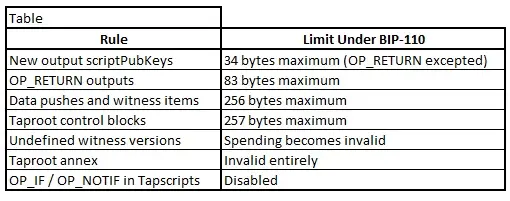
Here is the part almost every headline gets wrong. Existing UTXOs are grandfathered permanently. Your Bitcoin is not at risk. Existing Ordinals, inscriptions, and BRC-20 tokens remain on the blockchain and stay spendable. The rules apply only to new outputs created after activation. When the temporary rules expire after roughly 52,416 blocks, everything returns to current norms unless a follow-on proposal extends them.
So why the panic? Because BIP-110 targets the infrastructure that powers Ordinals, Runes, and BRC-20 activity. It does not ban them. It obstructs the methods they use. Developers could find workarounds, split data across transactions, or migrate to secondary layers. But the path would become far more expensive and technically complex.
The 0.83% Myth: Why Miner Support Does Not Decide This
The standard narrative goes like this. BIP-110 needs 55% miner signaling to lock in early. That is 1,109 blocks out of 2,016 in a single difficulty period, or roughly 110 blocks per day. Current signaling sits near 0.83%. Therefore, BIP-110 is dead.
This narrative ignores how UASF actually works.
BIP-110 uses a modified BIP-9 deployment with a mandatory signaling window. If the 55% threshold is not reached by block 961,632 (projected around August 7), enforcing nodes begin rejecting blocks that do not signal bit 4. Lock-in happens no later than block 963,648. Activation follows at block 965,664, projected near September 6.
The key word is "enforcing nodes." Not miners. Nodes.
In 2017, SegWit also faced stalled miner signaling. The UASF movement, led by the BIP148 client, set a flag date of August 1. Miners eventually signaled not because they supported SegWit, but because the economic majority made it clear that the chain without SegWit would be worthless. The same dynamic could apply here.
The 0.83% figure measures miner enthusiasm. It does not measure node adoption, exchange readiness, or economic weight. Those are much harder to track and much more important.
Who Supports It, Who Hates It, and Why
The debate over BIP-110 is not really about data limits. It is about what Bitcoin is for.
Supporters argue that Ordinals and similar uses impose externalities on the entire network. Increased node storage requirements, higher bandwidth costs, and elevated transaction fees crowd out ordinary payments. They see BIP-110 as a defense of Bitcoin's core utility as sound money. The specification even invites a longer-term successor proposal once it expires.
Opponents push back on multiple fronts. Michael Saylor called BIP-110 "a bad idea" and published a 110-point essay against it. Adam Back, CEO of Blockstream, dismissed a flip-the-bit push as "idiocracy." Jameson Lopp's February analysis called the proposal "reckless and doomed to fail."
Their argument is not technical. It is philosophical. Introducing consensus rules that restrict how people use the scripting system sets a precedent for content-level censorship. Bitcoin's neutrality, they argue, means the protocol does not judge transactions by purpose. It judges them by validity. If you start banning data you dislike, you open a door that does not close.
Miners have a simpler objection. Ordinals and Runes pay real fees. Inscription activity has become a meaningful slice of revenue, especially during periods when standard transaction demand is soft. Removing that demand hurts hashprice directly. That is why Foundry USA opened a hashrate-weighted miner vote running until early August, with non-responses counting as No. F2Pool refused outright. AntPool has stayed silent. Only Ocean Pool, which began signaling by default on July 15, produces effectively all current signaling blocks.
The Real Risk Nobody Is Measuring
The danger of BIP-110 is not that it activates with majority support. The danger is that it activates without it.
If a significant minority of nodes enforces BIP-110 while the majority of miners and exchanges ignore it, the network splits. Not cleanly. Not temporarily. Two chains emerge with the same history, the same UTXO set, and the same transaction format. Except one rejects certain transactions the other accepts.
Here is what makes this worse than 2017. BIP-110 does not include replay protection.
In 2017, Bitcoin Cash implemented replay protection. Transactions on one chain were invalid on the other. BIP-110 does the opposite. Because it is a soft fork with tighter rules, a transaction valid on the BIP-110 chain is almost certainly valid on the legacy chain. That means a payment you send on one chain could be duplicated on the other without your consent.
For most users, this is abstract. For exchanges, it is a nightmare. For ETF providers, it is already decided.
BlackRock's IBIT prospectus, filed with the SEC, contains language that should chill every ETF holder. The trust "will permanently and irrevocably abandon incidental rights to forked or airdropped assets unless a future SEC rule change allows otherwise." Other issuers use similar language. If a minority BIP-110 chain gains economic value, IBIT holders will not receive those coins. Neither will most exchange users. Only self-custody holders who control private keys before the snapshot would have a claim.
That is the hidden asymmetry. The 0.83% figure makes BIP-110 look like a fringe proposal. But if even 5% of economic nodes enforce it, and if those nodes represent exchanges or payment processors, the split becomes real. The value of the minority chain depends entirely on whether anyone trades it. And that depends on whether exchanges list it.
The August Timeline You Need on Your Calendar

The eCash hard fork is unrelated to BIP-110 but shares the August timeframe. It is a hard fork, not a soft fork, scheduled at block 964,000 with replay protection built in. Existing holders would receive eCash balances automatically if they control private keys. ETF holders, again, forfeit this.
Two forks. One month. Different mechanisms. Different risks. Most coverage conflates them.
What You Should Actually Do Before September
The Self-Custody Checklist
If you hold Bitcoin and want maximum optionality:
- Verify your wallet type. Bitcoin Core wallets and most standard hardware wallets will follow the majority chain by default. If you run Bitcoin Knots 29.2 or another BIP-110 enforcing client, you are explicitly choosing a side.
- Check your exchange's fork policy. Most major exchanges have not published BIP-110 statements. Ask directly. If they do not answer, assume they will follow the majority chain and will not distribute minority fork coins.
- Consider timing. If you plan to move to self-custody, do it before block 961,632. Post-snapshot movements do not grant you fork optionality.
- Do not panic-sell. The 2017 fork wars saw Bitcoin rise from $1,000 to $2,500 during activation uncertainty. Protocol stress does not automatically mean price collapse.
The One Thing You Should NOT Do
Do not download and run BIP-110 enforcing software unless you understand UASF mechanics and are prepared for the possibility of being on a minority chain. The Bitcoin Knots 29.2 client is not a standard wallet. It is a political statement. Running it without understanding the replay risks could cost you more than doing nothing.
FAQ’s
Will BIP-110 eliminate my existing Ordinals?
No. Existing inscriptions and UTXOs are grandfathered permanently.
Is BIP-110 the same as the eCash fork?
No. BIP-110 is a soft fork tightening data rules. eCash is a hard fork adding Drivechain functionality. They are unrelated.
Can BIP-110 be reversed after activation?
It expires automatically after one year. No vote or reversal is needed.
Will there be two Bitcoins if BIP-110 activates?
Only if a significant economic minority enforces it while the majority ignores it. The split would be messy and lack replay protection.
Should I sell my Bitcoin before August?
There is no technical reason to sell. The risk is chain fragmentation, not protocol failure. Historical precedent suggests Bitcoin often rallies during governance crises.
Key Takeaways
- BIP-110 is a UASF. Miner signaling at 0.83% is irrelevant to whether nodes enforce it. The 2017 SegWit precedent proves this.
- Your existing coins are safe. Grandfathering protects all pre-activation UTXOs. The risk is fork optionality, not loss.
- ETF and exchange holders forfeit forked coins. Read the prospectus fine print. Self-custody is the only way to preserve optionality.
- Replay protection is missing. Unlike 2017's Bitcoin Cash, BIP-110 does not prevent transaction replay across chains.
- The real deadline is August 7, not September 6. Mandatory signaling begins then. Activation is just the consequence.
Disclaimer:
This article is for informational purposes only and does not constitute financial, legal, or investment advice. Cryptocurrency markets are highly volatile, and protocol-level events carry risks that cannot be fully predicted. The author does not endorse any specific wallet, exchange, or client software. Always conduct your own research and consult qualified professionals before making financial decisions. Past performance and historical precedents do not guarantee future outcomes. The author may hold positions in cryptocurrencies mentioned.





