
On August 15, a small gaming and advertising company called Super League Enterprise traded about 393,000 shares. Three days later, on August 18, that number hit 37.3 million. Nothing about the company's games, its ad contracts, or its earnings had changed in those three days. What changed was who wanted to own it, and why.
The answer is Metaplanet, the Tokyo-listed firm that built itself into the world's third-largest corporate Bitcoin holder in under two years. On August 18, Metaplanet announced it would hand over 2,100 Bitcoin and $2.5 million in cash to Nasdaq-listed Super League Enterprise (SLE) in exchange for a controlling stake. Once the deal closes, Super League disappears and a new company called Superplanet takes its place, expected to trade under the ticker SUPA.
The headlines called it a Bitcoin treasury deal. That's technically true, but it undersells what actually happened here. A company most investors have never heard of just became the vehicle for one of the largest Bitcoin treasury moves of the year, its long-time shareholders were diluted down to a sliver of what they used to own, and all of it happened in the same week Bitcoin ripped higher by more than 20%. Here's the part of the story most coverage is skipping.
The Deal, In Plain Numbers
Reading a legal filing is nobody's idea of a good time, so here's what actually changes hands, stripped of the jargon.
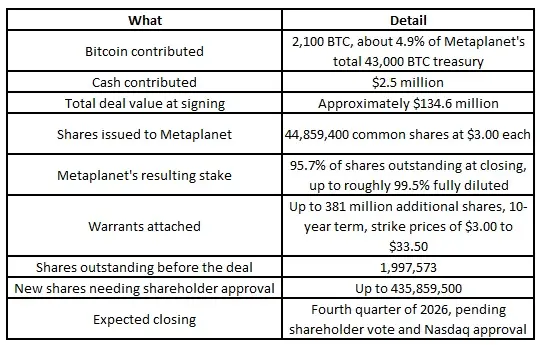
Look at that shares-outstanding row again. A company with under two million shares in existence is asking permission to issue up to 435.8 million more. That's not a typo, and it's the number almost nobody put in a headline.
Why a Tiny Esports Company Became the Target
Super League Enterprise wasn't a random pick. It's a real, if small, operating business built around immersive gaming, content, and advertising. Its CEO, Matthew Edelman, had spent the past year cutting debt and simplifying the balance sheet, unglamorous work that normally gets zero attention outside the company. That cleanup is exactly what made Super League useful to Metaplanet.
A clean, already-listed Nasdaq shell with a real business inside it is worth far more to a Bitcoin treasury builder than an empty one, because Nasdaq's listing rules and investor scrutiny are much easier to clear when there's an actual company underneath the ticker.
This is the quiet mechanic behind a growing slice of "Bitcoin treasury" news in 2026. Filing for an IPO takes months and invites regulatory friction. Buying control of an already-listed, already-compliant small company and simply repurposing it is faster. In Metaplanet's case, it also didn't require a single new dollar of cash. It required Bitcoin.
The Real Story Isn't the Bitcoin. It's the Shares.
Here's the part buried under the exciting stock-price headlines. Before this announcement, if you owned Super League stock, you owned a real piece of the company. After the deal closes, that math changes dramatically. Metaplanet walks away with roughly 95.7% of the company on day one. Add in the warrants and preferred stock it's entitled to, and its position could climb toward 99.5% on a fully diluted basis, according to Super League's own proxy filing.
The existing shareholder base, people who held SLE stock before August 17, is being diluted down to somewhere around 4% of the company at closing, and potentially quite a bit less if Metaplanet and its partner, Evo Fund, eventually exercise every warrant they've been granted over the next ten years.
To be fair, that outer figure assumes a full decade of maximum warrant exercise, which may never actually happen. But even the closing-day math tells a story the 50 to 80% single-day stock pop doesn't.
A stock price jump feels like a win for shareholders. Watching your ownership stake shrink toward single digits is a different kind of event entirely, and both things are true here at the same time.
This Isn't the Same Playbook That Just Blew Up
If you've followed crypto news through 2026, "Bitcoin treasury company" has started to sound almost like a warning label. The digital asset treasury model, companies that raise capital specifically to stockpile Bitcoin or other tokens, had a rough year. Bitcoin Standard Treasury Company, backed by Blockstream's Adam Back, saw its proposed merger collapse under unfavorable market conditions.
Twenty One Capital, the world's second-largest corporate Bitcoin holder, lost its CEO, Jack Mallers, earlier in 2026. Several publicly traded treasuries, including Strategy itself, have sold portions of their Bitcoin just to cover debt payments, buybacks, or operating costs. Pantera Capital went as far as predicting "brutal pruning" across the entire sector in 2026, with only the strongest, most disciplined treasuries expected to survive the shakeout.
Analysts at Benchmark specifically flagged why this deal reads differently from the wave of "shell-and-PIPE" treasury transactions that dominated the past two years. In most of those deals, a shell company raised discounted third-party capital, often from private investors buying in below the market price, then used that cash to buy crypto. Metaplanet skipped that step entirely.
It used Bitcoin it already owned, priced at the market rate, with no special discount for itself. It also locked up its own shares for five years, longer than the typical insider lockup in comparable deals. Whether that discipline is enough to make Superplanet a survivor rather than another casualty of the sector's pruning is a question nobody can answer yet. What's verifiable right now is that Metaplanet built this one differently, on purpose.
The Week Bitcoin Made This Trade Look Like Genius
Here's a detail that hasn't shown up in the coverage yet, and it's worth doing the math yourself. Metaplanet's press release valued its 2,100 BTC contribution at roughly $132.1 million, based on Bitcoin's closing price on August 14. That implies a price of just under $63,000 per coin at signing.
One week later, Bitcoin was trading above $76,900, its best week since 2024, fueled by a US Treasury announcement to ramp up long-dated bond buybacks and renewed White House pressure to pass crypto market-structure legislation. Run that same 2,100 BTC through the new price and you get roughly $161.6 million, an implied gain of close to $29.5 million in about seven days, before Superplanet has even closed, let alone opened for trading under its new ticker.
That number isn't guaranteed to hold. Bitcoin could just as easily fall back below $63,000 before the deal closes in the fourth quarter, and Metaplanet would end up contributing a smaller dollar amount for the exact same 2,100 coins. That volatility is the entire risk profile of this transaction, in miniature, and it's a risk every future Superplanet shareholder is inheriting whether they've thought about it or not.
A Simple Checklist for the Next "Bitcoin Treasury" Headline
This kind of deal is going to keep happening as the DAT sector consolidates. Here's a short framework worth keeping in your back pocket before you react to the next one.
- Whose money is actually moving? Is the treasury using its own appreciating Bitcoin, or third-party cash raised at a discount?
- How many new shares are being created? Compare the new issuance to the existing share count, not just the headline dollar value.
- Is there a warrant overhang? Warrants exercisable years into the future are dilution that hasn't happened yet, but eventually might.
- Who controls the board after closing? A majority stake with board control behaves very differently from a passive minority investment.
- What's the lockup period, and who is locked up? A five-year insider lockup signals something very different than a 90-day one.
None of these require a finance degree. They just require reading past the headline.
What This Means If You Hold Small-Cap Crypto Stocks
The temptation in a story like this is to chase the pop. Super League jumped anywhere from roughly 50% to over 100% in the hours after the announcement, depending on which snapshot of the day you check, before settling into a smaller but still substantial gain. Day traders clearly noticed, given that 95-fold jump in trading volume.
A one-day pop and a good long-term investment are not the same thing, though, and the most common mistake in moments like this is treating them as interchangeable. The more useful question isn't "did the stock go up." It's "what percentage of the company will I actually own once every warrant, preferred share, and lockup provision plays out." For Super League's legacy shareholders, that answer is a fraction of what they started with, wrapped inside a company that could genuinely be worth more per remaining share if Metaplanet's Bitcoin bet keeps paying off. Both things are true, and neither cancels the other out.
The Bottom Line
Metaplanet didn't just buy a Bitcoin position through Super League. It bought a Nasdaq listing, a compliant operating business, and a fresh shareholder base, all without spending a single dollar of new cash, and it did this during a year when most of its peers in the Bitcoin treasury business have been shrinking, merging, or quietly selling coins to survive. Whether Superplanet becomes the model other treasuries copy, or a cautionary tale about extreme dilution dressed up as a Bitcoin story, probably won't be clear until well after the deal closes in the fourth quarter. What's already clear is that the real headline was never the stock price. It was the cap table.
Key Takeaways
- Metaplanet is contributing 2,100 BTC ($132.1 million at signing) plus $2.5 million cash for a 95.7% stake in Super League Enterprise, soon to be renamed Superplanet (SUPA).
- Existing SLE shareholders will be diluted to roughly 4% of the company at closing, and potentially far less if outstanding warrants are exercised over the next decade.
- The deal is structured differently from the failed "shell-and-PIPE" treasury deals of 2025 to 2026 because Metaplanet used its own Bitcoin at market price rather than discounted outside capital.
- Bitcoin's price rise in the week after signing added an estimated $29 million in implied value to the deal before it has even closed.
- The transaction closes in Q4 2026, pending Super League's shareholder vote and Nasdaq approval.
FAQ’s
What is Superplanet?
Superplanet is the new name Super League Enterprise will adopt once Metaplanet's investment closes, becoming a Nasdaq-listed US Bitcoin treasury platform majority-owned by Metaplanet.
How much will existing Super League shareholders own after the deal?
Roughly 4% of the company at closing, based on the 1,997,573 shares outstanding before the deal against Metaplanet's 44,859,400 new shares, with further dilution possible if warrants are later exercised.
Is this the same as a SPAC merger?
No. A SPAC raises cash first and then searches for a target. This was a direct strategic investment into an already-operating, already-listed company.
When will the deal close?
The companies expect closing in the fourth quarter of 2026, subject to a Super League shareholder vote and Nasdaq's approval.
Does Super League's original business disappear?
No. The gaming, content, and advertising business continues to operate; Superplanet is not becoming an empty Bitcoin-only shell.
Why is this considered different from other 2026 Bitcoin treasury deals that failed?
Analysts noted Metaplanet used Bitcoin it already owned at market price, with no discount, and accepted a longer, five-year lockup, distinguishing it from the "shell-and-PIPE" structure blamed for several failed treasury deals this year.
Disclaimer
This article is for informational and educational purposes only and does not constitute financial, investment, or legal advice. The Metaplanet-Super League Enterprise transaction described here is a proposed agreement that had not closed as of publication and remains subject to shareholder approval, Nasdaq requirements, and other customary closing conditions; terms may change before closing. All figures are drawn from company press releases, SEC filings, and independent financial reporting cited above, with one clearly labeled independent calculation. Cryptocurrency and micro-cap equity markets are highly volatile, and past price movements do not predict future results. Do your own research and consult a licensed financial advisor before making any investment decision. The author holds no undisclosed position in Metaplanet, Super League Enterprise, or Superplanet at the time of writing.






