Hello! Today I'm going to introduce you a very interesting topic: gene therapy in disease treatment. Specifically, about how to use gene therapy for Huntington disease.
First of all, let's see what gene therapy is. By way of summary and without going into detail (since this post is rather informative), gene therapy is defined as the process in which a gene (or a DNA sequence) is exogenously introduced into an individual with the objective to have a therapeutic effect. Sounds simple, doesn't it?
Having described how to deal with the problem, let's focus on the problem itself: Huntington's disease. It is a rare and serious degenerative disease, which is also hereditary. Within the mode of inheritance, the disease is autosomal dominant, which means that a person affected by this disease can transmit it to her offspring with a 50% probability in each pregnancy, without difference between sexes. This disease affects approximately 5 people per 100,000 inhabitants and the symptoms are chorea (involuntary movement of the body), depression and dementia. It is a disease that appears at a late age (between 30 and 50 years).
Regarding the genetic bases, this disease occurs because the Huntingtin protein (encoded by the HTT gene) is produced in a longer than normal way. At the sequence level, the cause is an increase in the number of CAG (cytosine / adenine / guanine) nucleotide triplets within the HTT gene. Normally, we have within our HTT gene between 10 and 35 repeats of the CAG triplet. Well, Huntington's disease patients have between 36 and 120 copies (depending on the number, the disease is more or less severe).
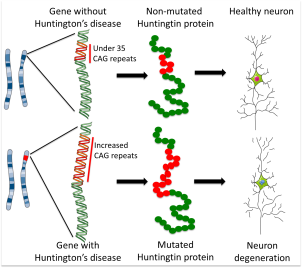
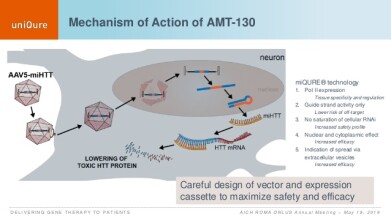
As we have said, this therefore makes the protein abnormally long. If this occurs, the protein can be "cut" into small pieces that accumulate in neurons, causing loss of function and neuronal death (leading to disease). Once all of the above has been defined, I am going to present you a possible solution. This type of therapy is designed by the UniQure company and is currently in the process of conducting first-phase clinical trials in patients with the disease. Treatment (known as AMT-130) involves reducing the production of the abnormal protein.
For this, a kind of "vehicle" is used (in this case it is a type of virus, AAV5) that carries a gene that codes for a microRNA (miRNA) inside. In a very simple way, a miRNA is a small molecule made up of ribonucleotides that is going to bind to the messenger RNA of the target protein (in this case of Huntingtin) to make it non-functional to translate.
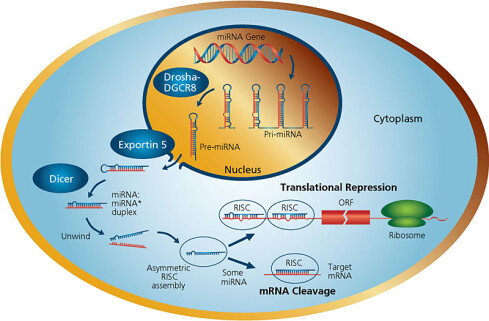
In this way and in summary, the "vehicle" with the miRNA will carry this molecule to the neurons in a specific way and will prevent the protein from being produced, reducing the effects of the disease. Administration is simple: it is injected with a small catheter directly into the brain and appears to have little risk and is well tolerated by the receptor.
As we have said, it is an experimental gene therapy that has yet to be tested in patients to study effectiveness. However, it is an example of a very future approach in the treatment of diseases, not only gene therapy, but the use of small molecules (such as miRNA) that silence the expression of something harmful. We will await the results of these clinical trials.
This is the end! I hope it was interesting your you :)