
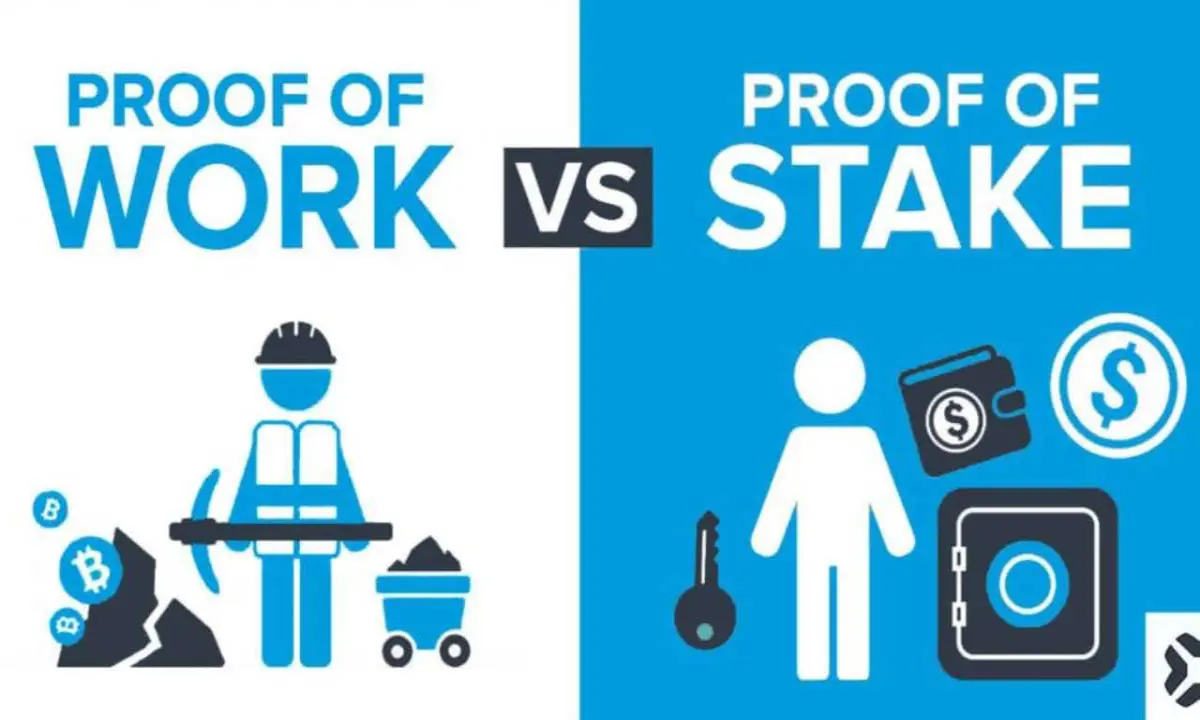
The basis of any cryptographic system is its ability to protect itself from attack with as little effort as possible. To achieve this capability in the short term, blockchains have a framework known as consensus algorithms, which are the basis for those models to become functional and prove their safety in the short term.
What builds trust from social consensus, what is the basis of the value of any blockchain, after all you use only that system because you trust it.
In this analysis, I will evaluate the energy, economic and security efficiency of the two main networks, Bitcoin and Ethereum, which have respectively two different consensus algorithms: PoW and PoS.
Energy efficiency
PoW-based blockchains naturally consume more electricity than PoS. This is because mining is a competitive dynamic where the greater the computing power of a network collaborator, the more rewards he is able to extract from it.
This promotes an efficiency race where miners constantly try to maximize two fundamental aspects:
The individual computing power of your hardware and the total amount of hardware allocated to the operating plan.
In a blockchain PoS there is no competitive dynamics of mining. The validators obey different rotation strategies to assume the right to construct the blocks. Thus, the network behaves more efficiently, with all the computational expenditure that would be attributed to the mining competition ceasing to exist.
Capital Efficiency
Objectively, the monetary policy of a blockchain can be defined independently of the consensus mechanism, which might not justify a comparison between PoW and PoS.
However, the economic dynamics that involve the costs of operating the network versus issuing rewards given by the network, can change quite a lot from PoW to PoS, even if both have policies that reduce or contain inflation over time.
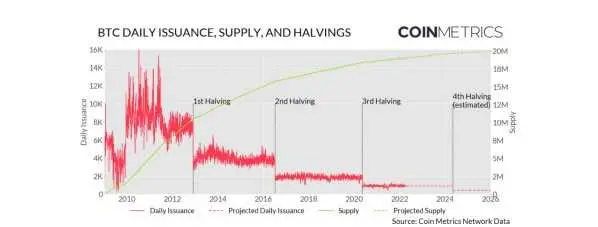
Bitcoin miners, for example, continue to have to bear the same costs of electrical energy and the maintenance and evolution of their hardware, even after the event of a halving.
This makes the viability of a mining plant depend on an increase in Bitcoin price that is proportional to the effect of halving. If this increase does not occur, the miners start to earn "less for the same work" or even remain at the loss.
Reduce new BTCs over time.
However, in the case of the operation of a network in PoS, the economic dynamics change significantly. There is no need to compete by continuously scaling computing power, nor to increase spending on electricity, due to the entry of new validator players.
The trend over time may even be an even greater reduction in validation costs with future optimizations, like Ethereum's danksharding proposal.
This "ease", however, does not come without disadvantages... Many argue that it makes PoS networks a game that "makes the rich richer", since not having significant spending on their operation, the validators can just keep capturing their rewards and putting them back into staking, in a vicious cycle of accumulation and enrichment.
On the other hand, PoS supporters usually counter that the larger PoW miners may also adopt the same behavior by reinvesting their profits in new, more powerful ASICs, thus capturing more rewards, and thus reinvesting their profits in the same vicious circle of accumulation and enrichment.
The fact is that today we have no way to make a real comparison considering Bitcoin and Ethereum, given that while Bitcoin mining has been running for at least 14 years and has gone through several cycles, Ethereum has recently adopted the PoS consensus, so that these impacts will only be observed in reality over time.
In terms of self-regulation, both PoS and PoW have their own mechanisms.
Security
In terms of security, everything is based on the network's ability to provide the right incentives to keep that structure functional, but the central basis of that security is built on the premise of that system.
PoW: Based on economic expenditure, that is, to justify greater security, it is necessary to justify a higher financial expenditure, which will always be based on the reward of that activity (purchasing power generated by the mined asset).
PoS: The risk of losing the stuck asset that adjusts the security of the network and regulates the agents belonging to that system, the greater the value understood in the currency that is staking, that is, the greater the aversion to the loss of the validator, the more secure the network.
Which one is better?
Each system will be more suitable for its determined application, understanding this need makes the process of analyzing any asset more sensitive to its purpose.
Both decentralization and the security and efficiency of a system are a spectrum that we must always observe in our analysis.
Understanding each of them in depth is one of the best ways to develop a good portfolio, but beyond that it is also fundamental for a good investor to understand that the crypto market is constantly changing and to keep studying and analyzing this market is essential to its success.
As nobody knows anything about the future, today it's best to invest in #Bitcoin and #Ethereum.






