
This is an attempt to document the spelling methods I tried to introduce to staff and students alike during my regime. For instance, I tried to get students to be aware of the fact that sometimes, small words exist within big words.
Last year, I sent out this beautifully crafted email to all Spelling Bee participants after the Preliminary Round. Unfortunately, it seems that the message didn’t get sent out. The team was supposed to set up a Google Classroom for all participants, but due to the barrage of tasks we all had to do, I never realised this idea. Perhaps setting up a Google Classroom for all participants should be first n foremost on our radar this year.
Anyway, enjoy reading my beautiful email:
*Dear students,
Words are wonderful. When you choose the right word, you express your feelings precisely.
Choosing feeling words
We focused on the five core emotions, Happy, Sad, Scared, Angry, Disgust. You may recognise them as characters from the movie “Inside Out”. We then chose these words: furious, heartbroken, delighted, despairing, elated
“Delighted” and “elated” belong to the same word cline of happiness.
“Elated” > “delighted”
“Heartbroken” and “despairing” belong to the same word cline of sadness.
“Despairing” > “heartbroken”
We hope that you will remember these words and use them to describe your feelings.
How to remember these words
We recommend these tips:
- Did you know that “Q” is always followed by “U”? Q and U, they stick together like glue. Great for remembering “quality”.
- Use the word-within-a-word trick. Did you notice some small words embedded within the following words?
- heartbroken
- delighted
- despairing
- elated
- opportunity
- socialisation
- creativity
In fact, you can think of Unity Port as a way to remember the spelling of “opportunity”.*
In any case, Ms Bubble Tea made reference to these spelling methods in the video she created to hype up the atmosphere for the finals. So it wasn’t like my words had gone to waste haha.
As the I/C, I took care to make sure that there was some correlation between the words used for the Junior Round (Year 1 & 2 students) and the words used for their seniors (Year 3 & 4 students) for the finals. Like, the words used for the Junior Round would be stepping stones to help them spell the longer and more complicated words for the Senior Round:
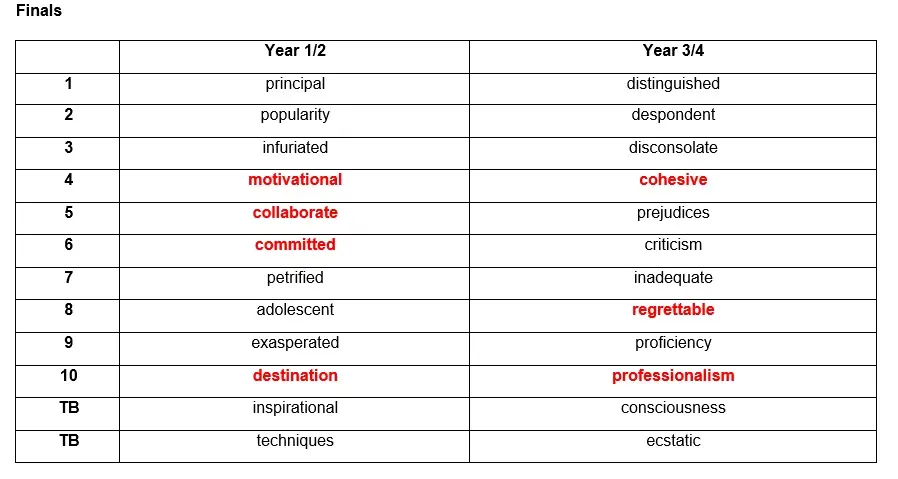
I thought long and hard about how to draw connections between the words used in the Junior Round and the words used in the Senior Round.







