If you’re a harried parent like I am, you would empathise that the holidays leave me with less white space to think and put things together than term time. This musing is less rigorously researched than I would have liked. Still, perfection is the enemy of the good, so I will just post it here as a way to usher in the new term. Hope you gain a fresh insight or two from this!
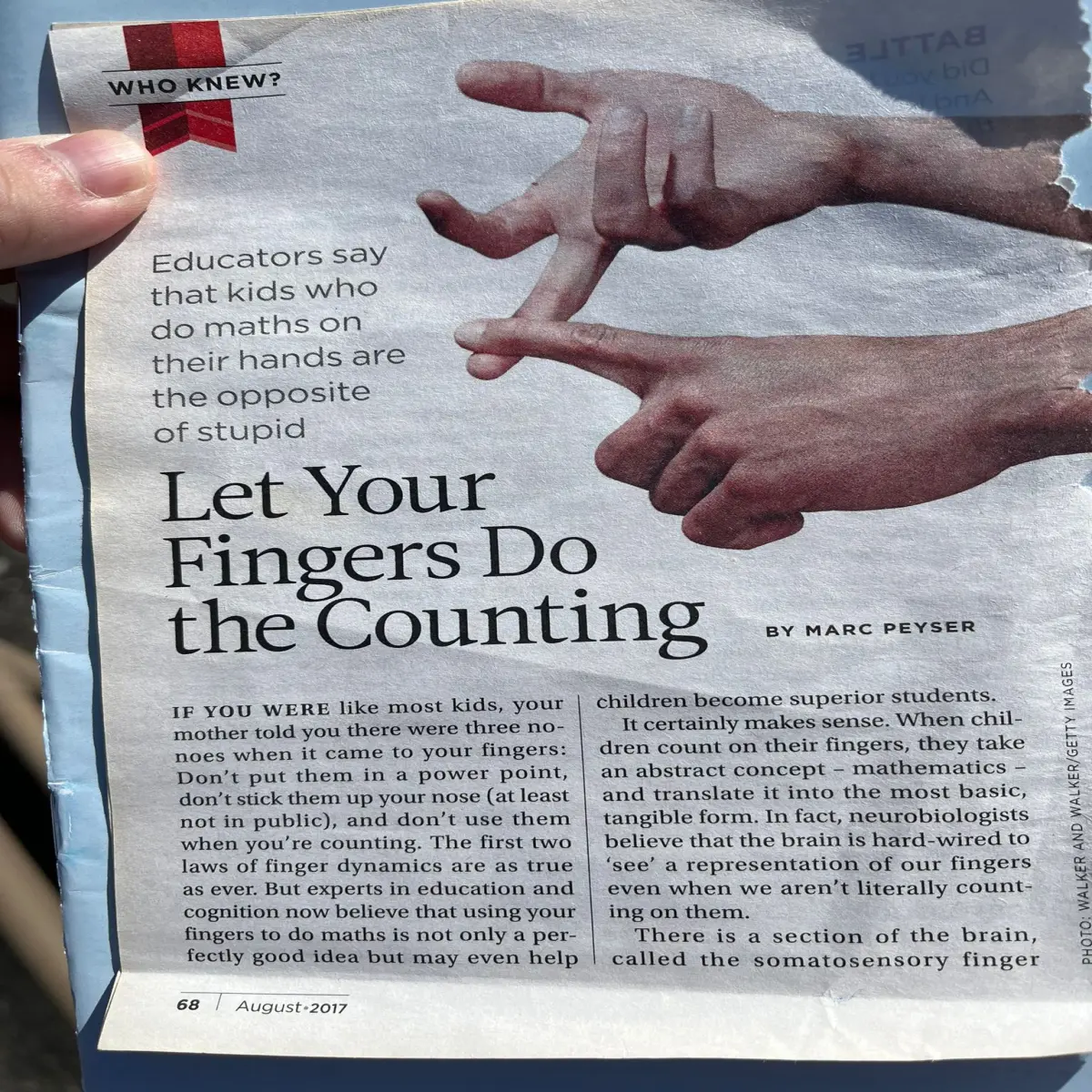
I have been mulling over finger spelling a lot recently since it’s a method employed by my school to teach students with dyslexia spelling. Hence, I had a Eureka! moment when I read “Let your fingers do the counting” (Readers’ Digest August 2017 article). I’m not kidding when I say that I feel that all my educational experiences fall into place and synergise together to uncover a greater truth. In an instant, I “saw” how finger spelling, skywriting, counting with one’s fingers and doing brain gym exercises are different methods used in different subject areas but leverage one’s fingers to boost learning!
Finger spelling is a method advocated by the Orton Gillingham (OG) approach. To spell a monosyllabic word, I sound out the first phoneme while raising the thumb of my non-dominant hand. I write the letter that corresponds to this phoneme at the same time. After that is done, I sound out the second phoneme, raise the index finger of my non-dominant hand and write the second letter that makes up the word. I continue doing this until I spell the entire word. Finger spelling can also be used to spell polysyllabic words. The OG approach allows the learner to use his fingers because fingers are connected to one of the language processing centers of the brain (Broca’s Area).
If you have not heard of finger spelling before, it’s because in the Singapore context, we use a similar method called the Elkonin box instead.
Back to the article. Educators should encourage their students to use their fingers to count. There is a section of the brain called the somatosensory finger area that is activated when we try to perform subtraction equations. This is our brain being hard-wired to “see” a representation of our fingers even when we are not literally counting on them. Thus, getting children to count on their fingers facilitates this process as an abstract subtraction equation is transformed into a tangible form.
Learning that basic finger dexterity has a positive impact on learning made me recall my primary school days in which my Mandarin teachers would get the entire class to skywrite a character - one stroke at a time - with big movements several times until they were satisfied that we had learnt it well.
Skywriting is also a technique employed for students who undergo the Dyslexia Structured Remediation programme. They blend the rime of a word first, then blend its onset before blending the onset and rime and finally skywriting the word with a flourish. Doing so apparently engages large muscle movements, which is beneficial for memory retention. I wonder if skywriting is a method used by Chinese teachers nowadays.
If improving finger perception is positively associated with learning, then getting young learners to do brain gym exercises seems to be the way to go. Tracing the number 8 with our fingers is a recommended exercise for us to reclaim calmness and practise mindfulness. Other exercises include pointing the letter ‘L’ left and right with both hands continuously. If doing so enhances one’s finger dexterity, then brain gym exercises kill two birds with one stone.