
Examination vetting has a way of revealing your assumptions. So, I was in charge of setting the listening comprehension texts for this year's Milestone Assessment. During the vetting session, my colleagues told me that my sentences were too difficult and that I had to simplify my sentence structure and whatnot.
Upon reflection, I realized that I could have been influenced as a result of my experiences taking Japan Language Proficiency Test (JLPN). In this notoriously difficult test, especially the higher levels, we were made to extract key information from dialogues that used obscure sentence structures and difficult vocabulary. Stuff that most Japanese probably wouldn't use in their daily lives. Maybe that was why I implicitly assumed that a good listening comprehension test would employ more formal linguistics terms.
Coincidentally, I read a chapter from a book by Toasmasters International. It advocated that we write for the ear and use simple vocabulary when crafting a speech. In fact, single syllabic words are the way to go since they are easier for people to follow and remember. After writing the text, count the number of syllables in each word. If most words have three, four, five, or more syllables, your audience may have difficulty following the message. I guess it drummed in the fact that I should Keep It Simple, Stupid and write conversational texts.
I redrafted my texts. Apparently, I could determine the sentence complexity of my work using the Flesch Kincaid Readability Tool which is included in MS Word. In case you need to use this in your work, let me show you how.
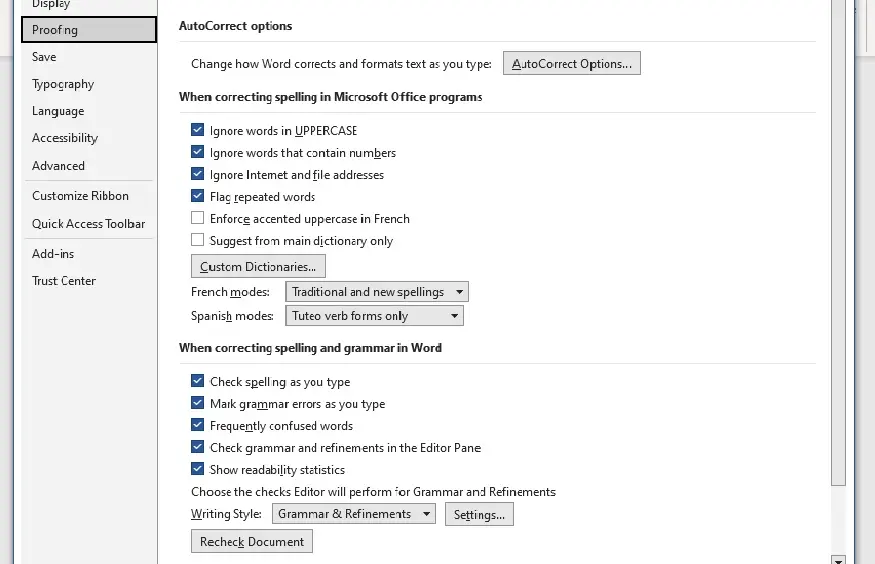
1. Go to 'File' then 'Options' in your Word document. Click on 'Proofing' and enable 'Show readability statistics'.
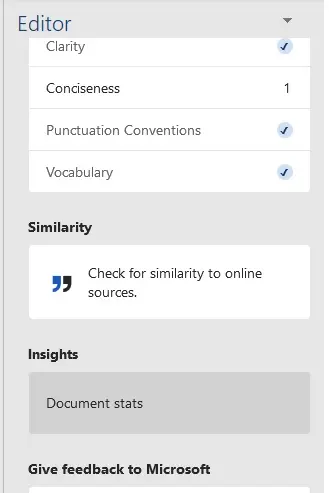
2. Then click on 'Editor'. It will lead you to 'Document Stats'. Click on that.
3. The Readability Statistics for your writing will pop up on your screen. Examine the data.
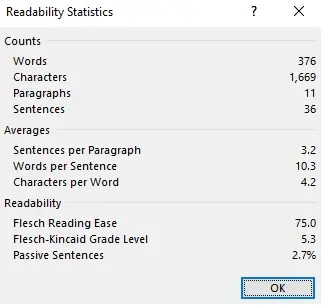
So what do these figures mean? According to Readable (https://readable.com/readability/flesch-reading-ease-flesch-kincaid-grade-level/), Flesch Reading Ease determines how reader friendly a piece of writing is. The higher the score, the easier it is for your intended audience to read. Aim for at least a reading score of 60 to 70 as this means that your 8th and 9th grade students (13 to 15-year-olds) will be able to manage the text. Mine is 75.0, so it is slightly above average.
As for Flesch-Kincaid Grade Level, it is directly equivalent to the US grade level of education. My score for this category is 5.3, so this means that an average fifth grader in America should be able to soak in the awesomeness of my text.
4. If you want another website to corroborate the findings from the Flesch Kincaid Readability Tool, try https://storytoolz.com/readability. You can just paste your text in the box provided and click on 'Check Readability'. So the following refers to the readability statistics I got from Storytoolz.
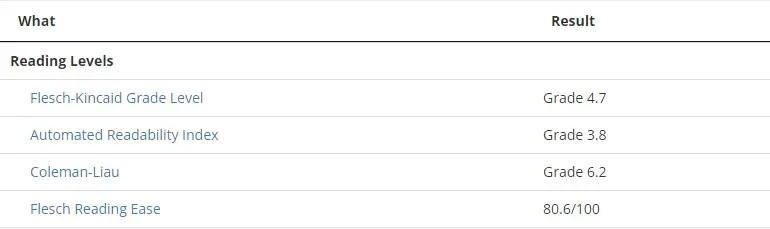
Seems that Storytoolz is a kinder (or a less rigorous) tool than Flesch because I scored above 80 for the Flesch Reading Ease!
A rather nerdy post, but I hope it sheds insights on the myriad considerations teachers grapple with when setting a test.






