
Another day another AMA! After yesterdays AMA with Satoshi Club (You can find the recap here), we followed up with the postponed AMA with 'Teh Moonwalker' Community. For everyone that missed it, we compiled the full recap of the AMA session below!
Segment 1: Questions by tehMoonwaLkeR
tehMoonwaLkeR: nice to have you ! please be so kind and introduce yourself and talk about your role in the project
Rim: Yes of course! I’m in the position of community manager at the DEXToken Protocol, with me is @AlistorZimon who serves in the position of business development. We both handle most of the communication, to take away the language barrier and to help translate the more technical side into digestible chunks.
Alistor: Hey everyone!
Q1: What is DEXG, why do we need it, what does it solve, and how does it work?
Rim: I'll give the word to @AlistorZimon
Alistor: Thanks. I could explain the nuances and details of the DEXToken Protocol for hours, but I’ll try to keep it concise. To push it into one sentence The DEXToken Protocol creates a new DeFi ecosystem utilising a sophisticated Automated Market Maker (AMM) and the IoT off-chain capabilities of the Flowchain network.
So let’s make it a bit more specific on what we are building. The centre of the ecosystem is the DEXToken Swap exchange, which features our academically researched sAMM model. The sAMM prices assets on the exchange more efficiently and executes trades smoother, which in turn reduces the occurring slippage by a wide margin.
So why is this important? The losses due to slippage and inefficient trade execution on Uniswap are in the area of high double to triple-digit million-dollar values per month. So there’s quite an interest for the market to see more sophisticated approaches in terms of automated market-making.
On the other spectrum of our project, we have the IoT capabilities of the sAMM, which serves several benefits, like tokenization of assets and processes for enterprises, off-chain trade execution and more advanced trading tools like cost-effective limit orders.
Rim: Some of this has never been done before, which I believe makes our project very special and one to take a closer look at. As DeFi works very modular in many ways, improving the AMM with our speculative AMM is a big deal, as it serves as the centre of many projects.
Q2: Can you explain how IoT comes into the picture? How does it all relate to each other? Which tech is it based on?
Alistor: The DEXToken Protocol is built by the Flowchain Foundation, which created the Flowchain IoT infrastructure. Connecting DeFi to IoT allows us to eliminate many limitations of the Ethereum network by taking actions which would cause ETH fees and transaction times off-chain before pushing the result back onto the Ethereum chain again.
Q3: What’s the current development stage of the project?
Rim: The public beta of the exchange framework will start in two days on the Ropsten testnet. We will open the platform and source code of the command-line scripts for developers and interested people to test, hack and report bugs and security vulnerabilities and get a share of the bug-hunt bounty.
Once we have worked through the feedback and reports, we will hand over the full code for security auditing to external partners. We envision this process to be done in early Q1 2021, allowing us to launch version 1.0 of the platform. This foundation will then serve as a "coatrack" to expand and iterate on, adding products in rapid succession.
Q4: How will the exchange attract liquidity and users?
Rim: This is very important, and we have noticed that our community has asked this question also many times, so we want to clarify our plans today.
Alistor: Aside from the already mentioned benefits of our sAMM model users will be offered advanced trading tools that the DeFi space still lacks because of the limitations of the Ethereum network. Among the topics on our internal development roadmap are cost-effective limit orders and other advanced order-types, as well as open-source bots usable on the platform to perform trades.
Now, let's take the example of limit orders. We can already see limit order workarounds on the Ethereum network, however, they are quite expensive and involve interacting with several smart contracts to function - if they function in time to execute the trade. Taking this process onto an IoT private chain that works almost instantly saves time, fees and helps proper execution of the trade.
Rim: For liquidity providers we will have an incentive and liquidity mining programme, rewarding LPs on our DEX. However, more details on this will be released once we get closer to the mainnet deployment.
Alistor: The functionality expansions will be continuously introduced on the exchange over time. As with DeFi and crypto in general, constant innovation and improvement are key to success.
Rim: Actually we discussed this as well, as being the first mover can be seen as a disadvantage, as it makes it hard to adjust afterwards. In this sense, I think we are the first generation of DeFi 2.0.
Q5: Can you expand on the secondary token?
Rim: We will officially announce the tokenomics and use-cases the closer we get to the mainnet launch and deployment of the secondary token. For instance, we have the ticker name ready and most of the details but until locking it in stone its good to be prudent.
Here is what I can say though: A share of each transaction fee on the exchange will be aggregated to the dividend pool, which will then be distributed regularly to $DEXG holders. Liquidity providers in the meantime have the possibility to ‘mine’ the secondary token via their LP shares as well.
Additionally, as a special incentive for our early supporters, all wallets that have participated in the $DEXG staking rounds will receive a share of the initial distribution of this secondary token depending on their overall participation throughout all staking round. This will be effectively the initial liquidity distribution of this secondary token.
Q6: What's the benefit of having two tokens?
Rim: The secondary token is in effect DEXG's utility token.
Alistor: So, no token has a long time value without a use-case. I can’t spoil the full array of possible use-cases at this point, but what I can confirm is that the token will be needed to use the mentioned advanced tools on the DEX to its full capacity among other things. The secondary token will also be able to be used for fee payments on the exchange, kind of similar to the CHI token of 1inch, decreasing the fee burden of the ETH network even further.
Segment 2: Live-Chat Questions
Q7: Impressive and fantastic project I must say. I wish your project success. But I have this question. From your medium, $DEXG has a theoretical supply of 200,000. Going further, you said the real market supply is less than this theoretical value. It's a bit confusing. Why do you go with theoretical supply? Which of these is more relevant? At what point is your real market supply determined and what is the actual market supply of $DEXG?
Alistor: Unfortunately we confused a lot of people with this! The final supply will be determined by 8 staking rounds + the 20,000 $DEXG that were locked as initial liquidity on Uniswap.
Depending on the community participation in the staking more or fewer rewards are issued. The 200,000 $DEXG were the maximum the protocol allowed. We are now almost finished with the staking with only two rounds to go and estimate a final supply of 55,000 $DEXG.
Q8:"... In 2021, you will launch Speculative AMM and its product line" The meaning of speculation is making a profit due to the large price difference? Does this mean that conditions for high volatility will be created specifically? Do you have a special algorithm for creating high volatile and making a profit from this?"
Rim: Nice one. No this has more to do with the naming of the AMM. Another name we have for it is that it works without a price. It's a priceless AMM. Volatility is always there, and we can exploit that by arbitrage for instance.
Q9: DEXG’s 6th staking round is Hyperion and this sixth staking round also adopts the liquidity locked staking model and utilising DEXG/USDC shared Balancer Pool. Can you give us a detailed explanation about the Pool? How is DEXG reward tokens being distributed?
Alistor: Once the $DEXG tokens are pooled on our official 90 DEXG / 10 USDC Balancer pool the received Balancer Pool Tokens can be used to stake at https://stake.dextoken.io to receive more $DEXG. You can find more details about this on our Medium.
Q10: Dextoken Governance ( $DEXG ) has a total supply of 55,000 Tokens, but I don't see that $DEXG holds a presale like other projects. What is the reason $DEXG doesn't hold a Presale?
Rim: As of now, we are still in the liquidity distribution phase, which we are doing over 8 staking rounds. We are currently close to the end of the 6th staking round with the final one concluding at the end of January. After all staking rewards have been issued the total supply is estimated to be 55,000 $DEXG. Once the staking concludes and the DEX has launched on the mainnet, $DEXG will fulfil its initial purpose as a governance token. Holders of $DEXG will be entitled to receive a share of the global trading fees on the exchange.
Q11: Dextoken Protocol has an off-chain issuable token technology to provide minted tokens. Can you explain how this technology works and can you also tell us what kinds of tokens can be minted off-chain using this technology and what will be the use of tokens minted off-chain?
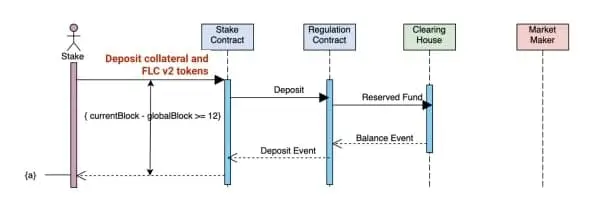
Alistor: To explain the full scope of the underlying IoT tech would be quite a lot. Utilising the Flowchain network enterprises can tokenise assets or production processes. DEXG and FLC tokens are needed as collateral to mint these tokens. The IoT sensor network employed will then use these tokens to follow production task X or issue signal Y.
Flowchain engaged in a few projects in this regard already, including things like ecological farming. Another quite simple example would be outsourcing flight miles, creating an off-chain token that is processed as fast as a centralised database would be at the fraction of cost. The sAMM could with the off-chain capability convert these tokens directly to monetary value. The use cases are pretty much unlimited.
Q11: I'm not good at keeping secrets, most especially that of benefits. So what do I earn for referring friends to this platform?
Alistor: We do not have a referral programme, but maybe you did your friend a great favour as we see a promising future for our project.
Q12: The DexToken protocol has a theoretical hard cap of 200,000 $DEXG tokens but not all of this will be minted due to the staking & supply rewards mechanism in place. What happens to the rest of the supply that isn't minted?
Alistor: The supply will be locked after the eight staking round. There will be no possibility to mint the unminted supply after that.
Q13: Would there be a token burn and buyback?
Rim: Actually, since we use Balancer for our staking, while our BPT tokens are inside the staking contracts, the BAL rewards mined by the contract are used for buybacks.
Q14: I understand that the daily volume of your token is from $340,000 to $370,000 so my question is how do you plan to increase the volume of your token on the exchanges? Are you planning to find more listings to increase it?
Rim: We are getting lots of offers but good ones there are few, from what we have seen, maybe in the future this will change though.
Q15: Defi is set to continue to dominate the crypto space come next year but faces it's biggest barrier of interoperability, providing cross-chain interactions and multiple blockchains. How does your DEX solution solve this?
Alistor: As of now, we focus on the deployment on the Ethereum network. However, once we have the infrastructure fully deployed it could become a possibility to move between chains utilising the off-chain infrastructure as the middle-man. This is not one of our current development focuses though.
Rim: I think we got the good ones out of there 🙂 Thanks for the questions! Also feel free to join us at https://t.me/Dextoken_Official_Group for the official news as it hits and the more relaxed and broad-ranging https://t.me/DEXG_PriceTalk where we discuss possibilities and can engage more regarding our developments.
That said we will also post the exact info on our public beta and how to use it and of course where to share your findings, whether you're a whitehat coder or a user with a strong opinion. I love those.
tehMoonwaLkeR: alright my friends this has been amazing! lets come to an end
Rim: Thanks for having us!
Links & Ressources:
- Official DEXToken Website
- Official DEXToken Staking dApp
- Official DEXToken Telegram Group
- Official DEXToken Announcement Channel
- Official DEXToken Twitter
- Official DEXToken Medium
- DEXG on DexTools
- DEXG at Coingecko
- DEXG at Coinmarketcap
- DEXG at Etherscan
- Official DEXG Balancer Pool
- Trade DEXG on Balancer
- DEXG/USDT Uniswap Trading Pair
- DEXG Proof of Liquidity
Disclaimer:
DEXG tokens are not intended to constitute securities in any jurisdiction. The white paper does not constitute a prospectus or offer document of any sort and is not intended to constitute an offer of securities or a solicitation for investments in securities in any jurisdiction.
The Flowchain Foundation Limited disclaims any and all responsibility and liability to any person for any loss or damage whatsoever arising directly or indirectly from (1) reliance on any information contained in this white paper, (2) any error, omission or inaccuracy in any such information, or (3) any action resulting therefrom.
The value of DEXG tokens is currently very volatile. Flowchain Foundation (“Company”) does not have any means of stabilizing the token value, please buy at your own risk. Unlike bank accounts or accounts at some other financial institutions, DEXG are uninsured unless you specifically obtain private insurance to insure them. Thus, in the event of loss or loss of utility value, there is no public insurer or private insurance arranged by Company, to offer recourse to you. Because DEXG are based on the Ethereum protocol, any malfunction, breakdown or abandonment of the Ethereum protocol may have a material adverse effect on the platform or DEXG. Moreover, advances in cryptography, or technical advances such as the development of quantum computing, could present risks to the DEXG and the platform, including the utility of the DEXG for obtaining services, by rendering ineffective the cryptographic consensus mechanism that underpins the Ethereum protocol.






