
The number of cryptocurrencies in existence went from somewhere less than 2000 in the year 2018 to over fifteen thousand as of now. More than 10,000 are active. Not every blockchain has the same underlying structure and tech. It varies vastly. The transaction model and consensus protocol along with the scripting language used to code smart contracts etc varies from one blockchain to other depending on what the particular blockchain is trying to achieve.
A big issue in the blockchain world is "What if you want to move your assets from one blockchain to other?" I cannot just convert my Bitcoin for corresponding Ethereum right? You use Exchange for this purpose. They have liquidity pools or order books that allow you to swap between certain assets.
Liquidity pools hold some (usually equal) proportion of both the assets. Suppose I want to swap my Bitcoin for Ethereum. I will send my Bitcoin to the liquidity pool and will get back corresponding amount of Ethereum.
In order books, you create an order for the swap. You will create a bid saying that "I want to buy Ethereum by paying only certain amount of Bitcoin". If someone is willing to buy at your decided price, your order matches and Voila!
On-chain exchange are fairly straight-forward. Suppose you hold 10 Chainlink token which is an ERC-20 token on Ethereum blockchain. You want to swap them for Symbiosis Finance token (SIS). You can create your order on one of the many DeFi apps working on the Ethereum chain that uses the either Order book or Liquidity Pools for allowing swap and Boom! You got your SIS token in your account.
Things get more confusing when you want to transfer coins from one chain to other. And even further complication arise when you want to transfer your tokens from one chain to tokens built on some other blockchain. What if you want to swap your ERC-20 token on Ethereum Blockchain for a BEP-20 token on Binance Smart Chain or maybe some other chain? Creating liquidity pools and/or managing orders for every pair of tokens across so many blockchains is very difficult.
There are wrapped tokens that exist on multiple blockchain at once. Consider BAT token for example. It exists on both Ethereum and Solana. You can use Solana’s wormhole to move your BAT from Ethereum chain to Solana. It also suffers from the same problem as liquidity pools and order books which is that there are so many combinations of so many tokens and coins in exsitence.
You might say that I will send my funds to a Centralized Exchange (Kraken, Binance etc) and then swap the coins there. Swapped assets can then be send to corresponding wallet. There are 2 issues with this method:
- Centralized Exchange doesn't suite everyone and for good reasons. Decentralization is one of the core concept of the blockchain.
- Centralized Exchange supports very small number of tokens. (Tokens should not be confused with native assets / coins). There are almost 500,000 custom ERC-20 tokens built on Ethereum. Again, not all of them are active but still a very large number!. There are tens of thousands of Algorand Smart Asset and many BEP-20 tokens. Centralized Exchange barely support more than top 100-200 of either of them.
Introducing Symbiosis Finance:
They try to tackle this problem of creating liquidity across platform in their own unique way. Symbiosis finance allows you to swap “any-to-any” token on different blockchain network.
Two points worth remembering:
- If there is a token on any blockchain, the highest liquidity for the token will probably be with the native coin or stablecoins based on that blockchain.
- For interchain transfer where the delay of the transaction will vary vastly depending on the blockchain, the least slippage will occur in stablecoin transfer.
So, instead of creating liquidity pool for every combination of native tokens, this is how swap occurs on the Symbiosis DeFi:
- Suppose you want to swap your ChainLink Token on Ethereum to Cake token on Binance Smart Chain and you have sent the swap request on Symbiosis app.
- The Symbiosis DeFi will swap the Chainlink token for stablecoin (Suppose USDC) on Ethereum chain. Instead of creating a liquidity pool, the algorithm aggregate already working pools on different DeFi (Uniswap, Pancakeswap etc) on Ethereum chain and it will choose the most efficient one.
- The USDC has a wrapped representation on the BSC network. So, the swapped USDC on Ethereum chain will be transferred over to the BSC as the wrapped version of USDC.
- This wrapped token will then be unwrapped i.e., the original representation of stable coin on BSC network.
- Finally, the aggregator on BSC network will try to find the most efficient way to convert the received USDC to your desired Cake Token.
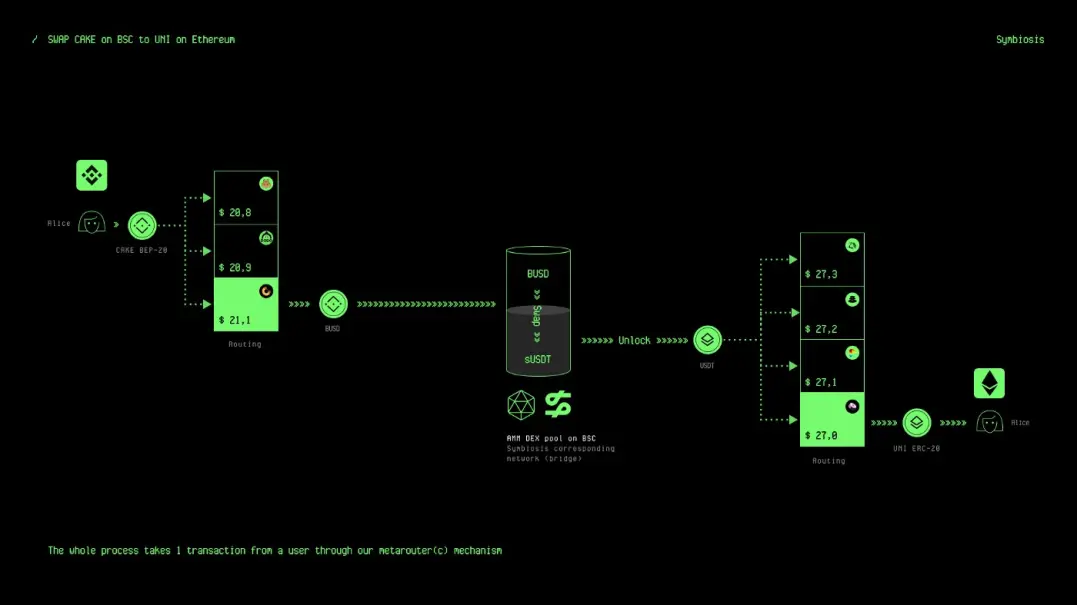
From the user perspective, all they have done is sent some amount of chainlink which has been magically swapped to Cake token with a single click!. All of the swaps and wrapping/minting etc are abstracted from the user. Since your tokens were transferred as stablecoin, you can be sure that the slippage of value will be as little as possible. You can also provide liquidity on the Symbiosis platform and earn a proportion of fees that is collected from the users.
- Just a Single Click for swap (even for inter-chain swap).
- Simplistic User Interface.
- Symbiosis is dencentralized and the algorithm will automatically choose the most efficient AMM for swap.
- No new wallet is setup and the asset stays in your cusody the entire time.
- Depending on the blockchain where you are performing an intra-chain swap, you might be asked to pay the transaction fees for swapping token in the native asset. Maybe you are swapping two ERC-20 token and you have to pay the fees for the swap in the native asset i.e., ETH. Symbiosis solves this problem too. You can simply pay the transaction fees with the token you are currently going to swap thereby further improving user experience.
- They even show you the most efficient path that will be taken when you swap tokens/coins using their platform.
In short, Symbiosis allow cross-chain transfer without needing liqudity for every pair of token and without requiring an intermediary like ThorChain. Try out symbiosis here.






