
Web3 was envisioned a long time ago and since then, the Internet has evolved a lot. We now have blockchain technology being used actively on the Internet and real world applications are being developed. Peer-2-Peer exchange of money without any central authority was envisioned by Satoshi when he created Bitcoin and even though most of the networks are centralized, most of them are trying to (and will be) be decentralized over the coming years.
But you need to interact with those blockchains in some way right? Well, there are nodes for that purpose. However, an ordinary user will be interacting with a wallet which will inturn interact with some node or blockchain itself to execute user's transactions. Imagine have an account with a "XYZ" bank. Suppose there is an app that allows you to transact from your account with "XYZ" bank. This is what wallet does. It allows you to transact over the blockchain with the asset in your address. Thousands of wallets have been developed for thousands of blockchains. Wallets come in different tastes.
1. Custodian Wallet: These wallets are held and controlled by a central authority. You are not the owner of funds if your funds are in Custodian wallets. For example, your funds in KuCoin exchange are actually held by KuCoin. You have no say over the funds. Instead, the exchange provides you with an IOU just like a bank. You are trusting KuCoin with your funds. Centralized exchange and non-custodian wallet in general defeats the entire philosophy of having P2P based cryptocurrencies in the first place. If you want your funds to be held by a central authority then why not create a new account in Bank?
2. Non-Custodian Wallet: These wallets are created by user for themselves and the users are the sole owners of fund. Here, the funds will be stored in a blockchain address which will be unique for you and only you can transfer the funds from the address if you know the secret key. If you ever lose that key, your funds are essentially lost!
Between the two, it can be clearly seen that non-custodian provides the greatest control over funds. Only the person who knows the secret key for the address can transact funds from that address. There are several non-custodian wallets out there and they come in their own flavors too. A non-custodian wallet might be open-source or it might be closed-source.
If the wallet is closed-source, it means that there is no way to know how it is implemented. So, you are essentially trusting the developer of the wallet that they will not steal your private key. Open-source wallets have their code published openly. Anyone can see how the wallet works and all the websites it might communicate with and under which circumstance it will do that.
Then there are wallets that have a price tag attatched to them. Why? Because the developer needs to be fed in order to make sure that the wallet evolves with time. Wallets can be free too and usually ask the user to donate if they can! or they earn by some other means. It entirely depends on the revenue structure of the organization developing the wallet.
There is a new wallet in the market which is open-source, non-custodian, free, developed by Community using DAO. "Tally Ho" is the new contender of the Metamask, brave wallet and many others. All of them are great in their own way and have been serving so many people but when concentration of people on a small number of options lead to less evolution because of lower competition.
Competition drives advancement and "Tally Ho" in my opinion is a worthy contender to the other Web3 wallet. Here's why:
- As I said, Tally ho is open source. This means you are free to review the whole code and even build it yourself. Here's their github repository.
- It is free to use. You do-not need to pay a single penny to use the service.
- It is non-cutodian, so you and only you are responsible for your funds. Your secret key never leaves your wallet.
But you might say, there are many other wallets that already do this. Here is what makes Tally ho different.
Tally Ho is working to be a DAO-owned wallet. What does this mean? Instead of an organization owning and developing the wallet, it will be owned and developed by the community itself. That means, the future features and everything that happens in the wallet will be decided by the Tally Ho community itself.
The governance token is being called $DOGGO which will be launched alongside the full alpha (market wide stable) release of Tally Ho wallet. The smart contract of the token will be deployed by the community itself. The token will be used for the governance of the wallet once the DAO commence. There is no pre-allocation of the token to any early-investor, dev or anyone else according to this thread. There will be a merkledrop of over 33% token community wide and the rest will be released later. There are no exact dates or figures yet as most of it will be decided by the community itself! Welcome to the real Web3.
The other great thing about the wallet is the swap fees. When you swap one token for another, fees is charged by the provider for that swap. Metamask charges 1% for each swap using there platform. Compared to others, it might be less, but guess what? It can be even lesser and more productive. Tally ho does that. How?
Well, the swap fees is 0.5% and that swap fees goes to the community owned multi-sig wallet. The multi-sig wallet will have no governance power. No one knows what to do with the swap fees as of now but it will be decided by the DAO using governance. Maybe the community decides to use the swap fees to reward liqudity provider or maybe a way to pay income to developers?
Also, Tally ho is already compatible with almost every dapp that support metamask. It also support ledger devices. Check out the web extension here. The setup is almost as same as any other wallet. You install the extension where you will be greeted with this page.
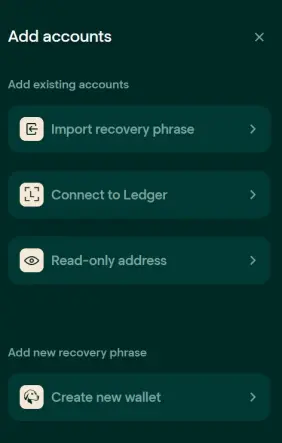
- You can import the secret phrase of your already existing wallet.
- You can connect Tally Ho with your ledger device.
- You can add a read-only address which allow you to watch your bag without allowing transaction.
- Or you can create a new wallet. You will be asked to store a secret seed phrase. If you lose this phrase, there is no way to recover your wallet. So, keep it secure.
Set up a nice and strong password for your wallet and you are good to go.
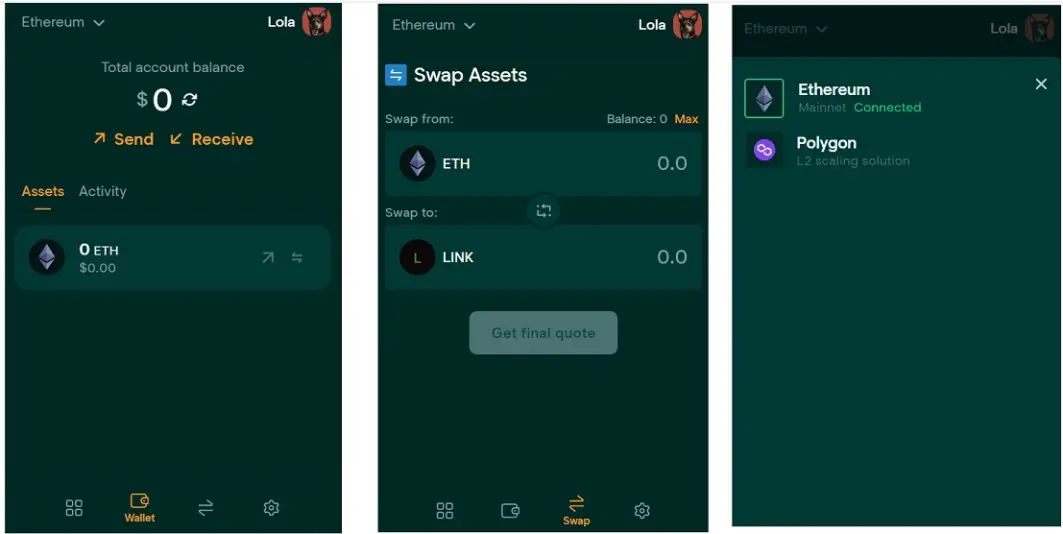
The Image on the left is the wallet page. You can see all your tokens and their total value on the page. Less clutter and minimalistic design has always been my favourite. So, I genuinely like this.
The Swap assets page allow you to swap your token for some other token. The swap fees, as I said earlier, is only 0.5% and it cannot get any better than this. You will be provided with a long list of available token to chose from. There is a search option though so that is good :-).
Last but not the least, they also support Polygon L2! If you are not familiar with Layer-2 solutions, you should. Layer-2 is essentially an express-way developed on top of Ethereum street. Layer-2 allows you to transact your tokens with miniscule gas fees and transaction confirmation time is usually in seconds. They only support Polygon L2 as of now but there are plans of incorporating other L2 solutions like Optimisim. The future looks bright!
Do give the wallet a try! Tally Ho is trying to stay true to the definition of Web3 while making sure the centralization is as little as possible at any step.
Let me know if there are any mistakes or if you have any doubts in the comments. Tips are much appreciated.





