
Every mining pool claims low fees, fast payouts, and solid infrastructure. Most miners have learned to skip the marketing copy and check the numbers that move their P&L. The pools that hold up under margin pressure aren't the ones with the cleanest landing page - they're the ones whose uptime, share efficiency, and payout logic survive operational stress.
Uptime Is a Revenue Line, Not a Technical Footnote
Uptime gets treated like a checkbox metric. It's one of the few pool stats with a direct, calculable line to your monthly revenue. A pool that drops connectivity for even 20-30 minutes during a busy stretch redirects your hashrate to dead air while everyone else keeps mining blocks. Large pools invest in multi-region infrastructure because a regional outage at scale is expensive for every fleet pointed at it. For operators running thousands of units, that single percentage point of downtime is treasury math, not IT trivia.
Stale Shares: The Quiet Tax on Your Hashrate
Stale and rejected shares are the quieter cost: they don't show up as an outage, they show up as a slow bleed in effective hashrate. A share goes stale when it reaches the pool's server too late for the current block template - usually connection latency, or a competing block found first. On a single ASIC, a 1% stale rate costs a few dollars a month, barely noticeable. Across a 200 PH/s fleet, at current hashprice (roughly $38-40 per PH/s per day), that same 1% is about $28,000 a year, lost for reasons that have nothing to do with your hardware. Pools with better routing and protocol efficiency post stale rates under 1% - worth requesting, not assuming.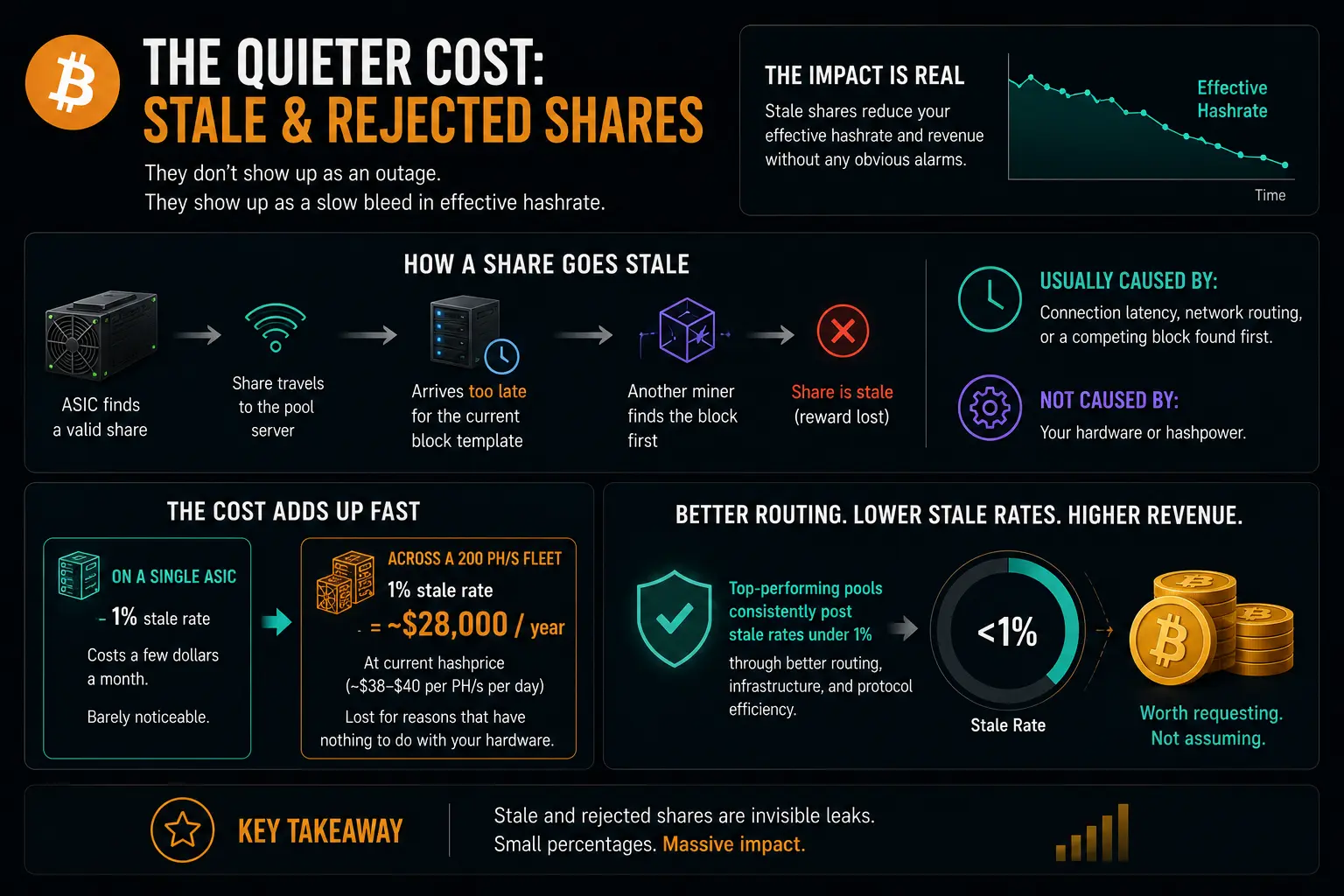
Payout Architecture: FPPS, PPS+, and PPLNS in Practice
Payout structure is where most pool comparisons go shallow: everyone lists FPPS, PPS+, or PPLNS without explaining what it changes for the miner.
- FPPS - used by Foundry USA, Binance Pool, and WhitePool — pays expected value from both the block subsidy and transaction fees, smoothing variance while the pool absorbs the risk.
- PPLNS - offered by AntPool and ViaBTC alongside their own FPPS products — ties payout to actual blocks found and shares contributed over a rolling window. It rewards sustained uptime but exposes you to variance if your fleet drops offline at the wrong moment.
- PPS+ - sits in between: a fixed rate on the block reward, with transaction fees passed through pool-by-pool.
None of these models is objectively better - what matters is whether the pool is transparent about which one it runs and whether funds land in your wallet on schedule. At scale, fee tiers and payout cadence are usually negotiable too.
Latency, Geography, and Why Routing Still Matters
Server geography sounds like a backend detail until stale rates spike the moment your connection routes through a node three continents away. Shares travel from your ASIC to the pool's server and back before the next block template arrives; every extra hop raises the odds that work gets discarded. That's why Stratum V2 gained momentum this year - in May, seven of the largest pools, including Foundry USA, AntPool, F2Pool, and SpiderPool, agreed to back the protocol as a shared standard, covering close to three-quarters of global hashrate. Firmware compatibility matters too: a pool slow to support new releases from Bitmain, Whatsminer, or Canaan forces operators to choose between squeezing out efficiency gains and keeping a stable connection.
Ecosystem Depth: What a Pool Offers Beyond Block Rewards
Beyond core infrastructure, the sharper competition is ecosystem depth - what a pool offers beyond accepting shares and paying out $BTC. Luxor has pushed furthest with fixed and upfront payout products that let large operators lock in revenue ahead of delivering hashrate, on top of its own firmware and data business. F2Pool and ViaBTC lean into broad coin support and accessible dashboards for smaller operators. Exchange-linked pools take a different angle: Binance Pool and WhiteBIT's WhitePool route mined BTC straight into an exchange account instead of an external wallet - WhitePool credits FPPS rewards to the user's WhiteBIT balance daily, skipping the manual withdrawal step and its on-chain fee. That's a convenience for a treasury team that wants mined BTC available the same day it's earned - but it's a different custody risk profile, not automatically a better one.
The Bigger Picture
Foundry USA and AntPool together account for roughly half of global Bitcoin hashrate - a concentration that data providers like Hashrate Index flag as a chokepoint risk for censorship resistance. Add tightening regulatory scrutiny in major mining jurisdictions, geopolitical risk around where fleets can operate, and margins so thin that CoinShares put roughly a fifth of miners at a loss earlier this year, and the pools worth your hashrate are the ones treating uptime, stale rates, and payout transparency as financial metrics - not fine print. Ask for numbers instead of dashboard screenshots, and check them against your own fleet data.





